
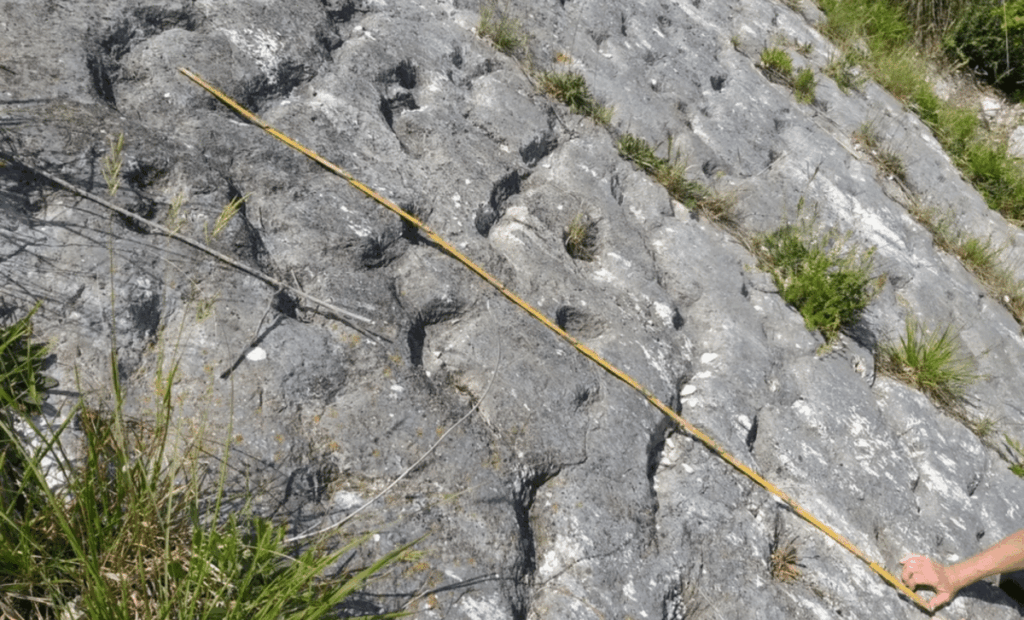
A recent discovery in Italy has given us an extraordinary glimpse into the distant past, revealing what might be an ancient sea turtle stampede. This unique find, made by rock climbers in Cònero Regional Park, has sparked widespread attention in the scientific community. Published in Cretaceous Research, a new study delves deep into the mystery of these 79-million-year-old tracks, raising questions about ancient marine reptile behavior and the forces that could have shaped their movement. Researchers speculate that these grooves were caused by sea turtles fleeing an earthquake, with some experts even suggesting that the tracks might reveal unusual underwater behavior never seen before.
In the scenic landscape of Monte Cònero, overlooking the Adriatic Sea, rock climbers stumbled upon something extraordinary, ancient grooves etched into the rock face. These marks, which could date back to the Late Cretaceous Period, seemed to have been created by the sudden movement of large creatures. After closer inspection and consultation with experts, it was concluded that the tracks were likely left by marine reptiles, particularly sea turtles. What makes these grooves so intriguing is not just their age, but the unusual nature of the marks themselves. While most marine reptiles left behind distinct, predictable tracks, these show signs of hurried movement, likely due to a seismic event.
The area where the tracks were found is located in the Cònero Regional Park, within the Scaglia Rossa limestone formation. This geological formation is known for its rich record of marine life, preserving millions of years of deep-sea sedimentation. The rock layers themselves provide an invaluable glimpse into Earth’s history. The study, published in Cretaceous Research, suggests that the turtles were likely fleeing from an earthquake, with the grooves preserved by a sudden underwater avalanche triggered by the seismic activity.
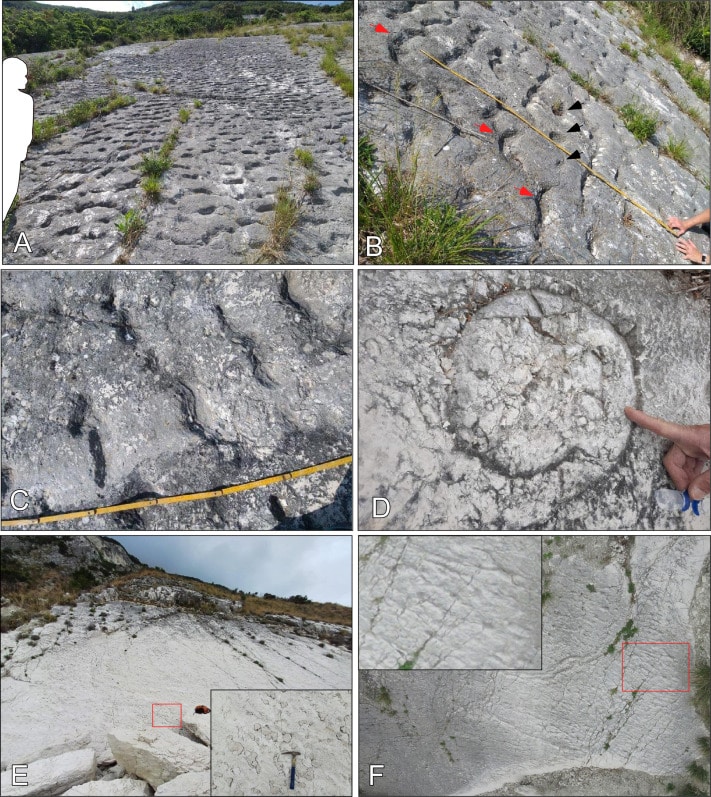 A) Panoramic view of the limestone slab exposed on Site 6, showing the extension and density of footprint marks. Outline of a covert free climber for scale on the lower left foreground of the picture; B) Detail of the slab surface of Site 6 showing a random distribution of arched paddle print marks (red arrows), and round, cup-shaped print marks (black arrows); C) Close up photograph of regularly spaced double curved paddle print marks on the same slab surface of Site 6; D) A Zoophycos fossil trace on the surface of the same footprint bed exposed on Site 9; E) Panoramic view of the slab on Site 12. The top surface of this pelagic limestone bed is studded with flute marks filled with the beige sediment from the bottom of a now-removed overlying calcarenitic turbidite (see enlargement of the red rectangle area shown in the inset); F) Aerial (drone) photograph of the subvertical slab of Site 10. The surface of this limestone bed exhibits a dense series of elongated positive structures, which may represent current ripple marks (see them enlarged in the inset). In the center of this image, notice a long sinusoidal trace crossing the ripple set, which may represent a groove of an object dragged on the oozy seafloor by a bottom current. Credit: retaceous Research
The Mystery of the Underwater Punting Tracks
One of the most fascinating aspects of this discovery is the unusual nature of the tracks. “The tracks are unusual because they seem to show underwater punting, where the two forelimbs enter the sediment together and the animal pushes forward,” explained Michael Benton, a professor of vertebrate paleontology at the University of Bristol, who was not involved in the study. In most vertebrates, when moving underwater, limbs are generally used in a sequence, not together. However, these tracks suggest a different form of movement.
The idea of underwater punting, where an animal uses both forelimbs to push forward simultaneously, is an anomaly when it comes to marine reptiles. The vast majority of aquatic vertebrates, including modern sea turtles, swim with their limbs moving alternately. As Benton noted,
“Most vertebrates tend to ‘walk or swim with the limbs out of sequence’ rather than putting two limbs down at the same time.”
This raises interesting questions about how these ancient sea turtles might have behaved in times of distress, especially during a chaotic event like an earthquake.
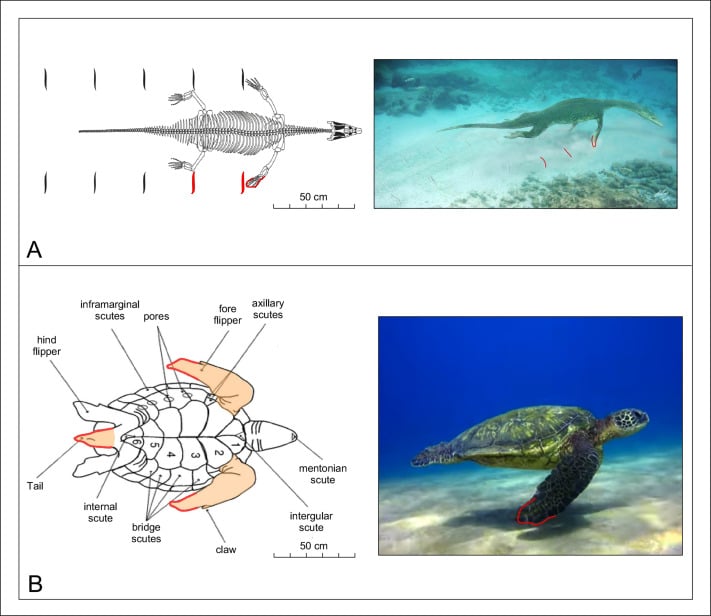 A) Skeletal model of Triassic nothosaur Lariosaurus, viewed from above, paddling along and producing the tracks with its front paddles (highlighted in red), modified from Fig. 7a in Zhang et al. (2014). The artist scene picture on the right is borrowed from the original work of Brian Choo (modified from Fig. 8 in Zhang et al., 2014), which illustrates how a nothosaur makes progression tracks with its fore fins on a soft seafloor while stalking for a prey; B) Anatomic ventral view of a generic sea turtle with highlighted in color the body parts (i.e., the fore flippers and the tail) that would leave track marks on soft sediment while swimming or grazing underwater close to the seafloor. The scene picture on the right is a modified still frame from 0’:55″ of a YouTube video showing a Hawaiian green sea turtle (Chelonia mydas) swimming close to the seafloor and brushing the soft sediment with the tip of its fore flipper (marked with a red contour line). Credit: retaceous Research
Could These Tracks Really Belong to Sea Turtles?
Despite the compelling evidence, some experts remain skeptical about the origins of the tracks. “Marine turtles generally have a very efficient swimming mode,” Benton pointed out. “A bit like underwater flying, where the front paddles swing round,” he said. This swimming technique, which closely resembles a figure-eight pattern, does not seem to align with the tracks that were found. Instead, the tracks suggest a much more laborious movement, where the forelimbs were likely pushing directly into the sediment.
Additionally, there’s the question of why the turtles would have made such tracks in the first place. If these creatures were indeed fleeing an earthquake, wouldn’t they simply have swum away, using their efficient paddling technique to escape the threat? Benton posed this concern, asking why the turtles didn’t “leave the sea bed and swim” directly away from the danger. These unanswered questions add another layer of mystery to the discovery and suggest that further study is needed to fully understand what happened.
Geological Clues That Support the Earthquake Theory
The geological context of this find is just as intriguing as the biological questions it raises. The trackways were preserved in the Scaglia Rossa limestone, a rock formation known for its detailed record of marine life from the Cretaceous Period. The rocks suggest that the tracks were made during a time of significant seismic activity. Researchers have noted that the region has experienced substantial tectonic movement over millions of years, which could have contributed to the underwater avalanche that preserved the tracks.
According to Alessandro Montanari, director of the Coldigioco Geological Observatory, rock samples collected from the area show evidence of a sudden underwater mudslide, likely caused by the earthquake.
“An earthquake caused an underwater avalanche within minutes of the tracks being made, preserving them,” he said.
This rapid preservation allowed the tracks to survive for millions of years, offering scientists a rare glimpse into a moment of chaos in Earth’s history.