
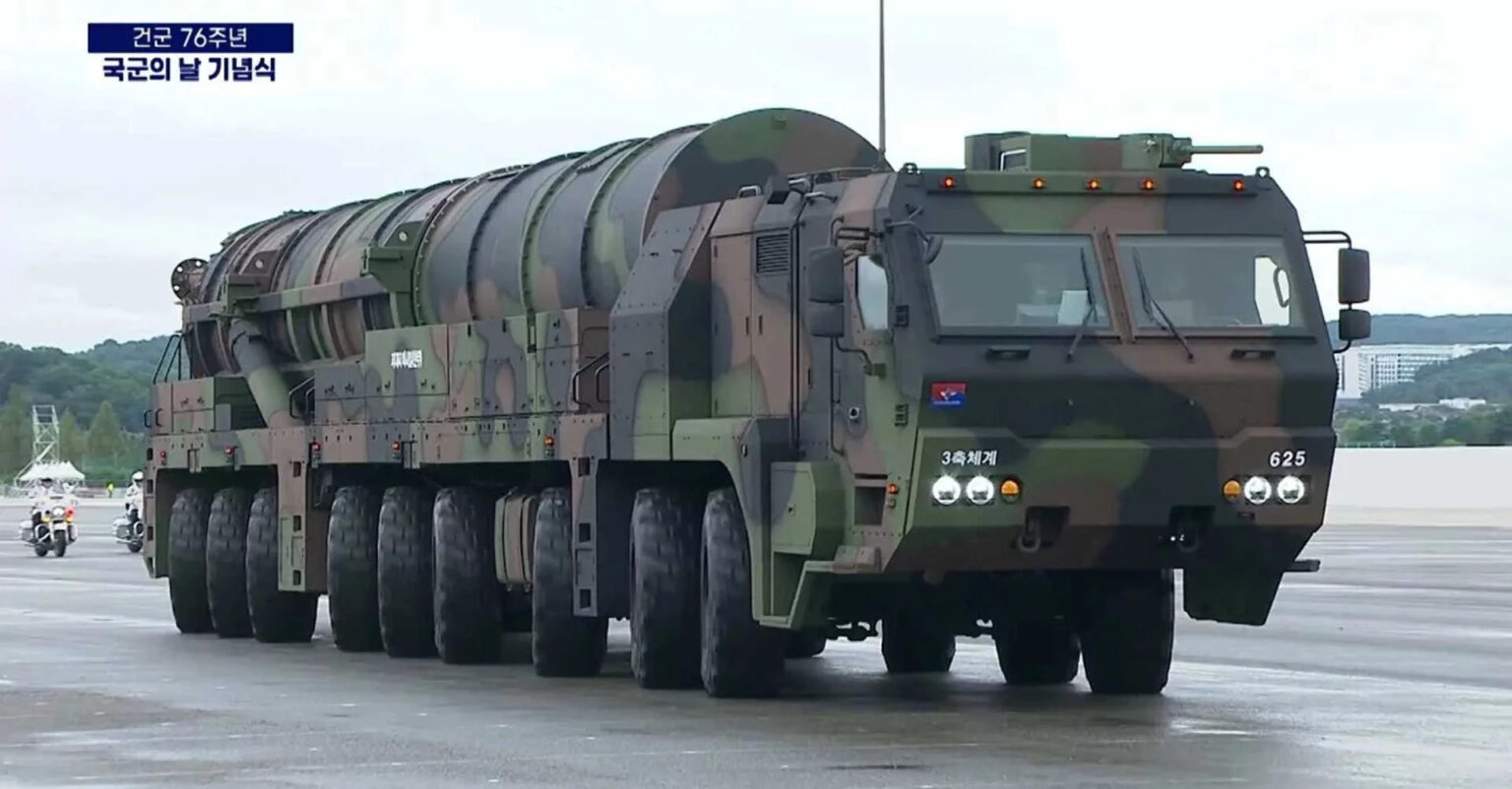
 The Hyunmoo-5 is the largest ballistic missile in South Korean service. It is designed to penetrate and destroy deep, underground, reinforced installations. (Korean Forces Network)
South Korea has operationally deployed its Hyunmoo-5 ballistic missile, a key component of South Korea’s military deterrent to the threat from North Korea. Some reports suggest the Republic of Korea Army commenced fielding it late last year.
Seoul has not indicated the number of Hyunmoo-5 systems it plans to induct, although government sources shared that fielding is to be completed by 2030.
First publicly displayed in a parade in October 2024, the Hyunmoo-5 was developed under the direction of the Agency for Defense Development in cooperation with Hanwha Aerospace. The missile is specifically intended to defeat deep, underground, reinforced installations utilised by North Korea.
Such installations harbour critical command-and-control, strategic and possibly nuclear weapons, as well as Pyongyang’s national leadership. Fielding an effective capability that threatens these facilities is a critical element of South Korea’s “Korean Massive Punishment and Retaliation” strategy intended to deter a future conflict by the North.
The Hyunmoo-5 is thus an integral component of Seoul’s “three-axis” plan to dissuade or to respond to a possible nuclear attack from North Korea.
The Hyunmoo-5 is primarily considered by South Korea as a short-range ballistic missile (SRBM) employed in the “bunker-busting” role. It achieves its target effect through its near-hypersonic impact and a conventional warhead weighing up to 9 tonnes.
This massive warhead payload restricts the missile’s range. However, it is estimated that a smaller 1-tonne warhead would extend the missile’s range to 3,000km or more, if the country wishes to modify the missile.
The warhead weight makes the Hyunmoo-5 unique, since conventionally armed ballistic missiles typically carry an explosive payload of 1,000kg or less. South Korea’s earlier Hyunmoo-4 SRBM reportedly carries a 2,000kg explosive warhead.
The Hyunmoo-5 is highly accurate, utilising both onboard internal navigation and satellite GPS guidance. The missile may also have counter-radar and decoy capabilities.
The missile is carried on a unique nine-axle transporter-erector-launcher (TEL). Despite its length, it maintains manoeuvrability using all-wheel steering.
The launch method is unique too. It is cold-launched using compressed air to expel the missile from the TEL prior to the two-stage solid propellant engines initiating.
by Stephen W. Miller