
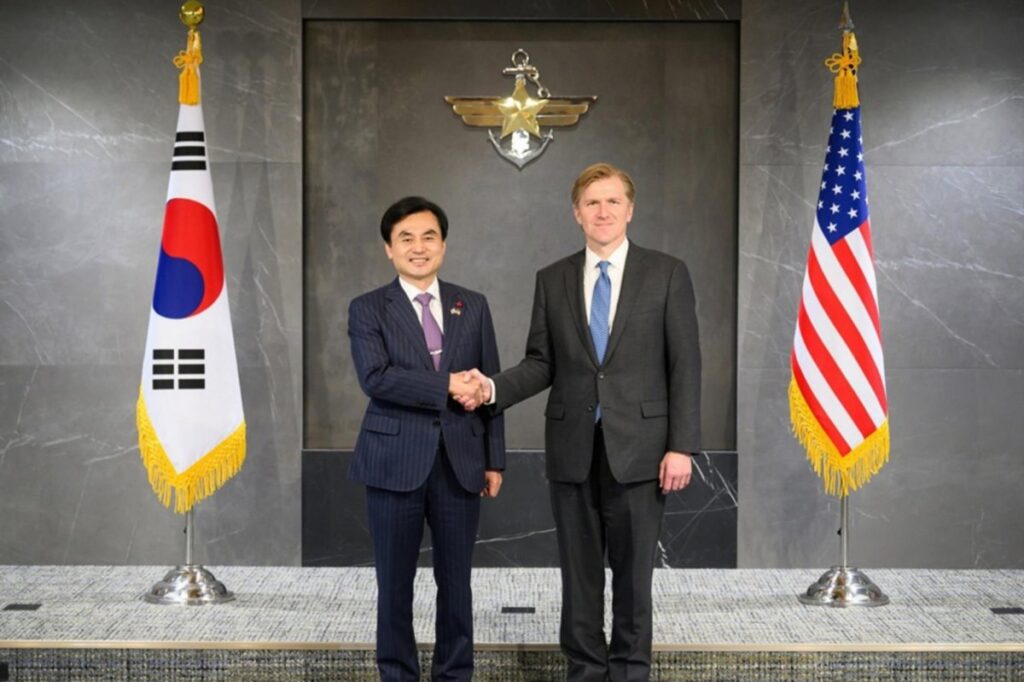
A handout photo made available by the ROK Ministry of Defense shows South Korean Defense Minister Ahn Gyu-back (L) shaking hands with Elbridge Colby, U.S. undersecretary of defense for policy, during their meeting at the defense ministry in Seoul, South Korea, 26 January 2026. Photo by ROK Ministry of Defense / EPA
Jan. 27 (Asia Today) — Recent remarks by Elbridge Colby, U.S. deputy secretary of defense for policy, have reignited debate over the pace of South Korea’s wartime operational control transfer.
Colby, currently visiting South Korea, said Monday that Seoul has the will to take a leading role in defending the Korean Peninsula by strengthening its own military capabilities, calling South Korea a “model ally.” His comments are widely interpreted as signaling U.S. support for accelerating the transfer of wartime operational control, or OPCON, under the administration of President Lee Jae-myung.
Colby, regarded as a key security strategist for U.S. President Donald Trump and an architect of the administration’s new National Defense Strategy, met separately with Foreign Minister Cho Hyun, Defense Minister Ahn Kyu-baek and National Security Office Director Wi Sung-lak to discuss alliance issues including OPCON transfer and South Korea’s pursuit of nuclear-powered submarines.
Defense Minister Ahn told Colby that transferring OPCON is essential to establishing a Korean military-led defense posture and urged closer communication, including the development of a roadmap to accelerate the process.
Under the current framework, OPCON transfer requires a three-stage verification process. The Security Consultative Meeting joint statement issued last November stated that the second phase – Full Operational Capability verification – would be completed this year. Some military officials believe that once this phase concludes, Seoul and Washington could immediately set a target year for transfer.
Speculation has grown that the final phase, Full Mission Capability verification, could take place as early as next year during combined ROK-U.S. exercises, potentially allowing OPCON transfer within two years if Washington agrees to provide supplemental capabilities during the transition. Such a timeline would move the transfer well ahead of the South Korean government’s original 2030 target, depending on U.S. policy decisions.
The new U.S. National Defense Strategy makes clear that South Korea is expected to assume primary responsibility for deterring North Korea, while U.S. forces prioritize homeland defense and deterrence against China. Under this framework, OPCON transfer appears increasingly inevitable.
If Washington presses for an accelerated transfer, Seoul must seek meaningful concessions, including U.S. administration and congressional approval for the construction of nuclear-powered submarines. In addition, the effectiveness of the U.S. nuclear umbrella could diminish after OPCON transfer, raising questions about long-term deterrence options.
Confusion may arise during the transition period, as South Korea would command the combined forces while the United States retains authority over nuclear decision-making. The risks are substantial, including higher defense spending and the possibility of a temporary security vacuum if deterrence against North Korea weakens.
For these reasons, the government must approach OPCON transfer with extreme caution and select its timing carefully to minimize strategic and economic risks.
— Reported by Asia Today; translated by UPI
© Asia Today. Unauthorized reproduction or redistribution prohibited.
Original Korean report: https://www.asiatoday.co.kr/kn/view.php?key=20260126010012243