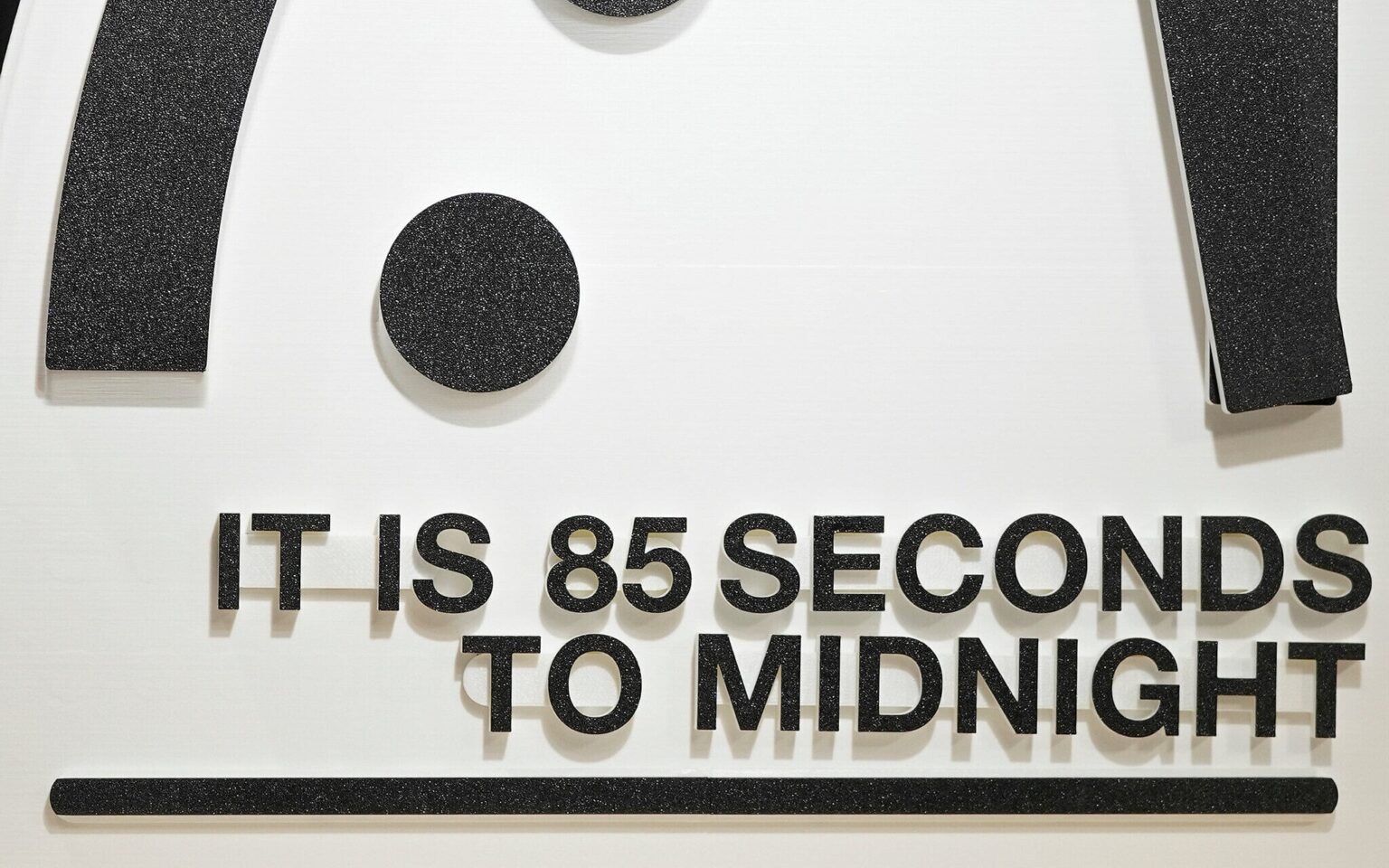
WASHINGTON (Reuters) — Atomic scientists set their so-called Doomsday Clock on Tuesday closer than ever to midnight, citing aggressive behavior by nuclear powers Russia, China, and the United States, fraying nuclear arms control, conflicts in Ukraine and the Middle East including last year’s Israel-Iran war, and artificial intelligence worries among factors driving risks for global disaster.
The Bulletin of the Atomic Scientists set the clock to 85 seconds before midnight, which would be the theoretical point of annihilation. That is four seconds closer than it was set last year.
The Chicago-based nonprofit created the clock in 1947 during the Cold War tensions that followed World War II to warn the public about how close humankind was to destroying the world. The Bulletin was founded in 1945 by scientists, including Albert Einstein and J. Robert Oppenheimer.
The scientists on Tuesday voiced concern about threats of unregulated integration of artificial intelligence into military systems and its potential misuse in aiding the creation of biological threats, as well as AI’s role in spreading disinformation globally. They also noted continuing challenges posed by climate change.
“Of course, the Doomsday Clock is about global risks, and what we have seen is a global failure in leadership,” nuclear policy expert Alexandra Bell, the Bulletin’s president and CEO, told Reuters. “No matter the government, a shift towards neo-imperialism and an Orwellian approach to governance will only serve to push the clock toward midnight.”
It was the third time in the past four years that the scientists moved the clock closer to midnight.
“In terms of nuclear risks, nothing in 2025 trended in the right direction,” Bell said. “Longstanding diplomatic frameworks are under duress or collapsing, the threat of explosive nuclear testing has returned, proliferation concerns are growing, and there were three military operations taking place under the shadow of nuclear weapons and the associated escalatory threat. The risk of nuclear use is unsustainably and unacceptably high.”
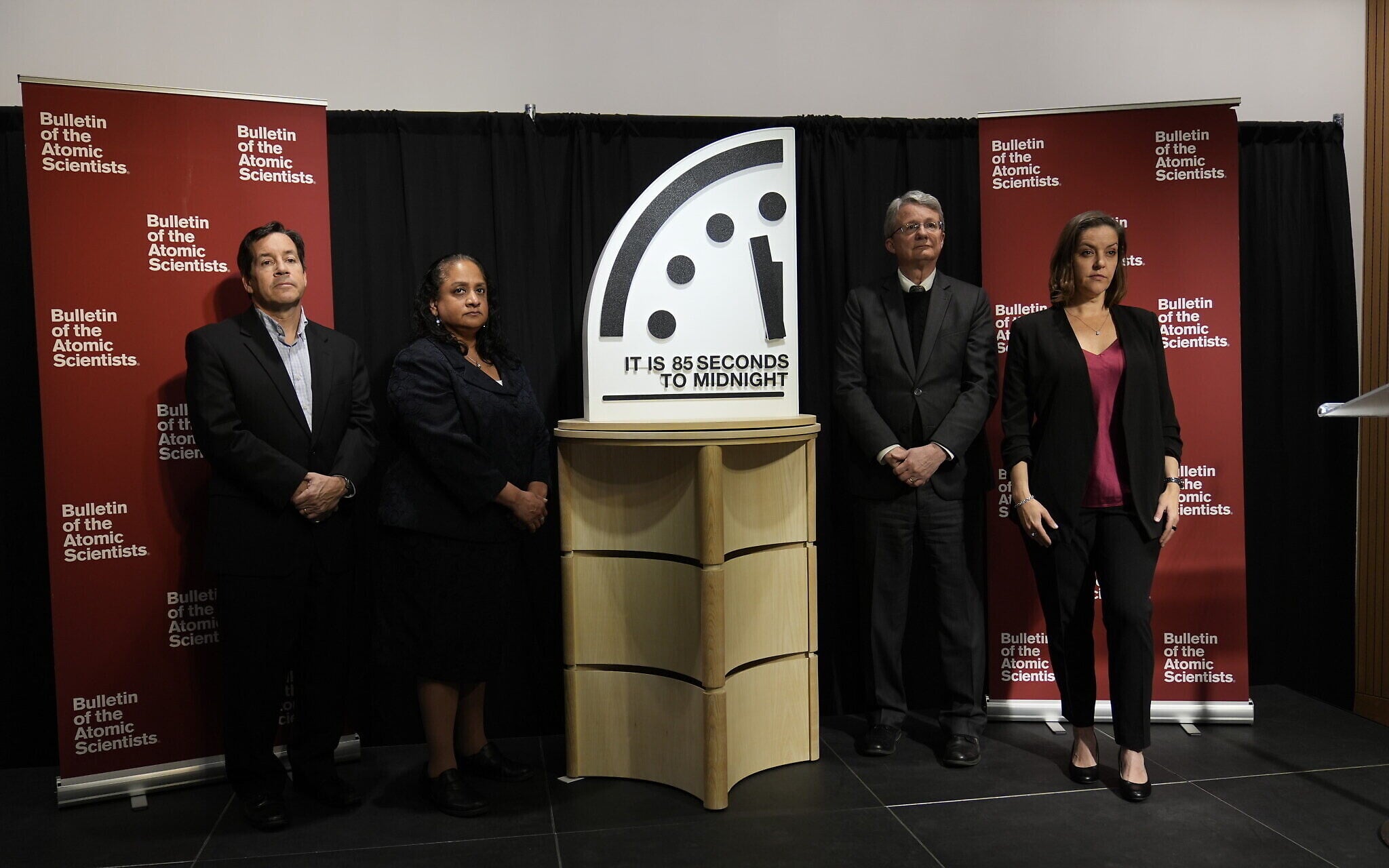
The Bulletin of the Atomic Scientist members, from left, Jon B. Wolfsthal, Asha M. George, Steve Fetter and Alexandra Bell, reveal the Doomsday Clock, set to 85 seconds to midnight, during a news conference at the Carnegie Endowment for International Peace, January 23, 2026, in Washington. (AP Photo/Pablo Martinez Monsivais)
Bell pointed to Russia’s continued war in Ukraine, the US and Israeli bombing of Iran, and border clashes between India and Pakistan, which are both nuclear powers.
Bell also cited continuing tensions in Asia, including on the Korean Peninsula and China’s threats toward Taiwan, as well as rising tensions in the Western Hemisphere since US President Donald Trump returned to office last year.
The last remaining nuclear arms pact between the United States and Russia, the New START treaty, expires on February 5. Russian President Vladimir Putin proposed in September that the two countries agree to observe for another year the limits set under the pact, which caps each side’s number of deployed nuclear warheads at 1,550. Trump has not formally responded. Western security analysts are divided about the wisdom of accepting Putin’s offer.
Trump in October ordered the US military to restart the process for testing nuclear weapons after a halt of more than three decades. No nuclear power, other than North Korea, most recently in 2017, has conducted explosive nuclear testing in more than a quarter-century.
No country would benefit more from a full-scale return to such testing than China, given its continued push to expand its nuclear arsenal, according to Bell, a former senior official at the US State Department’s Bureau of Arms Control, Deterrence and Stability.
Trump also sent US forces to capture Venezuelan President Nicolas Maduro, threatened other Latin American countries, vowed to restore US dominance in the Western Hemisphere, talked about annexing Greenland, and has cast doubt on transatlantic security cooperation.
Russia launched its large-scale invasion of Ukraine in 2022, and there is no end in sight. Among the weapons Russia has used is the nuclear-capable hypersonic Oreshnik missile. Russia released a video in December of what it said was the deployment of the Oreshnik in Belarus, a move meant to boost the Russian ability to strike targets across Europe.
“Russia, China, the United States, and other major countries have become increasingly aggressive and nationalistic,” Bell said.
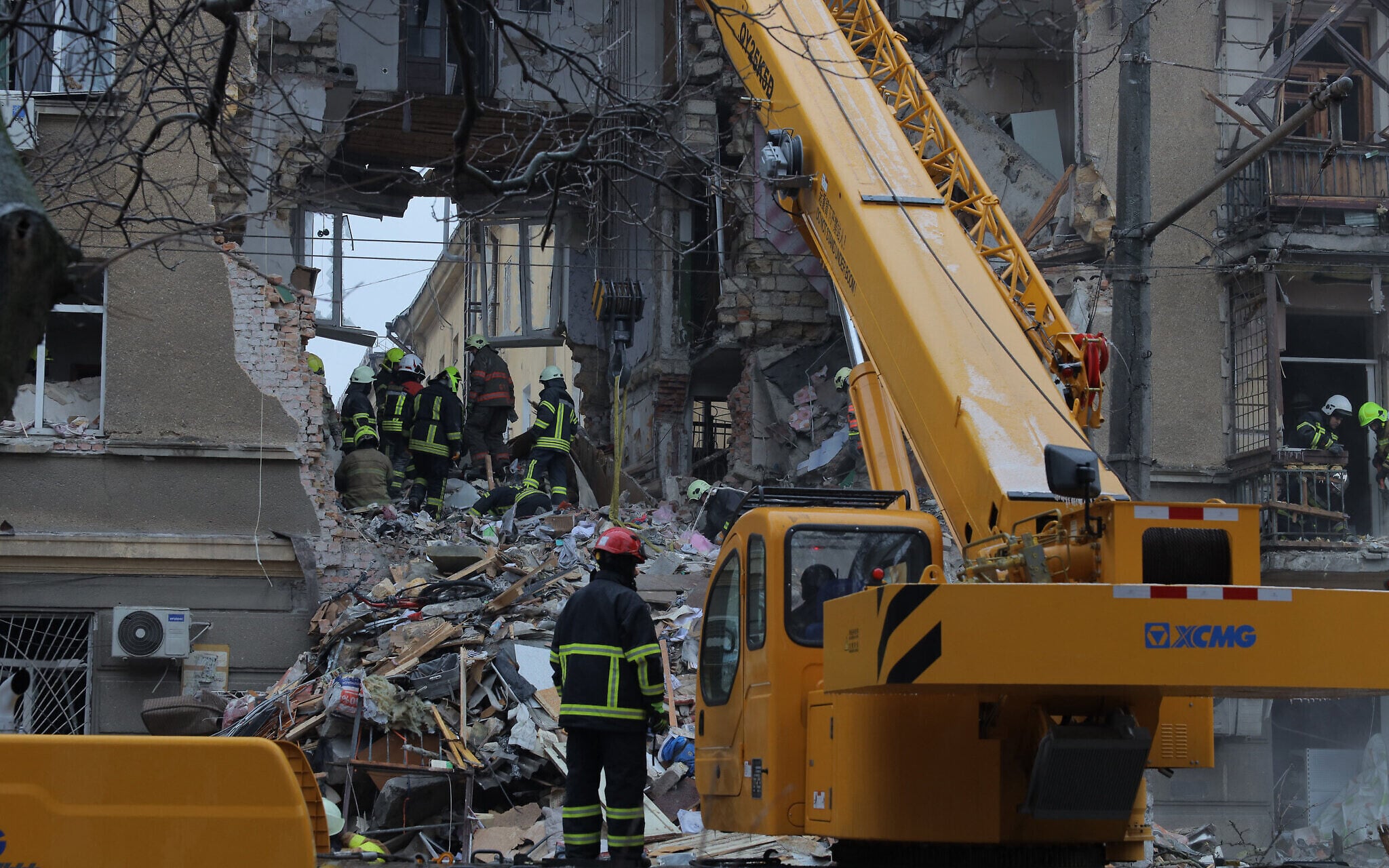
Ukrainian rescuers work among the rubble of a heavily damaged residential building following a Russian air attack in Odessa, Ukraine, on January 27, 2026. (Oleksandr GIMANOV / AFP)
Their “winner-takes-all great power competition” undermines the international cooperation needed to reduce risks of nuclear war, climate change, misuse of biotechnology, potential AI-related hazards, and other apocalyptic dangers, Bell said.
Bell also cited Trump’s domestic actions against science research, academia, the civil service, and news organizations.
Maria Ressa, a 2021 Nobel Peace Prize recipient for her journalistic efforts exposing abuses of power in the Philippines, including how social media platforms were used to spread disinformation, participated in the announcement. Ressa lamented the rise of technology that circulates lies more quickly than facts.
“We are living through an information Armageddon that’s brought about by the technology that rules our lives, from social media to generative AI. None of that tech is anchored in facts. Your chatbot is nothing but a probabilistic machine,” Ressa told an online press briefing.
Times of Israel staff contributed to this report.