
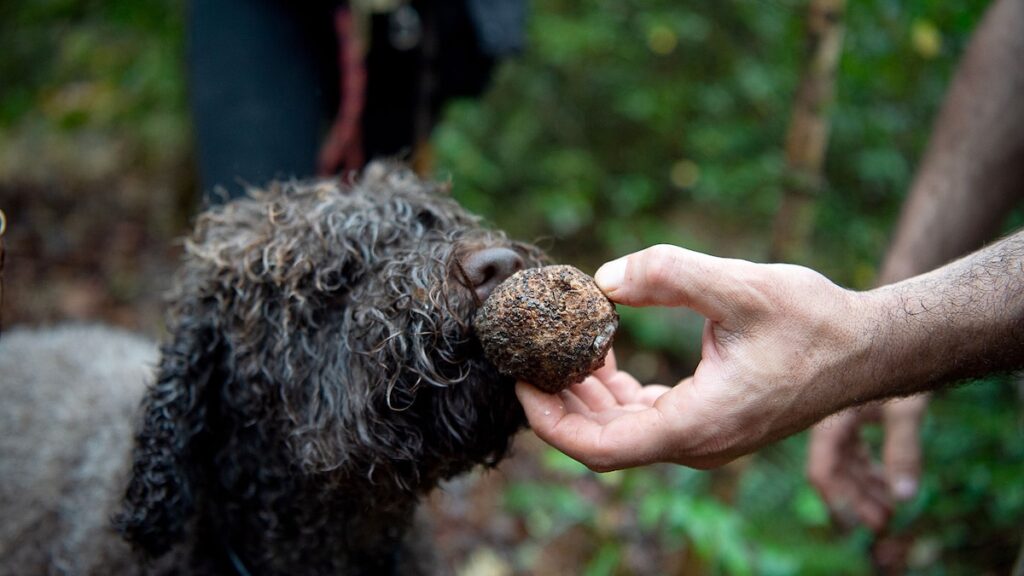
During the COVID-19 pandemic, Benjamin Lemmond, now a mycologist at the University of California, Berkeley, found himself stuck at home without access to his lab or field sites. So he had to change his research plans. His supervisor dropped off a microscope and boxes of truffle specimens collected by foragers and amateur hunters. One specimen, long labeled under its European name Leucangium carthusianum, had been found in the Pacific Northwest. But an iNaturalist report from a collector highlighted the same species in New York, far outside its known range.
Lemmond borrowed that sample, sequenced it, and realized it wasn’t the European species at all. “We ended up describing it as a new species,” he says. Now, his team actively collaborates with foragers, including Gilbert and Dechiara, to identify more new species.
Once every couple of months, the couple also visits a truffle orchard at the Mountain Research Station in Waynesville, North Carolina. Since 2010, the station has been actively studying the cultivation potential of Black Perigord truffles, a highly-prized truffle native to Perigord region in France and factors influencing their harvesting.
Inga Meadows, plant pathologist at North Carolina State University, and her team at the station work closely with Gilbert and Dechiara, regularly checking in on the orchard’s truffle harvest with the help of their dogs. Meadows’ team inoculates young hazelnut, oak, and chestnut saplings with truffle fungal spores before planting them to enhance truffle production. Truffles are mycorrhizal, meaning the fungi must colonize the root tips of the host trees to proliferate.
The team has been testing orchard management practices like varying tree density and sunlight exposure, investigating different host species and looking at environmental factors influencing truffle production. Their aim is to ultimately provide science, evidence-based tips and advice to growers before they invest years in building an orchard.