
Looking ahead to the winter of 2026, REKK researchers Borbála Takácsné Tóth and Péter Kotek have published a policy brief on the European Union’s storage obligation.
According to their analysis, storage levels on 1 November 2025 stood at 82 per cent, significantly lower than the 90 per cent average observed over the previous three years, after the initial 90 per cent target was relaxed to a minimum of 75 per cent.
The study outlines several scenarios for how Q1 2026 might unfold. The analysis warns that the combination of lower starting stocks and the coldest temperatures in 20 years could lead to storages being nearly depleted by the end of the winter.
The researchers highlight a correlation between temperature and gas consumption: In a cold winter, EU27 gas demand in Q1 is estimated at 1,250 terawatt-hours (TWh). For an average winter, this figure drops to 1,192 TWh, while a mild winter would require only 1,127 TWh.
As the 2026 winter is proving to be significantly colder than usual, the authors employed long-range forecasts showing daily temperatures averaging 2°C lower than the 2021 cold winter scenario. Using 2006 historical data, a “very cold winter” scenario results in a total gas consumption of 1,387 TWh.
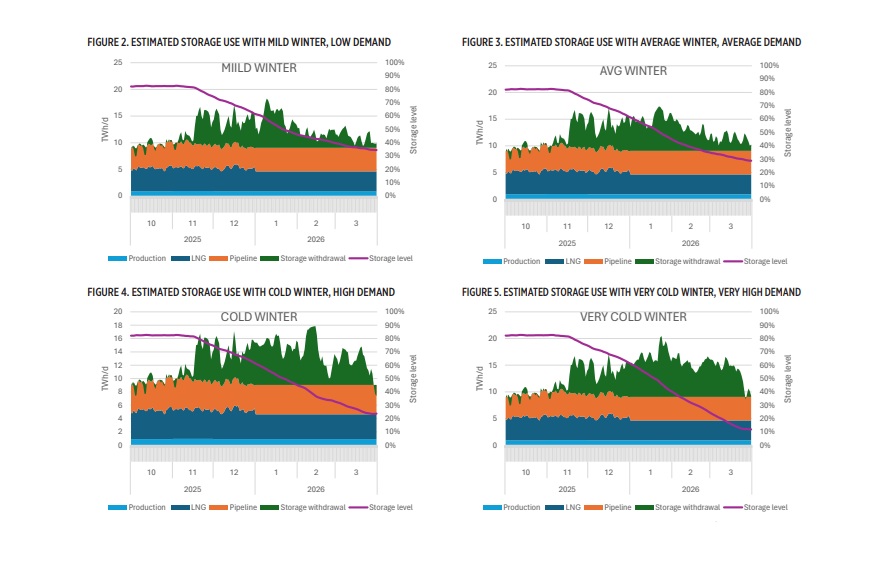
A very cold winter scenario could leave European storages nearly depleted with 12 per cent fill-up, below the historically lowest level of storage stocks by the end of withdrawal season. It is apparent that cold winter scenario may deplete European storages to 24 per cent of their working gas capacity by the end of the withdrawal season.
Even average temperatures may result in only 29 per cent fill-up by the end of March, while a mild winter could end with stocks around 34 per cent. Compared to previous years, these scenarios show depleted storages by the end of winter, creating increased injection demand in the coming months. This means that EU27 can withstand the current winter, but for the winter of 2026/2027 a stronger storage stockbuild is required.
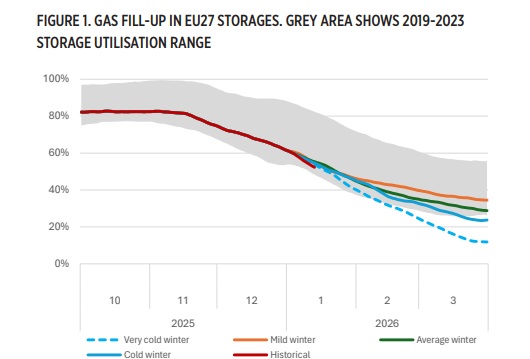 Source: REKK
The brief concludes that the EU storage obligation introduced in 2022 was a necessary response to the supply shocks following Russia’s invasion of Ukraine and dangerously low gas stocks.
With weak market incentives to store gas at the time, administrative targets were indispensable to safeguard the security of supply. Although mild winters and supportive price spreads later eased the situation, recent very low stocks after a cold start to winter show how risky it was to push for lower targets. As they have argued in a policy brief published in May 2025, the cost of maintaining storage should be viewed as insurance against supply shocks in a scarce and geopolitically volatile market. As long as the war in Ukraine continues, the EU should fully exploit the strategic advantage of its storage capacity.
“We believe that if this winter turns out to be as cold as it currently seems, the storage facilities will end the season at their lowest-ever levels,” said Borbála Takácsné Tóth. “In my personal view, this is the responsibility of the gas industry lobbyists, and it is highly problematic that the Commission was not more resilient and did not follow the recommendations of our previous May 2025 policy brief, which called for maintaining the 90 per cent storage obligation, but instead softened it.”