
Russia’s army is advancing in Ukraine at the slowest pace seen in more than a century of modern warfare, according to a new report by the Washington-based Center for Strategic and International Studies (CSIS), which says Moscow is paying an extraordinary price for minimal gains while sliding into long-term decline.
Despite Kremlin claims of battlefield momentum, Russian forces have advanced just 15 to 70 meters per day in their main offensives since early 2024 – slower than some of the bloodiest campaigns of World War I, CSIS found.
Follow our coverage of the war on the @Kyivpost_official.
Since February 2022, Russian forces have suffered nearly 1.2 million casualties, including up to 325,000 killed – losses unmatched by any major power in any war since World War II.
“Despite claims of battlefield momentum in Ukraine, the data shows that Russia is paying an extraordinary price for minimal gains and is increasingly a declining power,” CSIS said in its annual assessment.
Meters, not breakthroughs
The slow pace is most evident on Ukraine’s eastern front.
The offensive on Chasiv Yar, launched in February 2024, has advanced at an average rate of just 15 meters per day.
After nearly two years of fighting, Russian forces have moved roughly 10 kilometers and have failed to fully secure the city.
The push toward Kupyansk, which began in November 2024, progressed at about 23 meters per day.
The operation against Pokrovsk – launched after the costly capture of Avdiivka in February 2024 – advanced at roughly 70 meters per day.
Other Topics of Interest
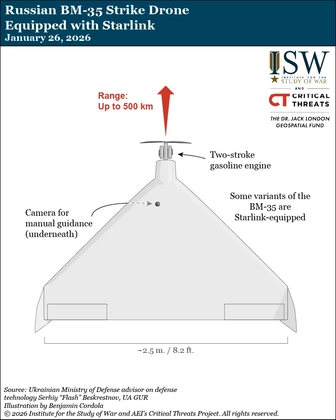
Russia Uses Starlink to Extend Drone Strikes Deep Into Ukraine
Experts warn that Russia’s reliance on Starlink-equipped drones is designed to overcome Ukrainian electronic warfare and exploit gaps in air defenses.
After two years and some 50 kilometers of fighting, Russian forces now control most of the city, CSIS said.
By comparison, during the Battle of the Somme in World War I – one of history’s bloodiest battles – French forces advanced about 80 meters per day. At the 1918 Battle of Belleau Wood, US troops advanced at roughly 410 meters per day.
Huge losses, tiny gains
Despite the bloodshed, territorial gains have been marginal. Russian forces seized about 0.6% of Ukraine’s territory in 2024 and 0.8% in 2025 – less than 1.5% combined since the start of last year.
At the peak of the full-scale invasion in March 2022, Russian troops briefly occupied around 115,000 square kilometers of Ukrainian territory.
By November 2022, Ukrainian forces had retaken roughly 75,000 square kilometers through successful counteroffensives.
Today, Russia controls about 120,000 square kilometers – roughly 20% of Ukraine – including Crimea and parts of the Donetsk and Luhansk regions seized before 2022.
CSIS estimates that about 75,000 square kilometers were captured during the full-scale war itself.
“These results fall decisively short of Moscow’s goal to militarily conquer Ukraine,” the report says.
CSIS draws a historical contrast: it took the Red Army 1,394 days to reach Berlin during World War II. Russia hit that same mark in December 2025 – but had advanced only as far as Pokrovsk, more than 500 kilometers from Kyiv.
Attrition by design
According to CSIS, Russia has turned to a war of attrition after failing to defeat Ukraine quickly in 2022.
The strategy relies on mass infantry assaults, artillery, glide bombs, and drones to wear down Ukrainian defenses – accepting extreme losses in the hope of eventually exhausting Ukraine’s military and society.
The report notes that while Russia has adapted tactically, including expanded use of drones and electronic warfare, it has failed to achieve operational breakthroughs capable of collapsing Ukraine’s front lines.
Economic strain and long-term decline
Beyond the battlefield, CSIS says the war is exposing deeper structural weaknesses in Russia’s economy.
Manufacturing contracted for much of 2025, economic growth slowed to just 0.6%, inflation remained high, and labor shortages worsened.
Russia continues to fall behind in key technologies, including artificial intelligence, and has zero companies among the world’s top 100 technology firms by market capitalization.
The report describes Russia as increasingly dependent on China for trade, energy exports, and critical components needed to sustain its war effort – from machine tools to missile-related materiel.
While sanctions have not collapsed the Russian economy, CSIS concludes that the war is locking the country into low productivity growth, technological stagnation, and mounting long-term costs.
War Russia can’t win quickly – or cheaply
Russia “is not marching toward an inevitable battlefield victory,” the report says, but instead grinding forward at enormous human and economic cost – while relying on propaganda to sustain the image of success at home and abroad.
“The great irony,” CSIS notes, “is that Russia’s performance on the battlefield falls far short of its ambitions – yet the Kremlin remains willing to keep fighting, no matter the cost.”