
Intelbrief / Towards a Credible European Deterrence? Rearmament and the State of NATO
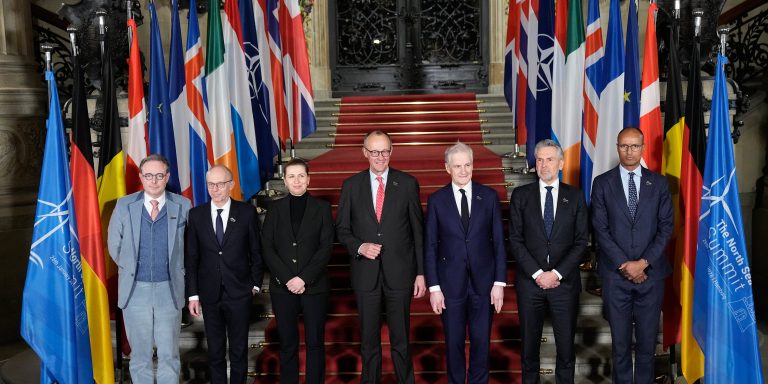
(AP Photo/Martin Meissner)
Bottom Line Up Front
- As Europe grapples with the gradual erosion of the institutional and normative foundations of the liberal international order, its most glaring vulnerability remains its fragmented defense posture.
- Significant issues persist in mounting a credible, non-U.S.-dependent European deterrence and defense framework, with some structural and others solvable through policy innovation and major investment.
- Although Europe collectively fields a sizable number of military personnel (roughly 1.4 million active-duty personnel), interoperability remains limited.
- The timelines European officials have set themselves to substitute most U.S. capabilities short of the nuclear deterrent are colliding with a very rapidly shifting international order, leaving European states to hedge against an increasingly unreliable and mercurial transatlantic relationship
The latest flashpoint in transatlantic relations—President Trump’s escalatory remarks about acquiring Greenland—triggered a surge of calls from European leaders for greater autonomy and accelerated rearmament, a tit-for-tat that has now become a fixture of EU-U.S. relations. Once threats of a coercive U.S. takeover of Greenland subsided, NATO Secretary General Mark Rutte delivered a stark reminder to the European Parliament: it is “dreaming” if it believes it can field a credible defense without the U.S. Many capitals responded negatively to Rutte’s assertion and aim to ‘Europeanize’ NATO, with some supporting the idea of an integrated European army in the long term. As Europe grapples with the gradual erosion of the institutional and normative foundations of the liberal international order—an order in which it has long seen itself as a central pillar and beneficiary—its most glaring vulnerability remains its fragmented defense posture despite its vast economic and cultural power. Europe’s Achilles’ heel is increasingly exposed as doubts grow whether the U.S. would mobilize fully if, for example, a small Eastern European state were to invoke Article 5 in case of a Russian military operation, rendering credible European deterrence and defense indispensable.
At the World Economic Forum in Davos last week -and in the accompanying wave of opinion pieces- a steady stream of Sun Tzu, Thucydides, and Morgenthau citations highlighted the resurgence of “might?makes?right” realism spreading across Europe as its transatlantic security partnership shows increasing strain. In the past year, European states have adopted expansive defense budgets and policies focused on defense readiness. Germany’s Zeitenwende has crystallized under Chancellor Friedrich Merz, with an explicit ambition to transform the Bundeswehr into Europe’s strongest conventional force. Poland is likewise accelerating its military build?up and is now the EU’s largest military by personnel, surpassing both France and Germany. Several countries, including the Baltic states (which remain on NATO’s front line of defense on the eastern flank), Denmark, and Belgium, have reinstated or expanded mandatory and voluntary conscription policies. At the EU level, through the Readiness 2030 framework – composed of the Eastern Flank Watch, the European Drone Defense Initiative, the European Air Shield, and the European Space Shield-member states aim to mobilize roughly €800 billion for defense and resilience efforts.
Significant issues persist in mounting a credible, non-U.S.-dependent European deterrence and defense framework, with some structural and harder to mitigate, while others can be redressed through policy and investment. The primary structural issue to defense integration – which would significantly boost European deterrence and defense – remains the deep reluctance of member states to subordinate defense decisions to a supranational authority. This reluctance is entrenched in the EU’s constitutional order, which confirms that national security – and thus core defense decisions – remain the sole responsibility of each Member State. This is reflected in the Common Security and Defence Policy’s strictly intergovernmental, unanimity-based design. Issues that can be redressed, including better joint procurement, interoperability, and a surge in manpower, can all be accomplished but will require time and investment that Europe may not have, depending on international developments.
Although Europe collectively fields a sizable number of military personnel (roughly 1.4 million active-duty personnel), interoperability remains limited. This does not just stem from the lack of a centralized command and differing strategic cultures, but also decades of fragmented, national-level procurement of defense systems, leading to the fragmentation of even the most basic equipment and weapons across European militaries. Currently, Europe operates 12 different types of main battle tanks, for example, and joint procurement continues to fall short of the 35% target even as European initiatives seek to boost member states’ buying the same or compatible systems. Some analysts have attributed this to persistent procurement nationalism, but much of this also stems from Europe’s underdeveloped defense industrial base and its procurement of systems outside the Union. Europe continues to be highly dependent on U.S. suppliers for advanced capabilities, including advanced air defense systems and HIMARS-type rocket artillery.
Military readiness gaps further complicate the picture. Around 80,000 U.S. troops currently stationed in Europe maintain high readiness levels—meaning they can deploy rapidly and sustain operations—while smaller European units do not. Closing this gap will require substantial, long-term investment and a change in the strategic culture of these units. In an estimate by the economics think tank Bruegel of a U.S.-independent, credible European response in the case of Russian aggression, Europe would need an additional 300,000 troops, potentially even more, to compensate for the fragmented nature such a combined force of national militaries would likely face.
Nuclear deterrence presents another fundamental challenge. France and the United Kingdom remain Europe’s only nuclear powers, while Europe largely relies on the U.S. nuclear umbrella, including American warheads stationed in Türkiye, Italy, Belgium, the Netherlands, and Germany, for deterrence. In addition to conventional capabilities, deterrence must now encompass cyber and grey?zone threats. Here too, Europe struggles: responses to sustained Russian hybrid activity on its soil have not yet put a significant dent in the Kremlin’s subthreshold campaign of sabotage, military signaling, and information meddling.
The timelines European officials have set themselves to substitute most U.S. capabilities short of the nuclear deterrent are colliding with a very rapidly shifting international order, leaving European states to hedge against an increasingly unreliable transatlantic relationship. It is, therefore, a misreading to infer from Trump’s decision to step back from acquiring Greenland that the fabric of alliance is being restored. European leaders face a closing window in which drastic measures must be taken if Europe wants to deter aggression and defend its Eastern front, regardless of U.S. support.