Executive Summary
This report assesses Armenia’s decision to advance the TRIPP corridor by restoring a dormant Soviet-era rail section linking Azerbaijan to Nakhchivan via Armenian territory, within a context of accelerating geopolitical realignment towards the West.
The initiative is assessed within the broader context of Yerevan’s ongoing geopolitical recalibration and its gradual diversification away from exclusive reliance on Moscow.
It further assesses Russia’s evolving strategy towards Armenia, examining whether Yerevan continues to hold strategic value for Moscow within the South Caucasus or whether its importance is being reassessed in light of the Kremlin’s shifting foreign policy priorities.
Key Takeaways
- Armenia’s westward shift via TRIPP increases dependence on the United States and the European Union and exposes Yerevan to regional and financial vulnerabilities.
- Moscow tolerates Yerevan’s drift, keeping limited leverage through military and intelligence assets, but Yerevan is not indispensable to Russia’s broader objectives.
- Pashinyan’s political strategy relies on visible public engagement and Western support, while Armenian systemic risk rises due to reliance on external guarantees.
Information Background
In January 2026, Yerevan’s formally requested Moscow to accelerate restoration of a Soviet-era railway segment crossing Armenian territory, historically connecting mainland Azerbaijan to its exclave Nakhchivan and onward to Turkey. This rail section is a foundational element of the proposed TRIPP (Trump Route for International Peace & Prosperity) corridor, a US-backed connectivity project emerging from a Trump-mediated Armenian–Azerbaijani peace framework.
Armenia’s railway network has been under a 30-year concession (extendable by 10 years) since 2008 to South Caucasus Railway (Yuzhno-Kavkazskaya zheleznaya doroga / YuKZhD), a 100% subsidiary of Russian Railways (RZhD). Under this concession, the Russian company retains operational control and maintenance responsibility across the network.
Prime Minister Nikol Pashinyan has publicly stated that if Russia is unable or unwilling to deliver restoration within an acceptable timeframe, Armenia is prepared to withdraw the relevant rail sections from the concession and rehabilitate them independently.
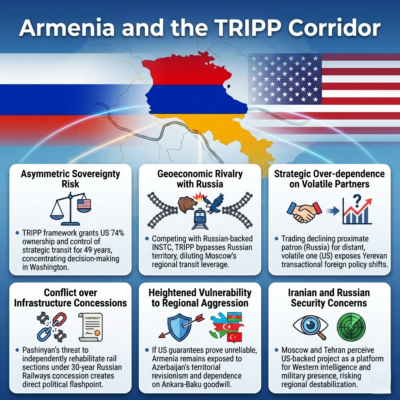
The TRIPP framework allocates 74% ownership and control to the United States and 26% to Armenia for the first 49 years, with Armenia’s stake potentially rising to 49% thereafter. Washington is expected to provide the bulk of financing; Armenia’s contribution consists primarily of land access and development rights.
Geopolitical Context
From Moscow’s perspective, incentives to restore this rail section are structurally weak. TRIPP directly competes with the Russian- and Iranian-backed International North–South Transport Corridor (INSTC) by offering an alternative east–west connectivity axis that bypasses Russian territory and dilutes Moscow’s transit leverage in the South Caucasus. Facilitating TRIPP would therefore undermine Russia’s long-term geoeconomic strategy, already challenged by the potential for the collapse of the Islamic government in Iran in the event of an US/Israel military attack.
Armenia’s ability to independently fund restoration is limited but not nonexistent. Rail rehabilitation costs for a relatively short Soviet-era segment are manageable in absolute terms, but burdensome relative to Yerevan’s fiscal space, particularly amid rising defence expenditure and economic uncertainty. Without Russian execution, Yerevan would almost certainly require external financing, most plausibly from US or EU sources. This would further internationalise a project already perceived by Moscow and Tehran as adversarial.
Armenia is clearly at risk of strategic over-dependence. Under TRIPP’s current structure, Yerevan cedes long-term control of a strategic transit artery for at least half a century, with decision-making power concentrated in Washington. This creates asymmetric exposure: Armenia bears the geopolitical fallout locally, while the US retains optionality.
This risk is amplified by US foreign policy volatility, particularly under Trump-style transactionalism. There is no structural guarantee that Armenia will retain long-term strategic relevance to Washington once immediate diplomatic or symbolic objectives are achieved.
Moscow’s Approach to Armenia: Strategic Interests and Limits
From a Russian strategic culture perspective, Armenia is not viewed primarily as an ideological partner, but as a geopolitical anchor, a buffer-management tool or a leverage node in the South Caucasus balance. The Kremlin’s policy thinking is transactional, security-centric, and status-driven, not emotional. Key Russian assumptions (often implicit in Russian-language expert discourse) are that Armenia is structurally dependent on Russia more than it admits: Armenia’s elite oscillates, but geography does not.
The South Caucasus is not a priority theatre, but a denial theatre — Russia’s goal is to prevent hostile consolidation (an anti-Russian bloc), not to dominate absolutely. From Moscow’s viewpoint, the nightmare scenario is not Yerevan drifting West per se, but Armenia, Azerbaijan and Georgia fully integrated into Western security, transport, and energy architectures, excluding Russia from transit, mediation, and military relevance. In this sense, Armenia’s ambiguity has historically served Russia well. Moscow does not require Yerevan to be loyal — it requires Armenia to be unavailable to adversaries as a platform.
Another key point is managing Turkey without direct confrontation. Russia sees Armenia as a pressure-release valve in relations with Turkey, a non-Turkic counterweight in a region where Ankara’s influence is expanding (historically, Armenia’s Christian population was regarded by the Russian Empire as a stabilising buffer along its southern frontier, separating imperial territory from predominantly Muslim polities). Russia does not seek confrontation with Turkey in the Caucasus, but it seeks balance without escalation. Armenia’s existence as a military-political actor — even weakened — complicates Turkish strategic depth. This is still valuable to Moscow, even if Yerevan is “difficult”.
In fact, President Vaagn Khachaturyan recently stated Armenia and Russia are “not brothers, just partners”, signalling a departure from the older paternalistic framing. Moscow’s physical footprint is shrinking. Russian border guards have been removed from Zvartnots Airport and other posts. Armenian officials have expressed that Russia-led security mechanisms (the Collective Security Treaty Organisation – CSTO) no longer guarantee the nation’s security, edging toward a “point of no return” in relations with the alliance.
Nevertheless, Armenia still matters to Russia for military infrastructure and intelligence depth. The Russian 102nd base in the Caucasian country is not about Armenia alone; it is about monitoring Iran, monitoring Turkey and NATO’s southern flank awareness. Even degraded, this infrastructure is not easily replaceable.
The rift with the Armenian political establishment emerged following the rise to power of Nikol Pashinyan. The subsequent deterioration in relations with the Armenian public, by contrast, intensified during Azerbaijan’s military aggression against the Armenian-populated enclave of Nagorno-Karabakh/Artsakh, when Moscow — and the CSTO — chose not to intervene.
This episode also generated significant public anger towards the Armenian Prime Minister himself, who adopted a notably uncompromising stance towards the local Artsakh leadership. From a legal perspective, CSTO obligations are territorially constrained, and international law does not recognise Artsakh/Nagorno-Karabakh as part of Armenia. Direct military intervention by Russia would have risked confrontation with Turkey, increased NATO’s regional proximity, and entangled Moscow in a peripheral conflict concurrent with operations in Ukraine.
From Moscow’s view, non-intervention was not betrayal, but a rational prioritisation of strategic theatres. This does not imply that Russia sought Armenia’s defeat; rather, Moscow was willing to tolerate Armenian losses to mitigate broader systemic risks. While a harsh calculus, it is internally consistent with the Kremlin’s strategic doctrine and risk management approach.
Moscow has also publicly expressed readiness to play a role in Armenian–Azerbaijani peace negotiations, yet its leverage in these processes is decreasing relative to US and EU involvement. Maintaining a mediator role inside every negotiation (or at minimum holding a veto capacity) is indeed something Russian foreign policy doctrine strongly favours.
Armenia enables this by historical dependence, military basing, intelligence penetration, and legacy trust networks. Even when the Kremlin’s mediation role weakens, its exclusion is unacceptable from Moscow’s perspective. That is why Russian officials react sharply not to Armenian criticism, but to EU monitoring missions, US-led peace frameworks, institutionalised Western presence.
Armenia also holds economic and sanctions circumvention value, as a logistics node, a financial intermediary and a sanctions-buffer space. Cutting Armenia off entirely would hurt Russia’s own flexibility. Furthermore, Armenia is Russia’s only friendly corridor to Iran not controlled by Turkey or Azerbaijan (Central Asian countries are part of the Turkish bloc). Even symbolic access matters strategically.
Any Armenian realignment that complicates Russia–Iran coordination is seen as strategically negative, regardless of Armenia’s internal politics. The current instability in Iran, compounded by the risk of a potential US or Israeli strike, presents a threat to Russian investments in the INSTC. For Tehran, the TRIPP corridor not only raises concerns regarding espionage and intelligence exposure but also risks disrupting a vital northern export route. Armenia is the only Eurasian Economic Union member state that shares a terrestrial border with Iran; should Yerevan withdraw from the Union, Iran would lose access to a market comprising millions of consumers.
Prime Minister Nikol Pashinyan has centred his political campaign on the slogan — now the core of his national project — “Real Armenia.” This initiative encompasses the reopening of the country’s borders, a reduction of dependence on Russia, and the diversification of Yerevan’s foreign and economic orientation through the normalisation of relations with historically adversarial neighbours, Azerbaijan and Turkey. Consequently, it is likely that the upcoming 2026 parliamentary elections will be primarily contested around this policy agenda.
Pashinyan’s principal opposition is not domestic, as Armenian parties remain reluctant to challenge policies that secure significant Western investment and potential security guarantees. Rather, opposition primarily stems from Armenian diaspora networks in Russia and the United States, which continue to uphold a vision of historic Armenia that emphasises traditional territorial claims and legacy narratives, rather than the geopolitical realities shaped by decades of conflict and territorial adjustments. The millions of Armenians in Russia stabilise bilateral relations regardless of politics, embed Armenian interests inside Russian society and reduce the feasibility of a “clean break”.
Russian analysts often frame Armenia’s current policy as asymmetric hedging without capacity, rhetorical distancing without real autonomy, and seeking Western guarantees that cannot substitute hard security. This produces irritation, not panic. Moscow’s prevailing view is that Armenia is dissatisfied but has nowhere to go fast. This explains why Russia’s response is often dismissive, passive-aggressive and informational rather than kinetic — not imperial punishment but strategic patience mixed with irritation.
From a Russian perspective, there is a potential risk of strategic miscalculation. Analysts in Moscow are particularly concerned that a rapid reduction of Russian presence in Armenia, in the absence of credible alternative deterrence measures, combined with Azerbaijan’s continued military superiority, could lead to renewed instability. Such a scenario may compel Russia to re-engage under less favourable conditions. This approach reflects conflict-management logic rather than altruism.
At present, the South Caucasus is not a priority theatre for the Kremlin. Russian foreign policy attention has increasingly shifted towards the Middle East, South-East Asia and Africa, where Moscow perceives greater strategic and economic returns.
Russia operates on long time horizons; its foreign policy planning typically unfolds over decades rather than electoral or short political cycles. Both in military affairs and in broader geopolitical competition, Moscow has historically demonstrated a willingness to tolerate short-term setbacks, including the appearance of weakness or disengagement, allowing adversaries to advance tactically. This approach is often intended to preserve resources and strategic flexibility, enabling Moscow to re-enter the arena at a later stage under more favourable conditions and to reassert influence.
In this context, it is plausible that the Kremlin will wait for the outcome of the Armenian parliamentary elections expected in 2026 before defining its next phase of engagement, in order to assess who its principal interlocutor in Yerevan will be.
Prime Minister Nikol Pashinyan faces a tangible electoral risk in openly confronting Moscow and alienating pro-Russian segments of Armenian society. His domestic support has eroded since 2020, particularly following Armenia’s military defeats during his tenure. His current strategy appears aimed at rapidly securing and showcasing the economic and infrastructural benefits of closer cooperation with Western partners, with the intention of converting these tangible outcomes into electoral support.
In parallel, the Armenian Prime Minister has adopted a strategy of sustained media overexposure. Through highly visible public activities — from cycling alongside his citizens to forming a music band — Pashinyan seeks to dominate the information space and saturate social media with his image. This approach forms part of a broader information-domain electoral campaign, conducted in a context where the political opposition remains fragmented and increasingly marginal in the public sphere.
Conclusion
Sabotaging relations with Russia carries immediate economic costs. Russia currently accounts for approximately 40% of Armenia’s import-export turnover, including energy, remittances, and logistics. A sharp deterioration would likely produce short- to medium-term economic shocks.
This exposure is compounded by Azerbaijan’s persistent rhetorical framing of southern Armenia as “Western Azerbaijan”, signalling unresolved territorial revisionism. In a scenario where Armenian leverage over transit diminishes and external guarantors prove unreliable, dependence on Ankara–Baku goodwill would represent a strategic vulnerability.
Russia has little strategic incentive to facilitate TRIPP but may choose partial compliance to delay Armenia’s westward realignment and preserve residual leverage. Yerevan, meanwhile, lacks the financial autonomy to pursue this project without deepening dependence on Western capital.
Strategically, Armenia is engaging in a high-risk rebalancing act: trading a declining but proximate patron (Russia) for a powerful yet distant and volatile one (the US), while alienating Iran and increasing exposure to Turkey and Azerbaijan. Unless Yerevan secures binding, long-term security and economic guarantees—which currently do not exist—TRIPP risks transforming Armenia from a buffered crossroads into a transit-dependent buffer state, with reduced strategic autonomy and heightened vulnerability to regional pressure.
In intelligence terms, this is not a diversification strategy; it is a substitution strategy, and substitution carries far higher systemic risk.
From Moscow’s perspective, Russia does not wish to lose Armenia, but it is also unwilling to invest significant effort to regain or secure influence over the country. Armenia remains strategically relevant, yet it is neither indispensable nor central to the Kremlin’s current broader foreign policy objectives.