
It was his last week of finals before graduating, yet despite exams and essay deadlines, one Armenian student decided to investigate the maneuvers of one of the world’s most corrupt, expansionist totalitarian regimes right here in the Bay Area.
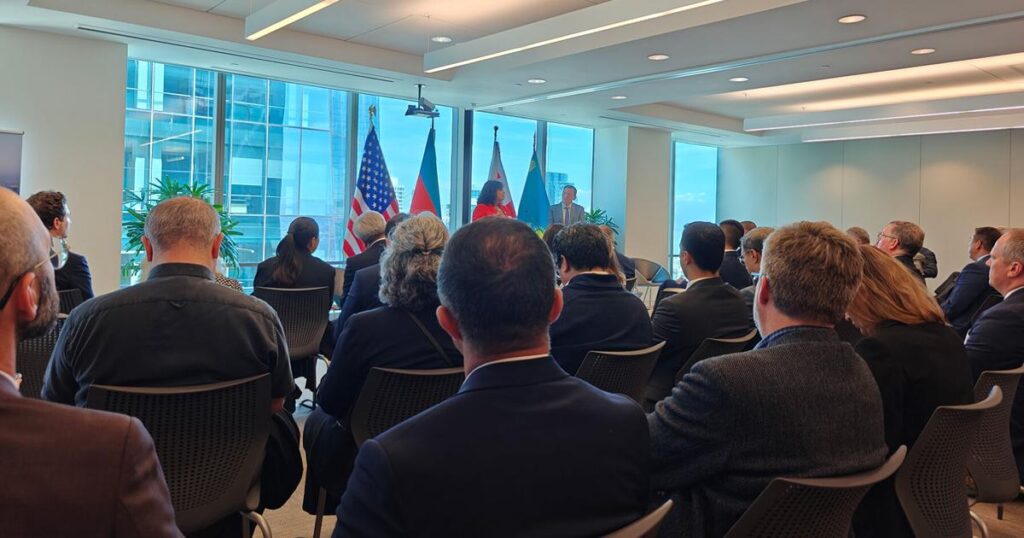
Last May, the Consulate General of Azerbaijan and the U.S. Commercial Service co-hosted a USA-Eurasia Energy and Environment Forum in San Francisco, where Azeri oligarchs openly advertised the “green” energy potentials of occupied Armenian lands to American business interests.
The Consuls of Georgia and Kazakhstan were invited alongside several top executives from Tesla, the California Public Utilities Commission, several global venture capital firms and more. Conveniently left out of this “Eurasian” affair were any Armenian officials and groups.
After multiple UC Berkeley students with Armenian last names got rejected from the event’s registration site, they tried again with “white-sounding” pseudonyms and were approved.
Two Armenian students attended. One canvassed outside the building, sharing information with attendees about Azerbaijan’s ethnic cleansing of the historically Armenian enclave of Artsakh (Nagorno-Karabakh) in 2023, blockading food, water and energy supplies to force out more than 100,000 Armenians from their homeland. The other student went inside.
He was granted anonymity out of safety concerns and fear of repercussions.
What seemed like just another networking event turned out to foreshadow a massive geopolitical shift with major consequences for the fate of Armenia’s sovereignty. Luckily, these students recognized this event for what it was — a microcosm of imperialism in our backyard — and took matters into their own hands.
The conference took place just weeks after the Consulate General of Azerbaijan coerced UC Berkeley School of Law’s Human Rights Center into cancelling the Armenian Students Association’s screening of the documentary “My Sweet Land.” The documentary follows an 11-year-old boy, Vrej, and his family as they flee Artsakh during the initial 2020 Azeri occupation, known as the Second Nagorno-Karabakh War.
The reverse effect of this censorship, of course, is that Armenians were galvanized. In that same week, decentralized Armenian students spontaneously organized a successful protest on Sproul Plaza, pressuring Berkeley Law to reschedule the screening.
It was through this assembly that I became friends with the student who attended the conference.
In September, the screening finally took place with record-breaking attendance — a wonderful show of collective power — and the story could very well end there.
Yet the confluence of these two events — the film censorship and the energy conference — signals something deeper and ongoing. Not only does it confirm that Azerbaijan’s actions were intentional and localized, but what the student documented at the conference reveals exactly why the Azeri regime is so concerned about suppressing narratives about a free Republic of Artsakh.
Tucked between high grassland plateaus and lush forested mountains, the land of Artsakh has immense solar and wind power potential, making it a perfect target for the petrostate of Azerbaijan.Since oil and gas make up close to 50% of its GDP and more than 90% of its exports, the country is “now doing its utmost for (the) energy transition,” said Azerbaijan Deputy Minister of Energy Orkhan Zeynalov at the conference.
This attempt to rebrand as a do-gooding pioneer in green energy does not sit well beside the country’s grotesque human rights abuses.Yet, despite its war crimes, environmental destruction and intense crackdown on its own population, Azerbaijan got to host the United Nations’ annual climate summit in 2024:COP29.
“Cop meetings have proven to be greenwashing conferences,” writes the renowned Swedish activist Greta Thunberg. They serve to legitimize criminal nations, like other recent hosts, Egypt and the United Arab Emirates, enabling their continued violations of human rights. The San Francisco conference served this same vindicating purpose.
Attendees failed to see this, either falling for Azeri deceit or willfully ignoring injustice.
In her opening remarks, Consul General of Kazakhstan Nazira Nurbayeva describes the event as a “wonderful opportunity to share ideas and create something very meaningful for our common future.”
Like clockwork, speakers followed the same playbook, masquerading behind a language of benevolence and collaboration. Deputy Executive Director for Energy and Climate Policy at the California Public Utilities Commission, Leuwam Tesfai, says she’s “very proud” that their clean energy efforts are “bringing new jobs” and “creating more training opportunities for communities that have been impacted by climate change.”
Does she know that doing business with Azerbaijan to achieve this would also require destroying communities? Does she know about the Armenians of Artsakh or that the prisoners of war still have not returned? The millennium-old monuments now pumped with bullets by crazed ultranationalist Azeri soldiers? Nothing is clean about this.
Nonetheless, Zeynalov proceeds with his PowerPoint illustrating the solar and wind energy potentials of three designated “green zones” — Nakhchivan, Karabakh and Eastern Zangezur — labeled as “liberated territories.” By the way, “Eastern Zangezur” implies there’s a “Western Zangezur.” This would be the internationally recognized Armenian province of Syunik.

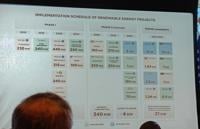
One slide depicts a three-phase implementation schedule, listing several regions’ energy capabilities and the companies set to reap them — British Petroleum, Saudi-owned ACWA Power, UAE-owned Masdar, China Energy and more.
The third phase, from 2031-37, shows wattages and companies, but no places.This, along with maps published by the government of Azerbaijan, its creation of so-called “Western Azerbaijan,” and public statements made by President Ilham Aliyev that “Present-day Armenia is our land,” make clear how Armenia’s sovereignty continues to be in imminent danger.
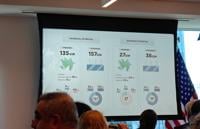
Hidden in plain sight, imperialist plans unfold, though in settings far less glamorous than the aesthetics of empire and rebellion. The absurdity of our current era lies in how easily we normalize, sanitize and turn a blind eye to terror. When such violent, immoral and undemocratic acts occur in spaces so commonplace, Armenian students must engage their critical eye.
Zeynalov continues, “I want to see American companies, and I don’t see them here,” followed by muted giggles from the corporate audience. Well, he got what he wanted.
Three months later, the U.S. brokered a peace deal between Armenia and Azerbaijan. It established the “Trump Route for International Peace and Prosperity,” or TRIPP, giving U.S. companies a 99-year lease on a transit route cutting directly through the Syunik province, connecting Azerbaijan to its autonomous exclave, Nakhchivan.
This act, on behalf of Armenia’s Prime Minister Nikol Pashinyan, bets on peace arising through shared economic ties. Will this open-for-business posturing really bring stability, or in an era of expansionist aggression — in Palestine, Ukraine, Venezuela, Greenland — will it make Armenia the grounds upon which global powers battle for supremacy?
I do not claim to know the answer, but as an Armenian student in the American diaspora, I can recognize what lies in my own sphere of influence, just like these two students did.
As Armenia orients with the West, this conference puts into question whether the U.S. truly wants peace in Armenia or instead benefits from inauthentically projecting peace between two countries, whose names Trump could not bother to remember, while aiding and abetting Armenia’s aggressor when no one is watching.
Well, somebody was watching.
Of course, it was “nerve-wracking and scary,” the student in an interview months later said, as he reflected on being in the same room with the very people who inflicted so much suffering on his people.
Yet one cannot show courage without first feeling fear, and I remain firmly in awe of this student’s bravery, placing himself smack in the middle of this truly disturbing event for the sake of public awareness.
As an Armenian in the heart of the American empire, you have the power to advocate not only for displaced Armenians but for what the Republic of Artsakh represents: liberty and self-determination for all people.
Embodying this spirit, the UC Berkeley alumnus leaves Armenian students with a message: “I want people to know that in terms of advocacy or just getting things done, they shouldn’t have to wait for an authority to direct them. Just one person standing up and deciding, I’m going to try to do something about this, can be really effective.”