
For many years, co-operation between Canada and Sweden was often viewed through a narrow lens — defence procurement. Discussions about fighter aircraft, technical specifications and military benefits tended to dominate attention.
Yet focusing only on defence equipment obscures a deeper shift now under way. What began as a technical defence relationship has gradually evolved into broader strategic convergence rooted in shared geopolitical interests, mutual economic benefits and a common understanding of the North.
As a researcher in Canadian studies, I am particularly interested in Swedish–Canadian relations as both countries seek to to strengthen the resilience of their political and economic systems.
This evolution in the relationship hasn’t happened overnight. It’s developed incrementally through political dialogue, institutional trust and shared security concerns.
It also comes after Canada signed a contract in January 2023 to acquire 88 Lockheed Martin F-35A Lightning II fighters from the United States and has committed funds for 16 of them.
The Canadian government is reconsidering the remaining portion of the planned purchase amid ongoing tensions with the U.S., but American officials have warned that cancelling the deal could require changes in bilateral air defence co-operation and lead the U.S. to assume a greater operational role.
But at the same time, Ottawa is examining a Swedish offer of 72 Saab Gripen jets and six GlobalEye aircraft.
Political alignment
Recent developments suggest that Canada–Sweden co-operation is no longer best understood as a transactional arrangement. Instead, it reflects a sustained effort by two northern democracies to strengthen long-term co-ordination in an increasingly unstable global environment.
The foundations of Canada–Sweden defence co-operation lie in longstanding exchanges on military aviation, joint exercises and technological collaboration. Although fighter aircraft discussions, including on the Gripens, are a visible part of this relationship, collaboration has increasingly extended beyond procurement.
Joint training in Arctic and cold-weather operations and interoperability in air operations and command-and-control systems now play a growing role in the Euro-Atlantic and northern European security landscape.
Sweden’s accession to NATO in 2024 has reinforced these dynamics, creating new opportunities for co-ordination between Canada and Sweden within the organization’s planning, exercises and capability development.
Canada’s lack of a Swedish aircraft purchase hasn’t curtailed defence co-operation, but redirected it toward political alignment on shared threats, Arctic and Baltic security and the institutional frameworks required among allies in northern environments.
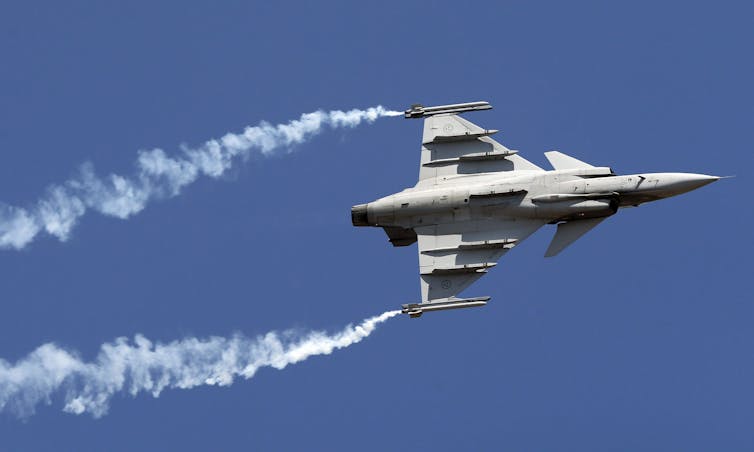
Gripen, a Swedish fighter aircraft, at an air show in India in 2017.
(AP Photo/Aijaz Rahi)
High-level engagement
In 2023, Canada and Sweden marked 80 years of diplomatic relations. This anniversary highlighted the depth and continuity of the bilateral relationship and served as a reminder that present day co-operation builds on decades of political trust.
High-level political contacts in recent years have further elevated the relationship.
Interactions among ministers responsible for foreign affairs, defence, industry and energy have framed co-operation around defence-related industries, technological sovereignty, innovation ecosystems and Arctic governance. This points to a maturing partnership in which security, industry and research policy are increasingly connected.
What stands out is that discussions have focused less on single contracts and more on long-term reliability, institutional compatibility and shared priorities.
These include security in the High North, collective defence within NATO and closer industrial and technological ties among advanced democracies with similar economic systems.
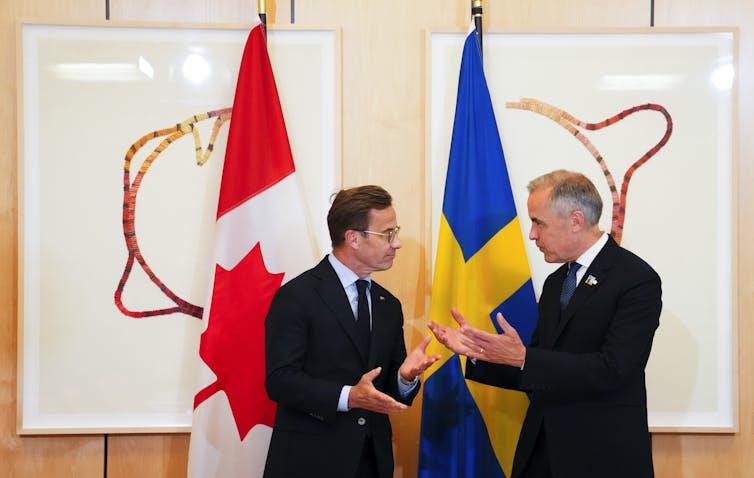
Prime Minister Mark Carney meets with Prime Minister of Sweden Ulf Kristersson on the sidelines of the NATO Summit in The Hague, Netherlands in June 2025.
THE CANADIAN PRESS/Sean Kilpatrick
State visit
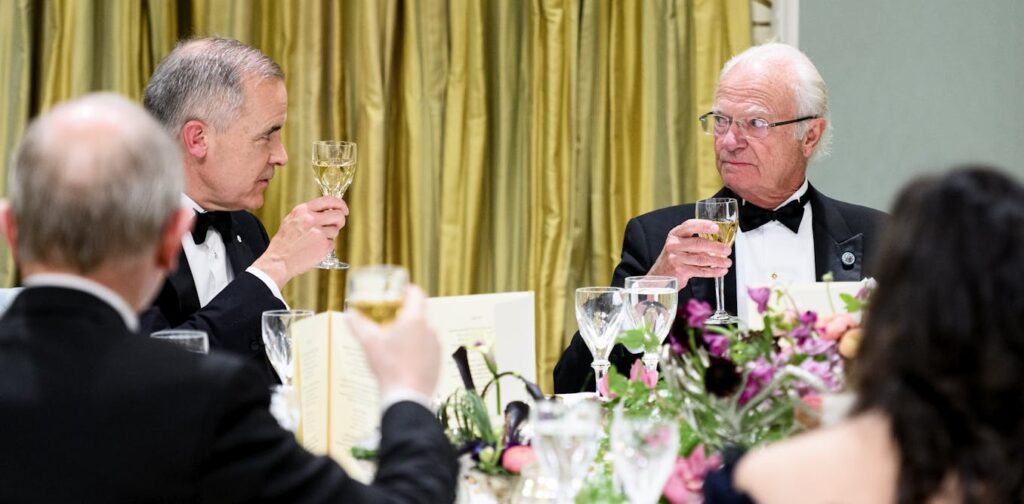
This broader relationship took on new political weight during the Swedish state visit to Canada in November 2025.
King Carl XVI Gustaf and Queen Silvia led the visit and were accompanied by senior Swedish cabinet ministers, including Ebba Busch, deputy prime minister and industry minister, and Defence Minister Pål Jonson.
The three-day visit combined ceremonial diplomacy with strategic and economic dialogue. Several Swedish companies participated in business and innovation events.
During the visit, Canada and Sweden formalized a strategic partnership framework covering security and defence co-operation, Arctic affairs, trade, innovation and the green and digital transitions.
The visit, which included meetings in Ottawa and engagements with research and technology experts, underscored that bilateral relations were no longer limited to defence but were expanding into long-term political co-ordination.
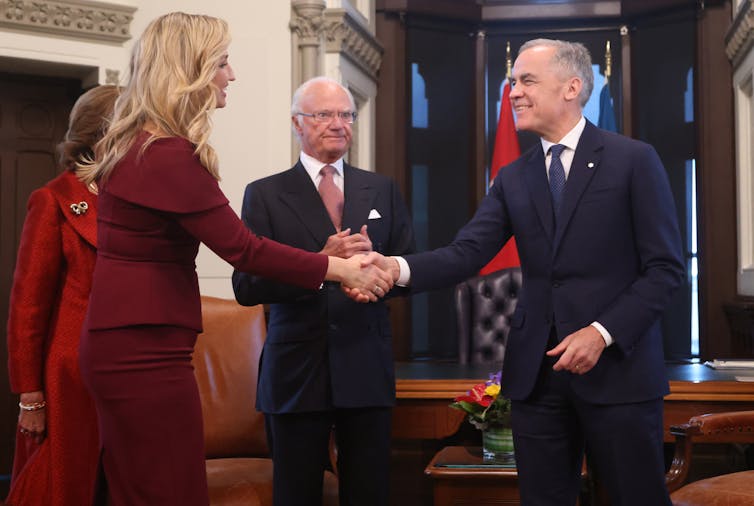
Ebba Busch, Sweden’s deputy prime minister and industry minister, shakes hands with Prime Minister Mark Carney as Sweden’s King Carl Gustaf looks on before a meeting on Parliament Hill in November 2025.
THE CANADIAN PRESS/ Patrick Doyle
The Rodinia metaphor
Busch has on several occasions used an unusual metaphor to describe relations between Canada and the Nordic region: Rodinia, the ancient super-continent that once linked what are now parts of North America and northern Europe.
Although geological in origin, the reference serves a political purpose. It frames present co-operation as a reconnection rather than something new. It situates Canada–Nordic relations within a longer narrative shaped by comparable northern environments, natural resources and innovation systems influenced by climate and geography.
Such historical imagery helps place industrial and strategic co-operation within a broader sense of continuity. In this perspective, partnership does not depend on a single defence decision but on structural similarities and long-term shared interests across the North Atlantic and Arctic regions.
Read more:
Snowball Earth: new study shows Antarctic climate even gripped the tropics
Changing economic and security landscape
Canadian leaders are increasingly emphasizing co-operation with like-minded middle and advanced economies, as Prime Minister Mark Carney did in his recent widely acclaimed speech in Davos.
Read more:
Mark Carney’s Davos speech marks a major departure from Canada’s usual approach to the U.S.
These economies include Nordic countries in areas like clean energy, critical minerals, digital innovation and security. The argument is that countries with compatible institutions, technological capacity and a commitment to rules-based international co-operation can enhance their influence by acting together.
Seen in this light, Canada and the Nordic states are not peripheral powers but form part of a northern cluster with expertise that is highly relevant to global challenges.
Energy transition in cold climates, Arctic infrastructure, resilience in sparsely populated regions and defence in harsh environments are areas where their experience carries weight.

A Canadian Coast Guard icebreaker makes its way through the ice in Baffin Bay.
THE CANADIAN PRESS/Jonathan Hayward
Northern resilience in an unstable world
Taken together, these developments point to a redefinition of Canada–Sweden relations. Defence co-operation is still important, but it’s being increasingly embedded in a wider framework that includes industrial collaboration, Arctic research, academic exchange and political co-ordination.
This reflects a broader shift in how strategic partnerships are built. Trust, institutional compatibility and shared outlooks now matter as much as contractual outcomes.
What started as talks about fighter jets has become a broader discussion about northern resilience and how democracies on the edges of great power competition can improve their security and prosperity by working together instead of relying on others.
Canada and Sweden are not simply discussing equipment. They are shaping a model of partnership based on long-term alignment, one that could prove more enduring than any single procurement decision.