
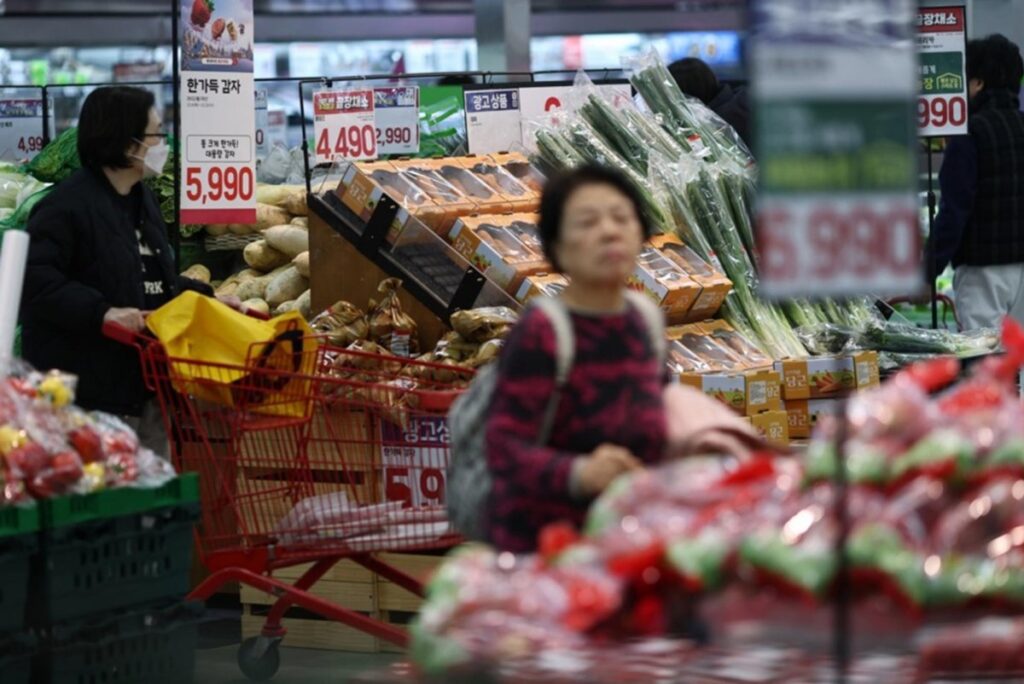
People shop for groceries at a supermarket in Seoul, South Korea, 07 December 2025. Food prices in South Korea have soared 27.1 percent since 2020, according to government data. File. Photo by YONHAP / EPA
Jan. 28 (Asia Today) — The ripple effects of South Korea’s domestic economic slowdown are increasingly being felt in the part-time job market, dealing another blow to young people seeking work.
According to a specialized part-time job portal, the number of part-time job postings nationwide fell 16.8 percent, 11.4 percent and 9.3 percent year over year from 2023 through last year, marking three consecutive years of decline. Part-time jobs traditionally serve as a bridge for young people before entering full-time employment, but even those opportunities are becoming harder to find.
On a monthly basis, the downturn that began in October 2022, when postings fell 12.1 percent, continued uninterrupted for two years and nine months through June last year, when they were down 10.3 percent. Temporary increases from July through September, attributed to consumption coupons funded by a supplementary budget, were short-lived. Postings declined again for three straight months from October through December.
The contraction in part-time work reflects worsening conditions for the self-employed. As domestic demand stagnates, business activity freezes, leading directly to the disappearance of part-time positions. According to the National Tax Service, the number of self-employed business closures nationwide reached 1,007,650 in 2024, surpassing one million for the first time. That figure is more than 110,000 higher than in 2020, when the COVID-19 pandemic first hit, and more than half of closures cited poor business performance.
The labor market impact is especially severe for younger workers. Last year, 717,000 people in their 20s and 30s stopped job hunting altogether and were classified as not seeking employment, the highest number on record. Employment experts say the growing number of young people remaining at home is partly due to the difficulty of finding even part-time work.
Weak domestic demand is not only pushing self-employed operators to the brink but also erasing key income sources for seniors and for young people entering the labor market for the first time. According to the National Data Service, the unemployment rate for those ages 15 to 29 stood at 6.1 percent last year, the highest level in three years and up from the pandemic-affected rate seen in 2022.
While employment challenges span all age groups, youth jobs require particular policy attention. The Bank of Korea estimates that each additional year of unemployment among young people reduces their subsequent real wages by an average of 6.7 percent, lowers the likelihood of securing permanent employment and increases the share of income spent on housing. Delayed entry into the workforce, the bank warns, raises the risk of economic instability later in life.
President Lee Jae-myung recently called the employment crisis facing young people a national emergency and urged extraordinary countermeasures. One response has been expanded hiring by public institutions. The government plans to recruit 28,000 full-time employees and 24,000 youth interns this year, the largest such effort since 2019.
Ultimately, however, durable improvement depends on the private sector creating a large number of quality jobs. Without easing labor market rigidity, opportunities for young people, who are among the most vulnerable workers, will remain limited. Policymakers must keep that reality in mind as they focus on job creation for the next generation.
— Reported by Asia Today; translated by UPI
© Asia Today. Unauthorized reproduction or redistribution prohibited.
Original Korean report: https://www.asiatoday.co.kr/kn/view.php?key=20260127010012697