
The race towards ultra-fast 6G wireless communication is gaining speed at Adelaide University, with the translation of research into high-tech devices.
Researchers at the Adelaide-based Terahertz Engineering Laboratory (TEL) are working with the Australian National Fabrication Facility (ANFF-SA) at Mawson Lakes to develop world-class technology to power the wireless technologies of the future.
Together, the newly-merged Adelaide University teams are designing and building cutting-edge devices that use terahertz waves – a largely untapped part of the electromagnetic spectrum – needed for 6G.
These waves, which sit between microwaves and infrared light, have only recently become accessible due to advances in engineering and manufacturing.
Researchers say the terahertz technology could transform everything from mobile communications to security screening, agriculture, and even astronomy.
“We’re exploring devices that could enable wireless data rates above one terabit per second across several kilometres,” said TEL Group Leader Professor Withawat Withayachumnankul.
“On the sensing front, we’re looking at safe, see-through scanners for security inspection, manufacturing quality control and agricultural monitoring. Terahertz frequencies also hold key molecular signatures that are vital for radio astronomy.”
To turn these concepts into reality, the TEL team relies on ANFF-SA’s world-class micro- and nanofabrication capabilities, valued at approximately $30 million.
While the TEL researchers lead the design and measurement of new devices, they are fabricated in partnership with ANFF-SA specialists who help refine, troubleshoot and manufacture the required components.
“ANFF-SA’s fabrication expertise is critical to the success of our projects,” said Prof Withayachumnankul.
“Their advice helps us to navigate challenges early in the design stage, ensuring our devices can be manufactured reliably and with the precision required.”
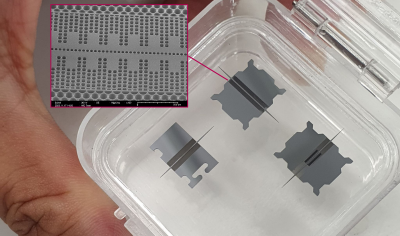
ANFF-SA’s advanced facilities have enabled the creation of highly specialised terahertz antennas and silicon components using techniques such as photolithography and deep reactive ion etching.
These processes allow researchers to produce intricate, micron-scale structures, including through-silicon vias (TSVs), which are essential for high-performance sensing and communication applications.
ANFF-SA Microfabrication Team Lead, Dr Jing-Ho (Mike) Pai, said the collaboration showcases how deep technical expertise and innovative research can drive major technological advancements.
“These silicon components are extremely precise – often perforated with patterns just a few microns wide,” Dr Pai said. “This level of detail is vital for achieving the performance required for next-generation communication systems.”
“Working closely with the research team, we are exploring fabrication options for these complex structures, ensuring reliability at every step. It’s incredibly rewarding to see ambitious concepts come to life.”
The hardware being developed through this partnership is expected to form part of the foundational technology for 6G networks, which will be the first generation of wireless communication to fully integrate terahertz frequencies.
“The work being done today at Adelaide University will help unlock wireless speeds vastly beyond what is possible today. With their vast bandwidth, sensing capabilities and ultra-low latency, terahertz waves are set to become a cornerstone of future telecommunications.”