
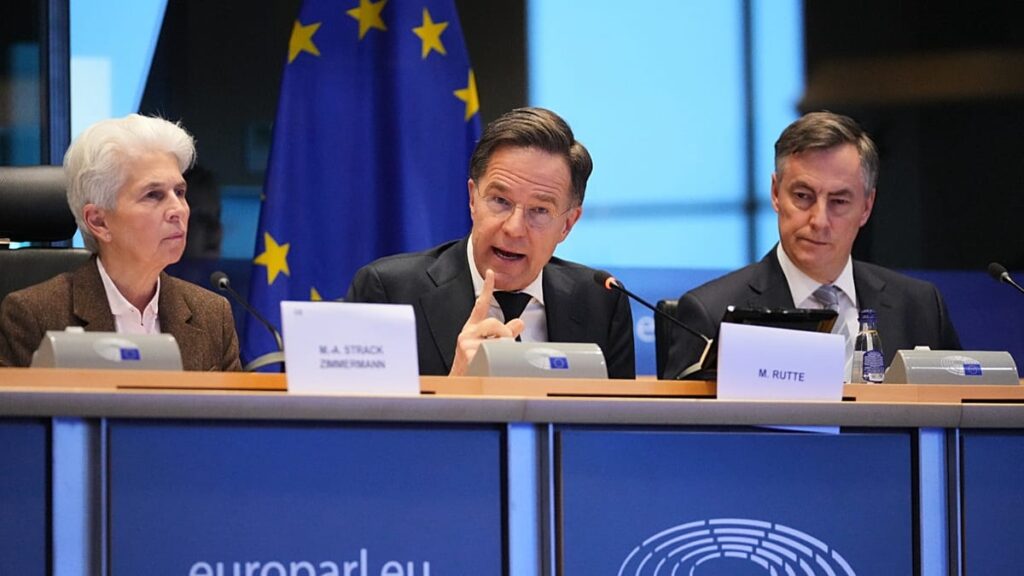
NATO Secretary General Mark Rutte this week faced a serious European backlash for remarks that have been interpreted as disparaging the continent’s defence capabilities, but US contacts have told Euronews his verdict was spot on, warning that Europe must not engage in “dangerous fantasies”.
Rutte clashed with lawmakers at the European Parliament on Tuesday, saying “if anyone thinks … Europe can defend itself without the US, keep on dreaming. You can’t. We can’t. We need each other.”
The comments came at a particularly volatile moment in transatlantic relations. A week earlier, European allies were prophesying the end of NATO if Trump made good on a threat to “take” Greenland, a semi-autonomous Danish territory that falls under NATO’s Article 5 security guarantee.
While not in the EU, Greenland is also covered by the bloc’s mutual assistance clause, which can invoke solidarity or support from other EU countries in the case of attack or coercion.
Europeans were quick to condemn Rutte’s blunt assessment, decrying it as unjustified given recent efforts to step up and bolster the continent’s defence systems. They also pointed to Rutte’s unorthodox way of communicating, saying he would do well to be less deferential to Trump.
“Rutte needs to be better at speaking. Saying half of NATO is useless gives Trump the green light to extort more from NATO allies”, Garvan Walsh, Senior Researcher at the EPP-affiliated Martens Centre think tank told Euronews.
“I think it’s a bit unfair, as the Europeans are ramping up defence budgets and are really moving to be more responsible for the defence of Europe, to say that they will never be able to do it. I believe they will be able do it”, Camille Grand, former NATO Assistant Secretary General for Defence Investment, told Euronews. “Europe has the capabilities, both the technical, the industrial, and the military.”
Rutte was accused of “unnecessary provocation” by a French MEP for Renew Europe, Nathalie Loiseau.
“His priority was to please Trump. How come that Ukraine is able to defend itself without US paying anything now and the coalition of the willing is the only group of countries providing assistance?”, she told Euronews.
Reality check
Yet others say Rutte’s remarks, while harsh, hold more than a grain of truth.
“Objectively, Rutte is right. Europe is going to take a long time to acquire these defences,” a US source with knowledge of US and NATO capabilities told Euronews.
“The question is can Europe deter Russia without the US, and we don’t know the answer to that at the moment,” the Washington-based official said.
“Part of deterrence is psychological, part of it is nuclear and defence capabilities: can Europe instil enough fear in Russia not to invade Moldova, or test Article 5?”
The US is no longer donating weapons to Ukraine in its battle against Russia’s full-scale invasion, now pushing into its fifth grinding year. Trump shifted US policy to only transferring weapons to Ukraine indirectly, mainly through NATO’s Prioritised Ukraine Requirements List, a mechanism that helps NATO allies support Ukrainian defence by purchasing US weapons.
But the official pointed out that the US is still providing targeted intelligence in Ukraine, helping the Ukrainians target Russian oil refineries and gain a vital military advantage.
Meanwhile, Kurt Volker, who served as US ambassador to NATO under George W. Bush and US Special Representative for Ukraine Negotiations under the first Trump administration, told Euronews that while the blistering backlash from Europeans is “regrettable for Rutte”, his assessment is correct.
Rutte warned Europe not to buy into “dangerous fantasies” about being autonomous enough to defend the continent without US support, Volker said in a call from Washington.
“What Rutte said is actually true. Europe depends so much on the intelligence we share, so until they develop their own then they simply can’t defend themselves without the US,” said Volker.
“He probably regrets saying it because of the response, but at least he’s warning Europeans: don’t engage in dangerous fantasies.”