
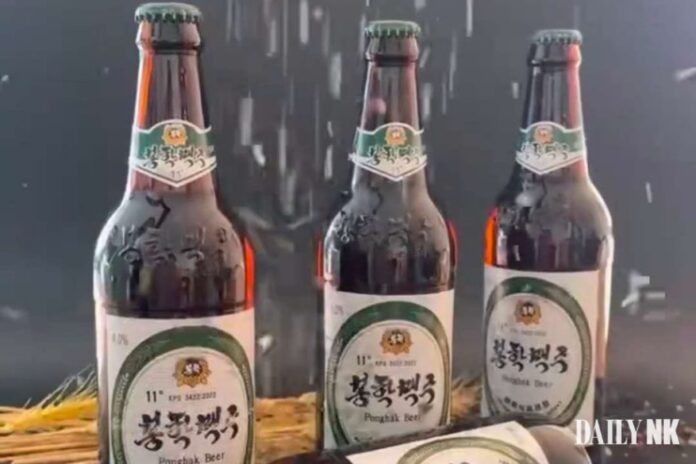
 FILE PHOTO: Ponghak beer sold in Dandong, in China’s Liaoning province. (Daily NK)
As the South Korean government moves to streamline the import of North Korean food products, Chinese traders are looking to take advantage of what may be an excellent opportunity.
“Seoul’s recent decision to streamline the reporting process for importing North Korean products is good news for Chinese businesspeople trading with North Korea. Their hope is that North Korean goods that are duds in China can be exported to South Korea instead,” a source in China told Daily NK recently.
Chinese traders who import beer and other products from North Korea into the Chinese market are happy to hear about procedural changes being mulled by the South Korean government.
These traders think that if these procedural changes encourage South Koreans to import more North Korean products, they will be ideally placed to broker those deals.
To Chinese traders, this sounds like a good way to offset the tougher controls on the distribution of North Korean food products that the Chinese government has imposed since mid-2025.
“Demand for North Korean food products in the Chinese market has been weaker than expected. Coupled with controls by the Chinese government, many Chinese traders have struggled to move product. So naturally they’re delighted to have a chance to re-export North Korean products to South Korea for a profit,” the source said.
North Korean traders cautiously optimistic
North Korean traders who have struggled to find buyers for products in China are also cautiously pleased to hear that Seoul is moving to simplify the process for importing North Korean food products.
Following the proposed changes, traders hope, they will be able to export alcoholic beverages like Taedonggang beer and blueberry wine and wild herbs such as gosari (bracken), gomchwi (ragwort), doraji (bellflower root), and chamnamul (pimpinella) to South Korea by way of China.
“This is still all hypothetical, but many North Korean traders would jump at the chance to import local food products to South Korea, given the foreign currency they would stand to earn,” the source said.
The sticking point is whether the imported products represent a violation of U.N. Security Council sanctions against North Korea. For example, U.N. Security Council Resolution 2397 forbids North Korean food products and agricultural goods from being directly or indirectly supplied, sold, or transferred.
South Korea’s Ministry of Unification discussed a proposed update to the rules governing inspections of imported North Korean food products during the 340th meeting of the council for promoting inter-Korean exchange and cooperation, which was held at the Seoul government complex on Jan. 22.
Since inter-Korean relations are currently severed, the proposed update would relax the documentary and on-site review that are typically required for import registration and instead mandate stricter safety inspections.
“The proposed rules, presuming they take effect, would promote the resumption of inter-Korean commerce on a small scale and help restore the basis for exchange and cooperation,” the unification ministry said.