
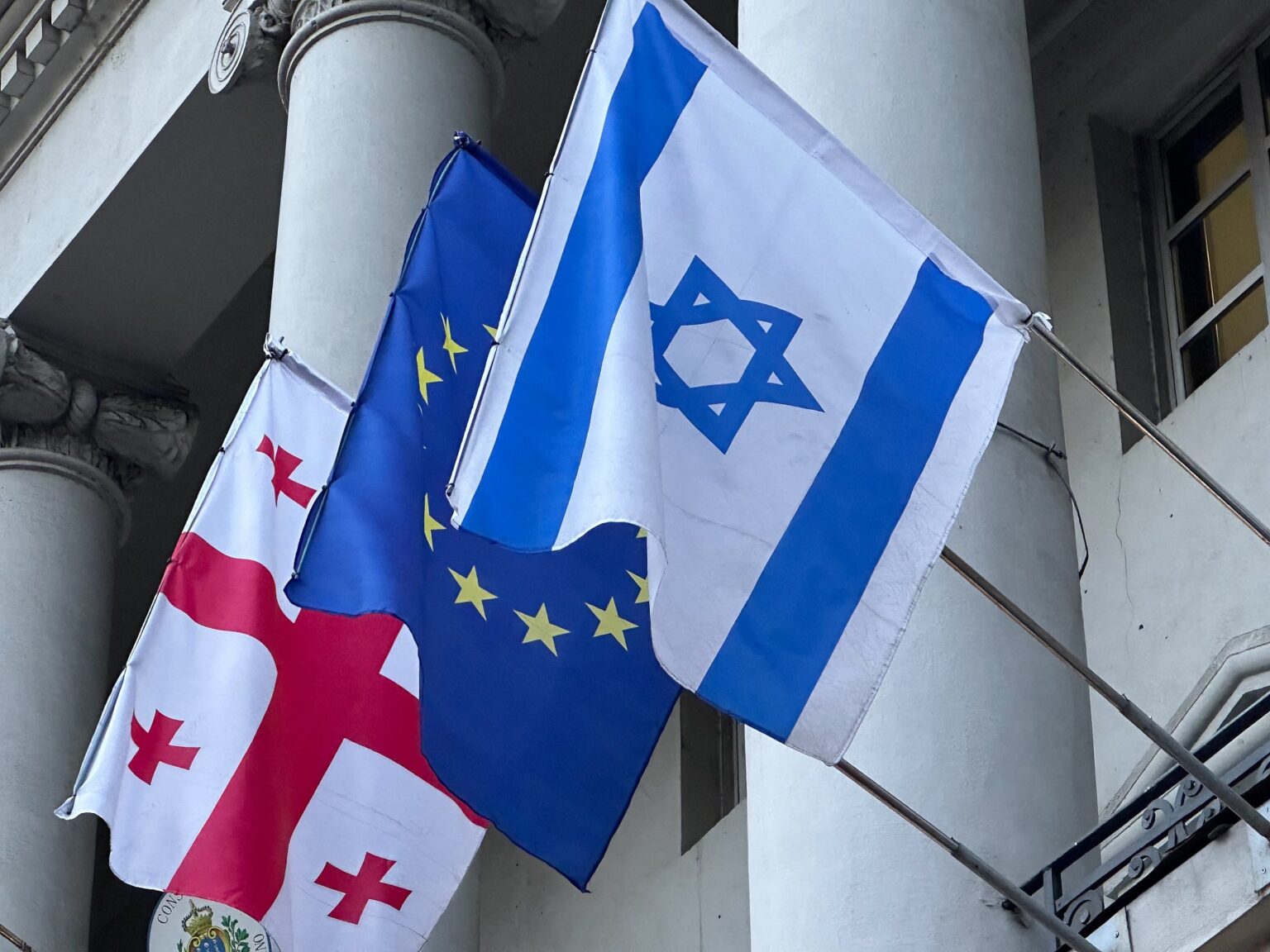
Some 100 politicians, business executives, journalists and other dignitaries will converge on Tbilisi next weekend for a conference celebrating 35 years since Georgia—still a Soviet republic—opened its doors to Israel and the Jewish world.
Israeli Week, which kicks off Dec. 11, will feature a range of activities, beginning with a “Solidarity for Israel” performance by Georgian vocalist Kristi Japaridze, who sings in Hebrew, English, French, Portuguese and other languages.
The delegates will mostly come from Israel—including mayors and Knesset members— but visitors are also expected from Turkey, Tajikistan and Iraqi Kurdistan. The event is being organized by Itsik Moshe, founder of the Israeli House organization and president of the Israel-Georgia Chamber of Business.
“Despite the diplomatic balance dictated by the current environment, Georgia has been considered over the years to be one of the most pro-Israel of all former Soviet republics,” said Moshe, who became the Jewish Agency’s first official representative to the Soviet Union in 1990, a year before the dissolution of the USSR itself.

Itsik Moshe is founder of the Israel-Georgia Chamber of Business and organizer of Israel Week 2025. (Photo by Larry Luxner)
And in 1999, the Israel-Georgia Chamber of Business opened the first official tourism representative office in Tel Aviv of any former Soviet republic.
That marked the beginning of the great wave of aliya to Israel from the former Soviet Union. Between 1990 and 2006, more than 1.6 million Jews from Russia and the other 14 republics comprising the USSR emigrated to Israel.
Moshe’s activism on behalf of Israel and Zionist causes nearly got him killed just over three years ago.
In November 2022, Pakistani agents affiliated with al-Qaeda and sent by Iran’s Revolutionary Guards Quds Force attempted to assassinate Moshe on the street, in front of the Israeli flag over his office. Fortunately, the plot was discovered by local security officials, who arrested several suspects including two Georgian-Iranian dual citizens.

Chanukah menorah donated by the mayor of Qiryat Bialik, Israel, is on display at the Museum of Georgian Jewish History in Tbilisi. (Photo by Larry Luxner)
Moshe, who remains closely guarded, expects a record 320,000 Israelis in Georgia this year (out of a total of five million), making them the fourth-largest source of foreign tourism after Russia, Turkey and Armenia. By 2030, the number of Israelis visiting Georgia will hit half a million, he said.
On Dec. 14, an all-day seminar will begin with a discussion on antisemitism with local university student leaders and Knesset members. Also planned is an exhibit by Israeli painter Hani Bouzaglo at the Wyndham Hotel Tbilisi, as well as an economic conference to promote bilateral investments in tourism, agriculture and technology.
Roughly 1,000 Jews live in Georgia, a mountainous, landlocked country of about 3.7 million inhabitants. Thanks to the prevalence of Israeli tourists, it’s not uncommon to hear Hebrew in the streets, and one of Tbilisi’s top tourist attractions is the Museum of Georgian Jewish History, which chronicles 2,600 years of Jewish life in this country.

Ancient Soviet relic parked on a street in Tbilisi, Georgia. (Photo by Larry Luxner)
Georgia, with its unique alphabet of 33 characters, was one of the first countries to adopt Christianity, shortly after neighboring Armenia. In fact, legend has it that a Georgian Jew called Elias brought the robe of Jesus Christ back home from Jerusalem after the crucifixion, having acquired it from a Roman soldier at Golgotha.
The ‘Israeli Week’ celebration coincides with the beginning of Hanukkah. Unfortunately, it also comes exactly a year since the launch of a wave of nonstop and sometimes violent protests against the government’s decision to halt talks on joining the European Union.
Much of the anger stems from a new law requiring any organization receiving more than 20% of its funding from overseas to register as a “foreign agent.”
Asked about those protests, Moshe had this to say: “There are demonstrations in every democratic country—and Georgia is a democracy.”
Miami native Larry Luxner, a veteran journalist and photographer, has reported from more than 100 countries in Latin America, Africa, Eastern Europe, the Middle East and Asia for a variety of news outlets. He lived for many years in San Juan, Puerto Rico, and the Washington, D.C., area before relocating to Israel in January 2017.