
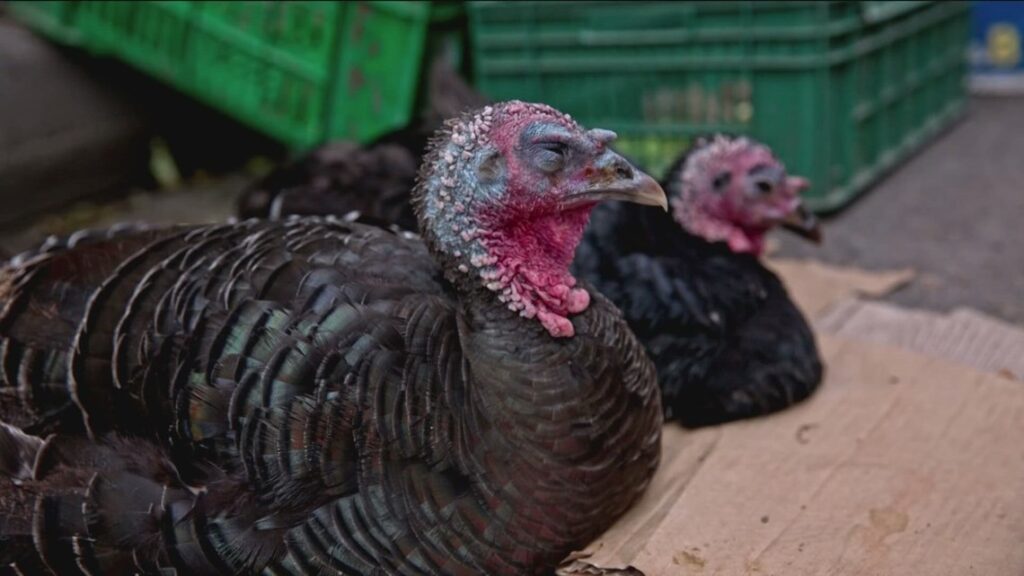
Wild turkeys have taken over Boise’s North End. Officials said to stop feeding them, scare them off, or the flock will grow and more severe measures may follow
BOISE, Idaho — A flock of about 50 wild turkeys has taken over Boise’s North End neighborhood, prompting a town hall meeting Thursday where wildlife officials urged residents to stop feeding the birds and start scaring them off.
“They’re a lot of fun at first, and then maybe they’ve kind of veered into not so fun,” said Jamie Utz, a wildlife diversity biologist with the Idaho Department of Fish and Game.
The turkeys, which Fish and Game believe traveled down from the Boise foothills, have caused traffic jams, damaged cars and lawns, and attacked delivery drivers. A video showing a U.S. Postal Service carrier fending off turkeys with an umbrella, and a resident’s dog chasing the turkeys off.
That carrier, Alyssa Turner, attended Thursday’s meeting.
“I never thought I’d be struggling with this,” Turner said.
Fellow delivery driver Rico Strix described chasing the birds for blocks just to do his job.
“I screamed, I yelled, I chased them. I’m a bird lover. I love birds. However… they did not let me go,” Strix said.
Resident Ronald Walker said the turkeys roost in his trees and have become a financial burden.
“I just paid my arborist $400 and to remove limbs that were about to fall, they had broken setting up in my trees,” Walker said.
Utz warned the flock could grow and behavior could worsen as breeding season approaches.
“Aggression does increase during breeding season. We’re right on the cusp of that. Come February, it’s probably likely that you’re going to see those Tom turkeys especially start to be even more aggressive than they already are,” Utz said.
Fish and Game is not considering relocation, Utz said, because there are few suitable locations and the stress could harm the birds. Instead, officials urged residents to stop making the neighborhood so hospitable.
“You cannot feed them,” Utz said. “These human food sources are no joke, this is why they are here.”
Several residents in the audience said they worry that the neighbors who are constantly feeding them won’t stop.
Utz also recommended “gentle hazing” techniques, including spraying turkeys with water, hanging reflective items from trees, and letting dogs chase them.
“It’s time to fight back,” Utz said.
Some residents said they already tried.
“I just come out with a pan and bang,” Walker said.
If softer measures fail, officials said more extreme options could be considered, including spraying oil on turkey eggs to prevent them from hatching, issuing hunting permits to residents, or hiring a contractor to trap and humanely euthanize the birds. Any meat from trapped turkeys would be donated to local food banks, Utz said.
Such extreme measures would require city approval. Other cities like Pocatello and Lewiston have faced similar problems in the past.
Utz said in Lewiston, where 25 to 50 turkeys took over a neighborhood, officials polled residents and found them split 50/50 on what to do. Live trapping by IDFG over three years only caught 15 birds, and nuisance issues continue.
She said Pocatello had more success. With 100 to 200 turkeys in the city limits, officials formed a task force that included the mayor, Fish and Game, and residents. They passed a feeding ordinance requiring animal feed to be placed at least 5 feet off the ground, with a $100 fine for violations. They also trapped and relocated almost 50 birds and issued limited hunting permits to select residents, resulting in 18 turkeys harvested. The result: fewer turkeys dispersed into smaller, more manageable flocks. The effort has been ongoing for more than 10 years, with officials revisiting these tools whenever the population grows.
Councilman Jimmy Hallyburton, who hosted the meeting, said he plans to convene a follow-up meeting with Fish and Game, mail carriers and other stakeholders to continue the discussion.
“I appreciate both the humor and seriousness,” Hallyburton said.
Most residents who spoke said they hope it doesn’t come to the more extreme measures, but something has to change.
“What we have to do is just mitigate the circumstances that we were given to work with that would make the most sense,” Walker said.