
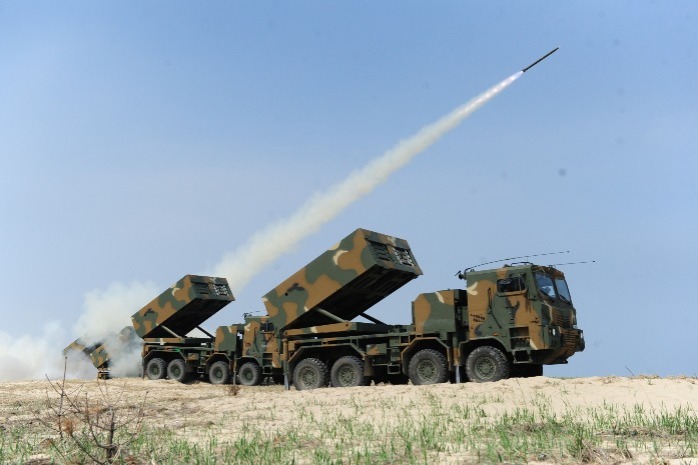
Hanwha Aerospace Co. has won a $2 billion contract to supply long-range rocket artillery systems to Norway after edging out US defense giant Lockheed Martin and European rivals, a move expected to accelerate the South Korean defense firm’s advance into Europe’s defense market.
Norway will acquire 16 launch systems and an undisclosed number of rockets for a total cost of 19 billion Norwegian kroner ($2 billion) for its next-generation Long-Range Precision Fires System, the country’s defense ministry said Thursday.
The contract also includes training, logistics support and infrastructure needed to bring the capability into service.
The win marks a rare head-to-head victory over Lockheed Martin’s HIMARS, long regarded as a NATO standard system, underscoring a shift in European procurement priorities toward faster delivery, longer range and cost efficiency as Russia’s war in Ukraine drags on.
Norway, which shares an Arctic border with Russia, has said the conflict in Ukraine has highlighted the importance of long-range artillery on the modern battlefield.
Hanwha’s Chunmoo system met all operational requirements set by Norway, including the ability to strike targets at ranges of up to 500 kilometers, and offered the fastest delivery schedule among bidders, according to officials.
The Chunmoo system is broadly comparable to Lockheed Martin’s HIMARS, combining a mobile launcher with guided rockets and missiles designed for both precision strikes and saturation fire.
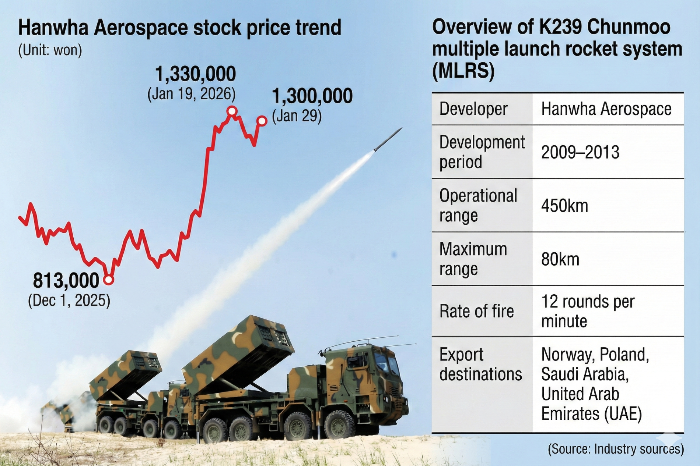
Image by Sookyung Seo, Gemini (Nano Banana)
“Hanwha will deliver launch units and training materials in 2028 and 2029, with missile deliveries following in 2030 and 2031,” Norway’s defense minister, Tore O Sandvik, said in the statement.
Defense industry analysts said the Norway deal is expected to expand Chunmoo’s presence in Europe beyond Eastern Europe and into the Nordic region.
EUROPEAN EXPANSION GAINS MOMENTUM
The tender initially drew bids from Hanwha, Lockheed Martin and a joint venture between Rheinmetall and KNDS Deutschland.
Some members of Norway’s parliament had argued the country should help develop a European missile alternative.
Officials in Oslo, however, said reopening or prolonging the competition would have risked higher costs and delivery delays.
Hanwha entered the European market in force after Poland ordered about 290 Chunmoo launchers in a deal valued at roughly 12 trillion won ($8.3 billion) in 2022.
That was followed by smaller orders from countries near Russia’s western border, including Estonia.
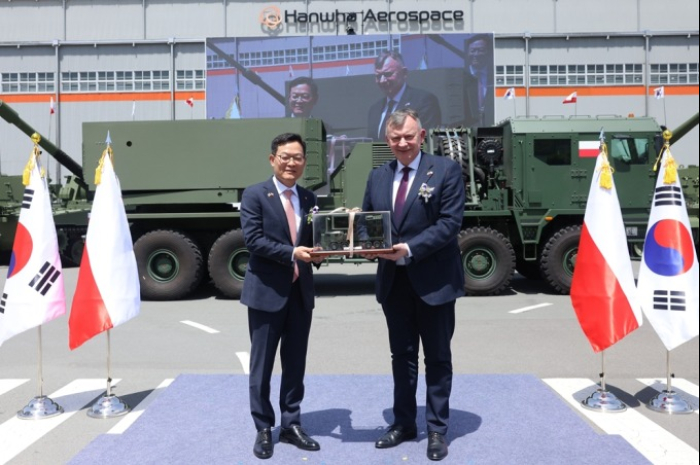
Hanwha Aerospace CEO Son Jae-il (left) and Artur Kuptel, head of the Polish State Armament Agency, sign a $1.6 billion Chunmoo rocket launcher deal on April 25, 2024
Last year, Hanwha signed an agreement with Polish defense company WB Electronics to form a joint venture producing missiles in Poland, including munitions for the Chunmoo system, ensuring manufacturing on European soil.
KOREAN GOVERNMENT BACKING PROVED PIVOTAL
Hanwha’s victory was also shaped by coordinated backing from the South Korean government, according to Korean defense industry officials.
While early expectations favored US or European suppliers due to NATO interoperability, Korean officials carried out sustained diplomatic outreach to emphasize Seoul’s long-term commitment to defense cooperation with Norway, the officials said.
As part of the agreement, Hanwha has proposed industrial cooperation with Norwegian companies that exceeds the value of the core contract, opening the door to follow-on work in maintenance, repair and overhaul, as well as future munitions supply.
Norway already operates South Korean-made K9 self-propelled howitzers and K10 ammunition resupply vehicles, which officials say could create logistical and operational synergies.
Shares of Hanwha Aerospace rose 0.5% Friday to 1,307,000 won, extending gains for a third straight session.