
Recent shifts in US foreign policy are placing the Western Balkans in a difficult position. While internal issues are challenging a delicate peace, outside forces are only exacerbating these issues. It now falls to the European Union to provide a clear path forward amidst such uncertainty.
January 30, 2026 –
Zach Rogers
– 
Articles and Commentary
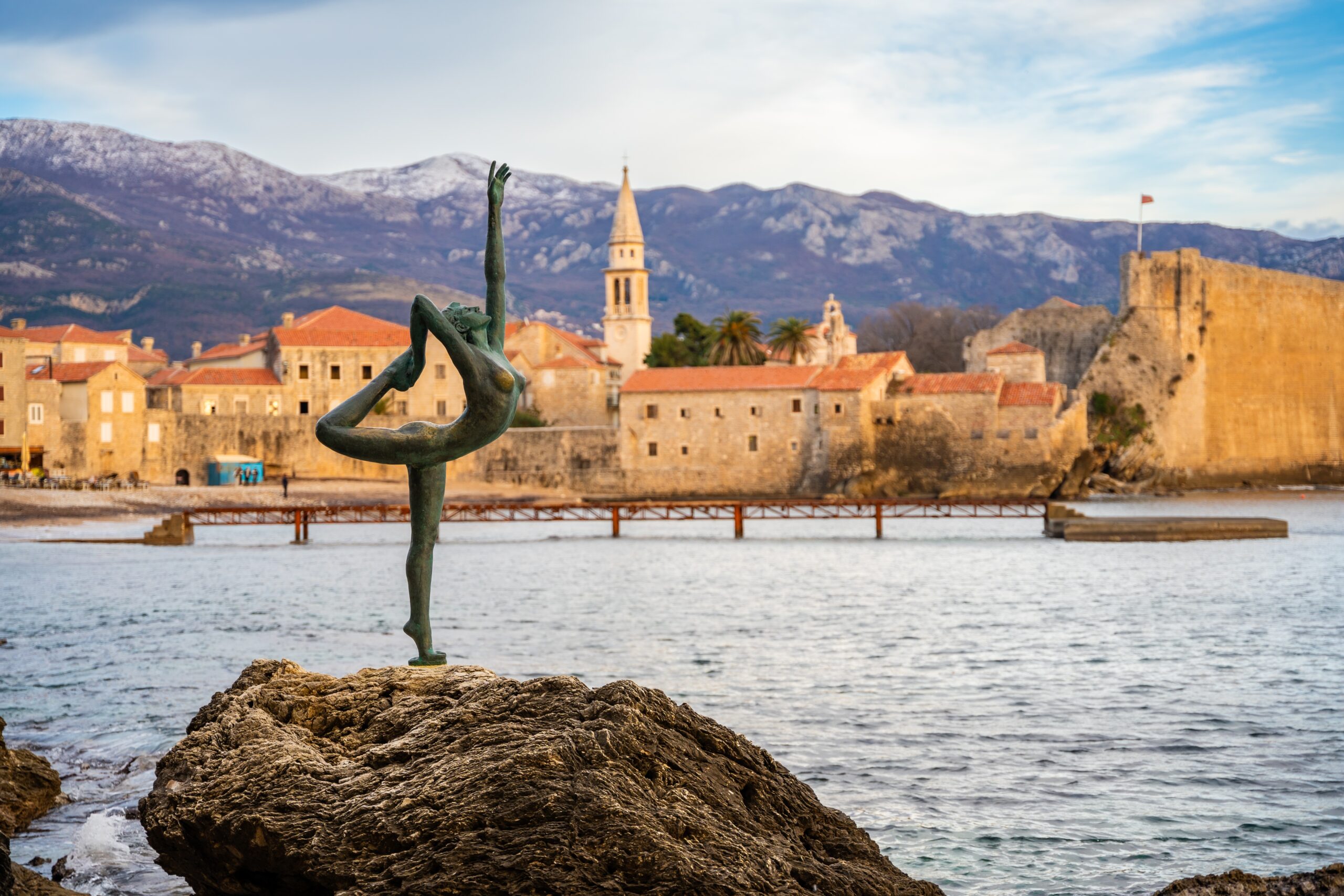
January in Budva, Montenegro. Photo: Tatiana Diuvbanova / Shutterstock
The release of the White House’s National Security Strategy (NSS) on December 5th formally reoriented the US toward the Western Hemisphere, establishing a “Trump Corollary” that treats the Balkans as a secondary concern. This pivot was confirmed through “Operation Absolute Resolve”, which resulted in the apprehension of Nicolás Maduro and his wife. The former leader of Venezuela was later charged with narco-terrorism, pleading not guilty in a New York court. As 2025 came to an end and the year began anew, the citizens of Venezuela woke up in disbelief to the actions of the Pentagon. So too are many Americans enraged by Trump’s blatant disregard for public opinion. With the White House embroiled in conflict in the Caribbean, the rumbling storm clouds of the Western Balkans feel ever closer, with increasing attacks from Russia and successful far-right groups. The ethnic volatility of the region is the wavering flame to the “powder keg” of Europe, while the same lines are being used by world powers who have used the Balkans to their own advantage over the centuries. Sanctions removed on October 29th have emboldened the secessionist politician Milorad Dodik and his associates, leaving the Western Balkans at the mercy of troubling powers in the region. Dodik paid his imprisonment bail but he is still effectively banned from political office for the next six years following a decision taken by Bosnia and Herzegovina’s (BiH) High Court.
Turmoil from the White House
The flagrant disregard for international law displayed by the Trump administration is alarming to say the least, with conflict already ablaze across the globe. Pulling back from Europe’s defence treaties to divert the military to the Caribbean and Caracas signals to a startled world that the United States under Trump will be a pariah like the regimes of Iran and Russia.
The war in Ukraine was essentially an assassination plot against Volodymyr Zelenskyy, and that was conveyed in Putin’s own blitzkrieg race to Kyiv in 2022. There were hopes that a swift decapitation of the Ukrainian government would ensure a capitulated state. However, what Putin found to his own surprise was the fierce and emboldened Ukrainian people with a duty to answer the call of their country’s defence. The actions by Trump’s intelligence forces did essentially the same thing to Maduro in Caracas, but this time, Trump’s luck held out, and he got his man. It should serve as a warning for future diplomacy with the United States, as Donald Trump shares more in common with Vladimir Putin than previously thought. The “civilizational erasure” espoused by Vice President JD Vance at the Munich Security Conference now rings ever so hollow given the United States’ recent invasion of another sovereign nation. It was ultimately more like a threat than a warning to European leaders regarding autonomy. Above all, it is imperative that European leaders collectively agree on the necessary reinforcement of the Western Balkans against hybrid warfare from the Kremlin.
Current framework
- Operation Althea: EUFOR Althea
- Established following the end of the Bosnian War and laid out in a 2004 EU Security Council letter.
- Designates a military force to maintain the ensuing peace of the accords signed in 1995.
- Reauthorized on 31st October 2025 between NATO and the European Union.
- Strategic Compass
- Established on 21st March 2022 following the invasion of Ukraine.
- A security plan for strengthening Europe’s current defence framework centred around cooperation among NATO partners by 2030.
Going forward, EUFOR Althea needs to be reinforced from every angle through the allocation of defence funds and the sharing of AI military technologies to combat Russian hybrid warfare. Also, by increasing attention in BiH to Milorad Dodik’s arrest and sentencing, the power of the truth may hold out against waves of disinformation. Given the pro-Russian sentiment expressed by the Social Democrat Party (SNSD) in Republika Srpska, the Western Balkans is becoming a challenge for European defence leaders to act in accordance with enforcing the framework of EUFOR Althea. Dodik is sure to be behind the scenes of Siniša Karan’s leadership bid in Republika Srpska, and in turn, working with Alexandar Vučić as part of his “stabilocracy”. A decisive element in withstanding threats from Putin requires cooperation among the Balkan states. However, until they can meet NATO standards, the prospects for this remain uncertain given populist politicians in the region who encourage tensions along cultural lines.
Time to take the stage
The haste of the Trump administration, whether through the lens of peace in Ukraine or his recent invasion of Venezuela, should make it quite apparent now that the NSS has taken on a new theme of conquest. As Europe has somewhat followed behind the foreign policy giant that is the United States, there is no question that the continent must rise to the challenge of solidifying its own borders before further conflict can ensue. The forced removal of a foreign government by the United States is a blot on its status as a world leader. It also entirely diminishes the fact that Trump has been suing for peace in Ukraine when he ultimately had every intention of invading Venezuela.
As Putin misunderstood the general feeling of Ukraine following the Maidan Revolution in 2014, his lack of judgment nonetheless produced an ill-planned invasion of Ukraine that maintains the strategy of turning young men into cannon fodder. In the same vein, Trump’s “charge” in Venezuela is certain to produce irreparable consequences, not only for the people of South America, but also in the Balkans and Ukraine. This sets a precedent that world leaders can simply remove a government that they disagree with, especially states with valuable resources. With an already fragile accord set for the Western Balkans following the Bosnian War, a weakened international legal system places the region in even more at risk than previously thought.
Spreading the rhetoric of anti-western ideals, the Kremlin continues its war of irredentism in the Balkans, now with artificial intelligence bots and nuclear arsenals rather than the power of “atrocity journalism” and propaganda posters seen during the Balkan Wars (1912-13). Drawing heavily on the fear created by the Bosnian War, Putin hopes to create a sense of hopelessness that will force public opinion into the geoeconomic trap that he has created alongside Trump. Solidifying a pan-Slavic and Orthodox hegemony will apply pressure on the nerve of secularity in Bosnia and Herzegovina. By emboldening regional leaders who would welcome Russian intervention in the Balkans, Putin views his hybrid war as a means to conquer larger tracts of land and exert influence on the Balkan Peninsula. Milorad Dodik is a prime example of this weaponization. Donald Trump removed sanctions from Dodik to increase pressure on Europe to grant Russia its “reset”, and in turn, Dodik and his vessel of influence, Siniša Karan, are using this “freedom” to promote their voices of hatred.
Leading actors
Poland has been consistently at the forefront of Russia’s continuous attempts to undermine stability in Eastern Europe. Ranking as the top contributor to the NATO mission in Kosovo (KFOR) and a staunch advocate of including the Balkans in the EU Cybersecurity Reserve, Poland is serious about European security. Having experienced multiple airspace incursions and territory violations by Russia, Poland has a crystal-clear picture of the vital importance of the containment of Russian aggression. If the Balkans were to be left out of European security infrastructure, it would only serve to exacerbate the current tug-of-war between Washington and the Kremlin.
The United Kingdom has had a turbulent year in terms of domestic politics, and as a result of its turbulence, the parliament has cut its previous pledge to the Balkans from 40 million to 24 million pounds. The funding is used specifically to counter disinformation that undermines democratic integrity in the Balkans. With Western Europe’s financial hesitance visible, Türkiye has optimistically taken on its own regional responsibility, launching the Balkan Peace Platform in July 2025. This has been done in hopes of creating “Balkan solutions” rather than succumbing to Russian or American vassalhood. The stability of American hegemonic security has created a power vacuum in the Balkans that democratic leaders must fill before it is exploited by opportunistic states abroad. If Europe can answer the challenge and punish international law breakers such as Putin and Trump, the imminent danger can be converted into a solution in the Western Balkans, answering the infrastructural inefficiencies of the Dayton Accords.
As the United States pivots hard to its “civilizational realism”, the European Union must fully accept the responsibility of UN Resolution 2795, effectively renewing the security guarantees of EUFOR Althea, and solidifying the European Union as the guarantor of Balkan safety.
Zach Rogers is a researcher and analyst specializing in the Applied History and Geopolitics of Eastern Europe and the Balkans. He holds an MA in European and Mediterranean Studies from New York University. Zach is a contributing writer at the Oxford University-based political journal, Europinion.
