
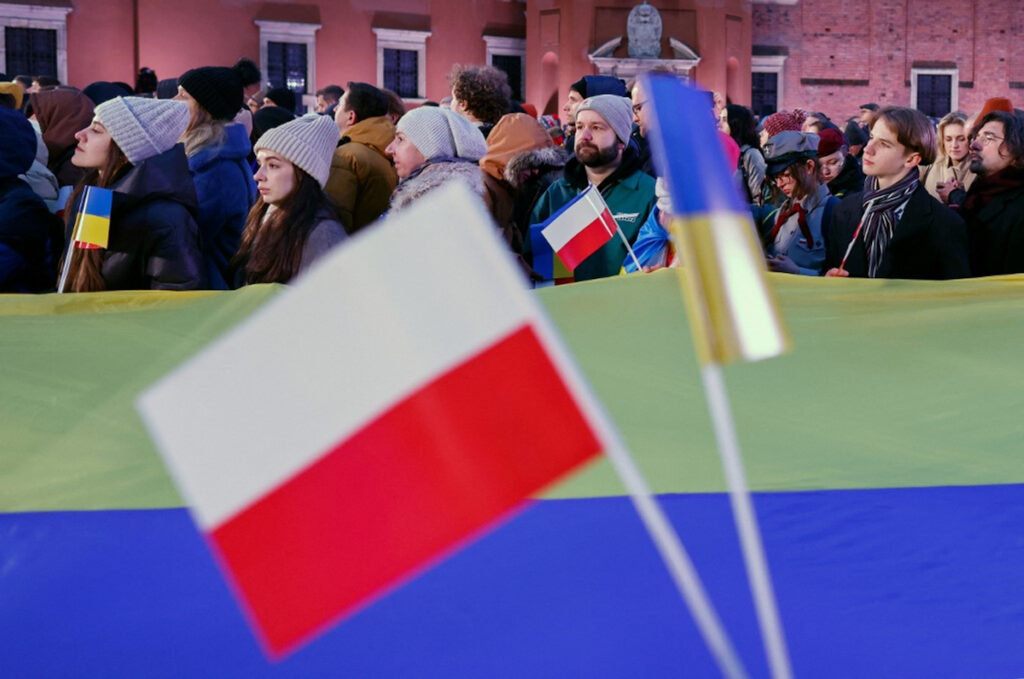
In the shadow of a full-scale war that has now lasted nearly four years, Polish-Ukrainian relations are entering a new stage. After the unprecedented wave of empathy in 2022, public sentiment in Poland has clearly deteriorated and is gradually shifting toward a more calculative approach.
This does not necessarily mean something negative – and the situation is not as bad as it might seem. Many people are concerned about rising anti-Ukrainian sentiments. It is a fact that police statistics show an increase in nationality-based crimes, and the internet is full of hostile comments. The latest research, however, indicates that while problems do exist, reality is less alarming than the online bubble suggests.
Follow our coverage of the war on the @Kyivpost_official.
Contrary to popular opinion, studies conducted on behalf of the Mieroszewski Centre (Ukrainian and Polish editions) show that moderate and neutral attitudes predominate among Poles, rather than extreme ones. Fifty-four percent of respondents declare a positive or neutral attitude (down from 63 percent in 2022, according to Mieroszewski Centre data). Today, society primarily expects a clear definition of Poland’s goals and benefits in the relationship – including symbolic ones, such as addressing difficult historical issues, notably the Volhynia Massacre. At the same time, we are observing a real deterioration in attitudes toward Ukrainians. The reasons are numerous and cannot be reduced solely to Russian disinformation (although it does play a role, more often exploiting existing tensions than creating them). Anti-Ukrainian emotions are being fueled by some opinion leaders and politicians of the far right, mainly the far-right Confederation of the Polish Crown party. This messaging resonates particularly with younger audiences and is heavily amplified on social media.
Other Topics of Interest
Allies Secured: US Senate Advances Massive Funding Deal, Defies Ukraine Critics
By protecting aid for Ukraine and the Baltics, a bipartisan majority rejects Trump administration cuts while setting a deadline for a separate, volatile debate on DHS enforcement.
A serious mistake was the lack of institutional action by the state. Pro-Ukrainian politicians – who make up the majority – failed to impose their own positive narrative. The social momentum of 2022 was not used constructively. This is partly due to the fact that the mass presence of Ukrainians is a relatively new phenomenon for a society that until recently was largely mono-ethnic. There was no clear policy on whether Poland seeks integration, assimilation, or merely to serve as a temporary refuge. Finally, there were no large-scale, effective integration programs or consistent communication with society. It is worth remembering that conflicts are a natural element of any social change.
Migration has become a major political issue in Poland, as it has in Western Europe. Because Poland does not host large groups of refugees from Africa or the Middle East, Ukrainians have assumed the role of the “other” in this debate. The far right has been effective in imposing its language on the public discourse in this area.
Poles are not hostile
The shift in sentiment means more calculation and fewer emotions. The overwhelming majority of Poles still display pro-Ukrainian attitudes, while expecting a more realistic approach. Today’s calculation concerns primarily historical, economic, and technological issues – not demands that are unrealistic in wartime.
There is growing public expectation that the Polish state clearly define the goals of the relationship and give it a more institutional character. The intensity of contacts also means that Poles and Ukrainians are getting to know each other better – 69 percent of Poles personally know at least one Ukrainian, according to the Mieroszewski Centre. Ukraine is no longer seen solely as a victim, but also increasingly as a competitor, which paradoxically reflects its being treated as a subject rather than merely an object.
History remains a key test for the relationship. The Volhynia Massacre during World War II still evokes strong emotions and is often used politically, while the Polish-Ukrainian fighting over Lviv (1918–1919) is no longer a source of tension – those events have been commemorated and the wounds have healed. The ongoing exhumations of victims in Volhynia are an important test of Ukrainian intentions for Poles.
A clear sign of enduring solidarity was the fundraiser “Warmth from Poland for Kyiv,” through which tens of thousands of Poles donated over $2.4 million for electricity generators for Kyiv’s residents. Significant support also came from the Polish state, the City of Warsaw, and the Polish Catholic Church. Similar fundraisers were later organized in other countries, modeled on the Polish initiative.
Negative emotions in 2025 were also stirred by the election of Poland’s new president, Karol Nawrocki. Despite the use of the “Ukrainian card” during the campaign, he was unfairly labeled an anti-Ukrainian politician. The atmosphere improved after his meeting with Ukrainian President Volodymyr Zelensky.
Anti-Ukrainian narratives still dominate on the right side of the political spectrum, but an increasing number of opinion leaders and politicians recognize the problem and are beginning to actively counter it. It is also worth remembering that relations are not just about public moods – there is close cooperation in the security sphere, and Poland is the second-largest supplier of goods to Ukraine after China.
Polish-Ukrainian relations are not as good as they once were, but the point of reference matters. Compared with the period before the full-scale invasion, they do not look bad at all, However, many problems remain and much work lies ahead. Their current state is certainly better than one might assume based on social media, as confirmed by Mieroszewski Centre research.
Moving forward, we can expect a more transactional Polish policy alongside continued unequivocal support for Ukraine. In relations between neighbors, crises always arise and stem from proximity. There will certainly be many more, including issues related to economic matters, but in moments of trial, so far both countries are passing the test.
Bilateral relations are a process – they will have better and worse moments, and the current cooling may paradoxically benefit both sides by encouraging a more rational outlook and clearer goal-setting. An excess of emotion, even positive, rarely serves relations well.
The views expressed in this opinion article are the author’s and not necessarily those of Kyiv Post.