
Seoul mounts diplomatic blitz as firms brace for fallout, experts see long road ahead
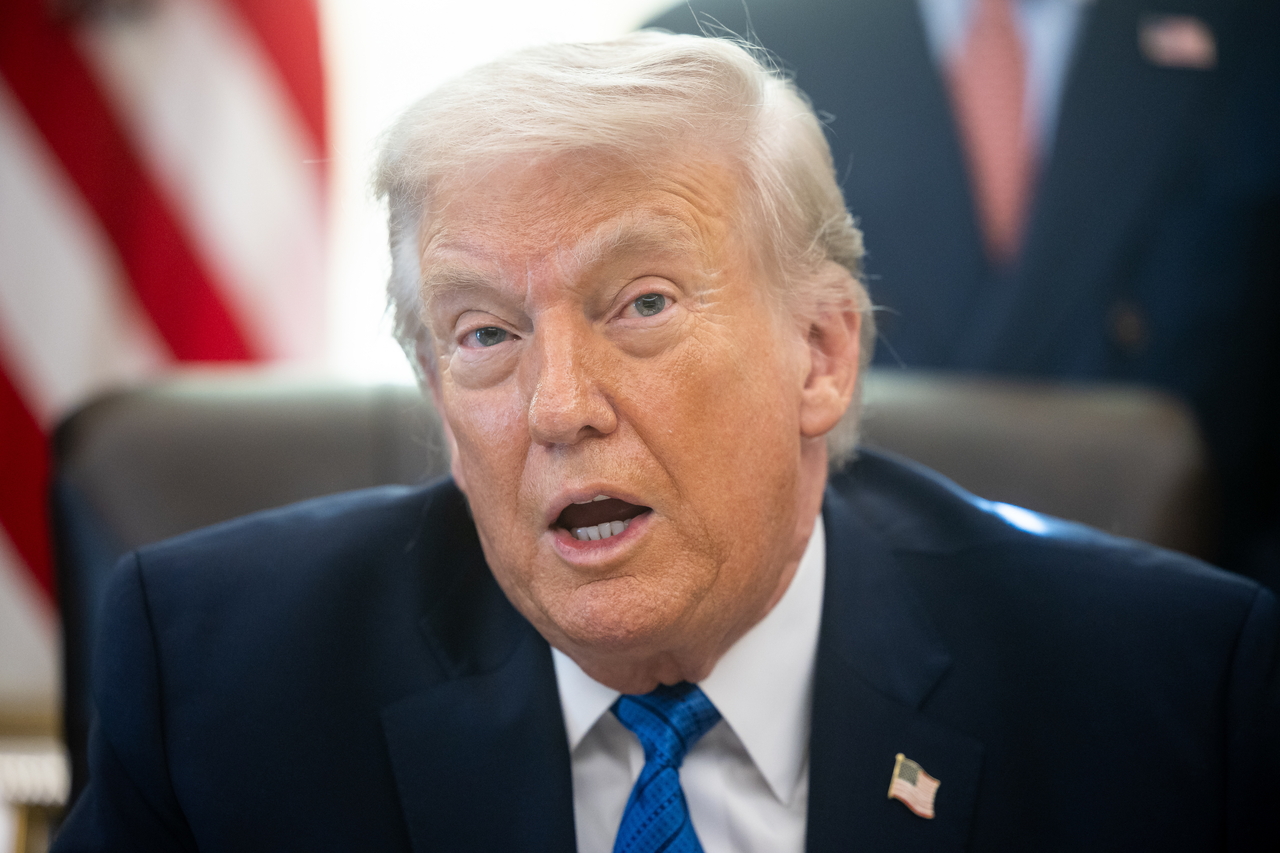 US President Donald Trump (EPA-Yonhap)
 In a move to contain trade frictions with the US, South Korea has dispatched Trade Minister Yeo Han-koo to Washington for a series of meetings following US President Donald Trump’s tariff warning, according to industry sources on Sunday.
Yeo landed in Washington early Friday and immediately began a tight schedule. By Saturday, he had met with Trump administration officials, lawmakers and key business figures. More meetings had been set for Sunday, underscoring Seoul’s diplomatic outreach.
The trip comes just days after Industry Minister Kim Jung-kwan wrapped up a separate visit to Washington, where he met with US Commerce Secretary Howard Lutnick and Energy Secretary Chris Wright. Kim’s discussions stayed largely within Cabinet-level channels. Yeo, by contrast, is meeting a broader cross-section of US political and industry figures. The back-to-back visits reflect Seoul’s effort to manage growing trade friction with the US.
The friction stems from remarks made by Trump on Jan. 26, when he threatened to raise tariffs on Korean automobiles, lumber and pharmaceuticals from 15 percent to 25 percent, citing delays in the legislative ratification of the Korea-US investment and trade agreement.
Korean officials have said the bill remains pending at the National Assembly due to domestic political and legislative processes, and that Seoul has been explaining these circumstances to US counterparts.
Before departing from Incheon on Thursday, Yeo said he would “assess the positions of the US government and Congress and seek a rational solution through comprehensive consultations.” He is expected to stay in Washington through Thursday, with a meeting scheduled with US Trade Representative Jamieson Greer to discuss the tariffs and other bilateral trade issues.
Kim, speaking to reporters after his return to Seoul on Saturday, acknowledged that talks in Washington had been frank. “The special bill has remained stalled in the National Assembly and the US side clearly expressed its frustration,” he said. “While no definitive conclusion was reached, we fully explained Korea’s position.” Several misunderstandings were resolved during the trip, he added.
Kim spent two days in discussions with Lutnick at the US Commerce Department, but left without a concrete outcome.
Some analysts in Seoul say Trump’s tariff pressure may also be linked to a pending US Supreme Court ruling on the legality of reciprocal tariffs.
For Korean companies, the uncertainty is already tangible. “Even last year, when tariffs fluctuated, many companies had to reconsider their production strategies,” said an industry source who requested anonymity. “If this volatility continues, it will delay annual business planning.”
Foreign Minister Cho Hyun is due in Washington this week for a ministerial meeting on critical minerals hosted by the US State Department. Though the event is multilateral, officials are working to arrange a brief pull-aside with US Secretary of State Marco Rubio. If it happens, Cho is expected to reaffirm Seoul’s position and point to steps taken since the Joint Fact Sheet was signed last November.
Local trade experts cautioned that Trump’s use of tariffs may no longer be episodic, but part of a lasting shift in global trade policy.
“Tariffs used to be temporary tools,” said Chang Sang-sik, head of international trade research at Korea International Trade Association. “Now they’re being used more persistently.”
“We can’t afford to treat this as a passing issue anymore,” said an official at the Ministry of Trade, Industry and Energy. “Pressure like this could continue under the Trump administration.”
By Jie Ye-eun (yeeun@heraldcorp.com)