
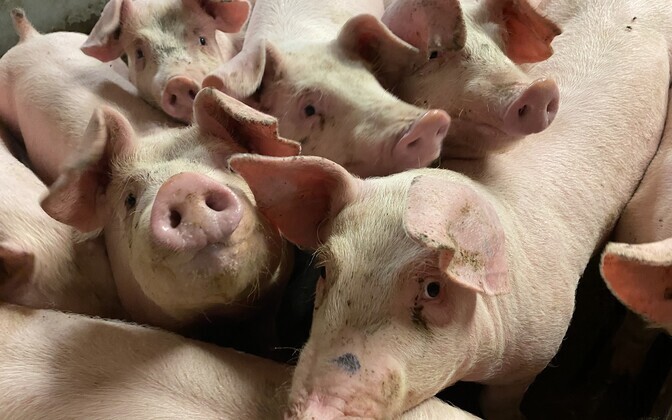
The Estonian state plans to create smaller pig farms in the future to protect farmers against African swine fever (ASF) outbreaks, but the continued spread of the disease in Europe and falling pork prices are making investments difficult.
Tens of thousands of pigs were culled last year in Estonia to stop the spread of ASF, and the government plans to create smaller farms with up to 2,500 sows in future. Experience shows that larger farms are more susceptible to the disease.
The Ministry of Agriculture said six smaller farms will be needed over the next five to ten years, with a total estimated cost of around €75 million.
“We are decentralizing primary production and ensuring investment support for that. This year, the state’s investment contribution is €13 million, which will go toward the establishment of the first two primary production farms,” said Minister of Regional and Agricultural Affairs Hendrik Johannes Terras (Eesti 200).
However, the rest of the money depends on the European Union.
While the virus has subsided in Estonia, it has reappeared in Spain, Europe’s largest meat producer. In January, more than 20,000 pigs were also infected on a farm in Latvia.
 Hendrik Johannes Terras. Source: Ken Mürk/ERR
The Estonian Chamber of Agriculture and Commerce supports the creation of smaller pig farms, but due to the continued spread of the disease, entrepreneurs’ confidence is low and establishing new farms will not be a quick process.
“Entrepreneurs inevitably supplement their own capital and the expected state support with bank loans and other borrowed capital. This poses a risk from the perspective of banks and financiers as well,” said the chambers’ head of agricultural policy, Ants-Hannes Viira.
Over 10,000 pigs were culled at Atria, Estonia’s second-largest pig farmer, last year. Although the herd has been restored, the company’s CEO, Meelis Laande, said Estonia’s ability to feed itself with domestic pork is weakened.
“Self-sufficiency is definitely an issue. Before the summer ASF outbreak, it was around 70+ percent; today the forecast puts it well below 50, possibly even under 40,” said Laande.
He added that pig farmers are already facing the next problem, making new investments difficult.
“We all operate under European pork prices, and that price has now started to fall sharply, which does not mean that Estonian pork is as cheap as the market price. In fact, the cost price is significantly higher. This has now dealt a new serious blow to the sector,” Laande said.
—
Follow ERR News on Facebook and Twitter and never miss an update!