
Review by Shatadru Chattopadhayay
Book Details
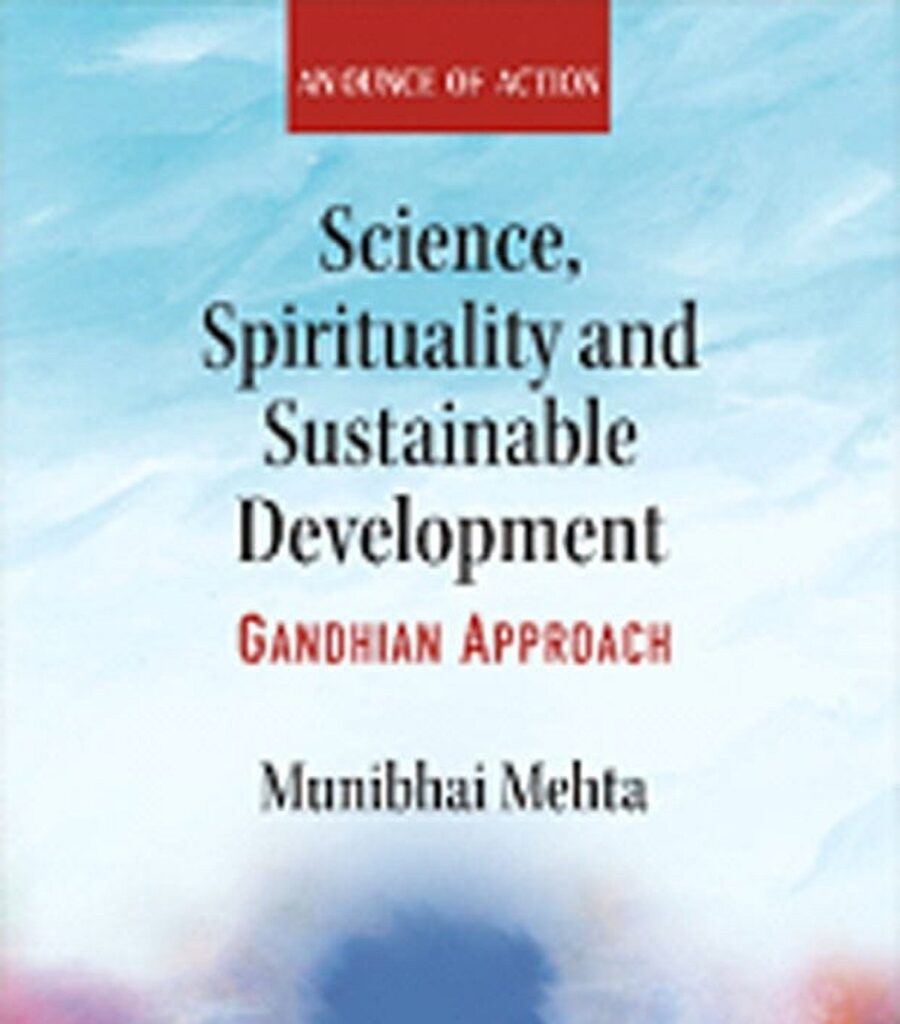
Title: An Ounce of Action: Science, Spirituality and Sustainable Development | Gandhian Approach
Author: Munibhai Mehta
Publisher: Rawat Publications
Price: INR 1295, Pages: 264
For the last 400 years, science and spirituality have remained completely separated. René Descartes (1596–1650) and others helped shape the idea that the world is made up of two parts: mind and matter. Francis Bacon, on the other hand, argued that knowledge should be utilised to control nature. This way of thinking helped the industry grow over time by viewing woods, rivers, soil, and minerals mostly as resources to be extracted and turned into money. Spirituality, on the other hand, engaged with dealing with purpose, morals, and the inner life.
The gap widened in places like India, which was colonised by Western nations. In traditions based on the Vedas and Upanishads, “outer” knowledge and “inner” wisdom were not seen as separate. Colonial education, on the other hand, saw local ways of knowing as old-fashioned and propagated that Western science was the only way to move forward. Agriculture did the same thing. Mixed cropping, seed saving, organic manures, and community-managed commons were pushed aside as “unscientific”, while monocultures and cash crops for export were promoted as modern.
Indian agricultural science continues to debate this question even today: should we rely on high-input “modern” methods that chase yield or return to older practices that build soil, save water, and work with local seasons? This is where Dr Munibhai Mehta places his book, “An Ounce of Action: Science, Spiritual Ecology and Sustainable Development”. His training and experiences make him someone who can speak to both sides: he is trained as a chemical engineer at IIT Bombay and shaped by Gandhian philosophy and ancient Indian scriptures such as the Vedas. He starts by suggesting that the “Green Revolution” has degenerated into the “Greed Revolution.”.
Walking the talk: The
Science Ashram
What makes Dr Mehta’s efforts more convincing is that he does not leave this bridge between science and spirituality as an elegant idea on the page. He is living it. The book repeatedly returns to the “Science Ashram” in Vadodara that he set up, not as a metaphor but as a working model. In an Indian setting, an ashram is a place where learning is tied to discipline and where knowledge is meant to shape conduct. By adding “science” to that word, Dr Mehta is making a quiet but pointed claim: technical skill, on its own, is not enough. It must be trained alongside restraint, attention, and ethical clarity.
The 20:20 promise: Cleaner skies, living soils, sea-farming futures
Dr Mehta gives his eco-agriculture approach a cricket-friendly name: the 20:20 Mehta Model. The promise is clear and useful, not flowery: decrease costs by 20% and boost productivity by 20%, suggesting a balanced approach like Buddha’s middle path. This is not a slogan for farmers but a survival guide against high fertiliser bills, uncertain rainfall, and risky markets. The solution rejects heavier chemicals or large machines and instead advocates age-old practices now validated by even Western science, such as decomposition, soil life, root systems, and water cycles, which are more relevant for small farmers. He refers to this as “spiritual ecology,” but in my opinion, it’s simply agronomy with a conscience.
That ethic is clearest in his answer to crop-residue burning. Rather than framing farmers as offenders to be punished, he treats them as partners who need workable alternatives. He describes a microbial treatment that helps break down paddy straw in situ, returning carbon and nutrients and lowering the incentive to burn. In Punjab, where this treatment has been piloted in some villages, he reports an 81 to 95 per cent reduction in stubble burning. The appeal is simple: farmers need quick field turnover, while cities need breathable winter air.
The book’s boldest leap is “Blue Revolution”: sea farming with salt-tolerant crops such as Salicornia bigelovii. Where conventional agronomy sees salinity as a barrier, Dr Mehta sees a frontier that could yield edible oil and a protein-rich meal using seawater in coastal deserts, easing pressure on freshwater resources. He had set up working models in coastal areas but on a small scale. Yet this is also where the argument needs firmer ground with firmer numbers on yields, costs, markets and environmental safeguards.
The river as a moral test
The book becomes most compelling when Mehta turns from crops to rivers, especially in his discussion of the Vishwamitri River in Vadodara. Here, the clash between two kinds of development becomes visible. One model, common across Indian cities, treats a river as a drainage channel to be tamed and beautified: concrete embankments, straightened flows, and real estate value added along the edges. It looks modern. It photographs well. It often fails ecologically. Dr Mehta argues for another approach: river revival through living buffers, which he calls bio-shields. Plant native vegetation along banks. Restore riparian zones. Reduce chemical runoff by creating farming corridors that keep toxins out of water. Preserve habitats rather than erasing them.
This is where “spiritual ecology” makes practical sense even to a sceptic. If you treat the river as a living neighbour, you do not pour concrete down its throat and call it renewal. If you treat it as a system, you understand that flood control is not only about walls. It is about catchments, wetlands, vegetation, and space for water to move. Dr Mehta’s river argument is also a quiet critique of a certain kind of Indian aspiration: the desire to build like rich countries did in the 20th century, even though we are now living with the consequences of those choices.
The spiritual dimensions: A
Gandhian approach
Dr Mehta, a renowned scientist himself, refers to the Bhagavad Gita and to the ongoing inner dilemma of scientists in Chapter 6: “Gandhiji and Yoga of Detachment for Scientists”. He subtly critiques how, in modern times, science is driven by commercial interests. He argues that the root cause of our ecological crisis is the scientist’s attachment to the fruits of their invention—patents, profits, and prestige. This attachment blinds them to long-term consequences (externalities). Instead, the author prescribes “Anasakti Yoga” (the Yoga of Detachment) as a professional ethic. A detached scientist works for “Sarvodaya” (the welfare of all), not for the market. His call for detachment is not a call to abandon ambition. It is a call to place ambition inside responsibility so that knowledge serves life, not only markets. Dr Mehta’s argument is the strongest when he turns spirituality into this kind of alertness, a habit of checking the full cost early, before the steep bill arrives in the form of smog, sickness, and water shortages.
What the book leaves underexplored
First, the book is slightly optimistic about adoption. In my own work, I have seen many ecological solutions fail not because farmers are ignorant, but because the system punishes transition. Fertiliser subsidies, short-term credit, skewed procurement, and risk-averse markets often push farmers back towards chemical dependency even when they want to change. Dr Mehta recognises this, yet the political economy of agriculture needs more space than the book gives it.
Second, I was left wanting a clearer route from promising pilots to wide adoption. What do these models cost per acre or per farmer, and who should invest when the gains are split between private benefits (yields, lower costs) and public goods (cleaner air, healthier soils, lower climate risk)? Without that economic and institutional roadmap, the solutions can feel like strong ideas still waiting for a delivery system.
Third, it requires great effort from the reader to connect the dots in the book. It reads like a collection of lifework: essays, speeches, ideas, and projects. This makes it rich in range but uneven in flow. The jump from ancient texts to microbial biochemistry can be abrupt for a general reader.
Why it matters now, and who should read it
Despite its unevenness, An Ounce of Action matters because it refuses the most common lie of our age: that the ecological crisis is only a technical problem. India is full of technical plans. Many are excellent. What we lack is the moral stamina to carry them through, the cultural patience to value slow repair, and the humility to stop treating living systems as passive tools. Dr Mehta offers a language for that missing layer. He also offers a method: build institutions like the Science Ashram where learning is linked to ethics, where science is tested in the field, and where spirituality is judged by what it protects.
This book should be read by scientists who want their work to serve life rather than markets alone. It should be read by policymakers who believe a river can be “developed” without being harmed. It should be read by spiritual seekers who want their faith to touch the ground, literally, through soil and water. And it should be read by anyone who cares about the purpose of a holistic life and the path to a sustainable future.
The book’s title is apt. We do not need perfect answers before we act. We need an ounce of action that is wise enough to unlearn and humble enough to keep learning.
(Shatadru Chattopadhayay is a political economist and Managing Director of Solidaridad Asia).