
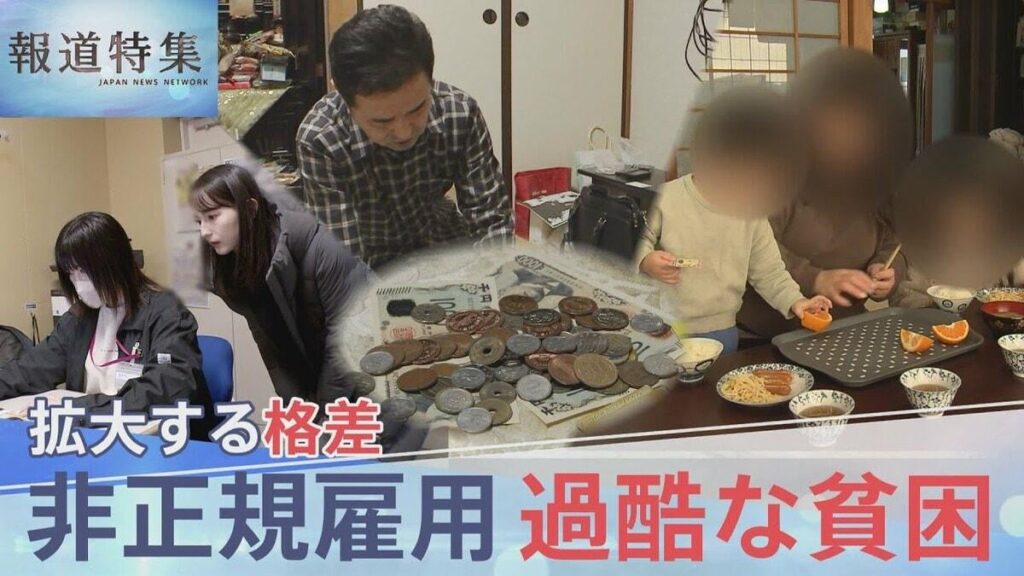
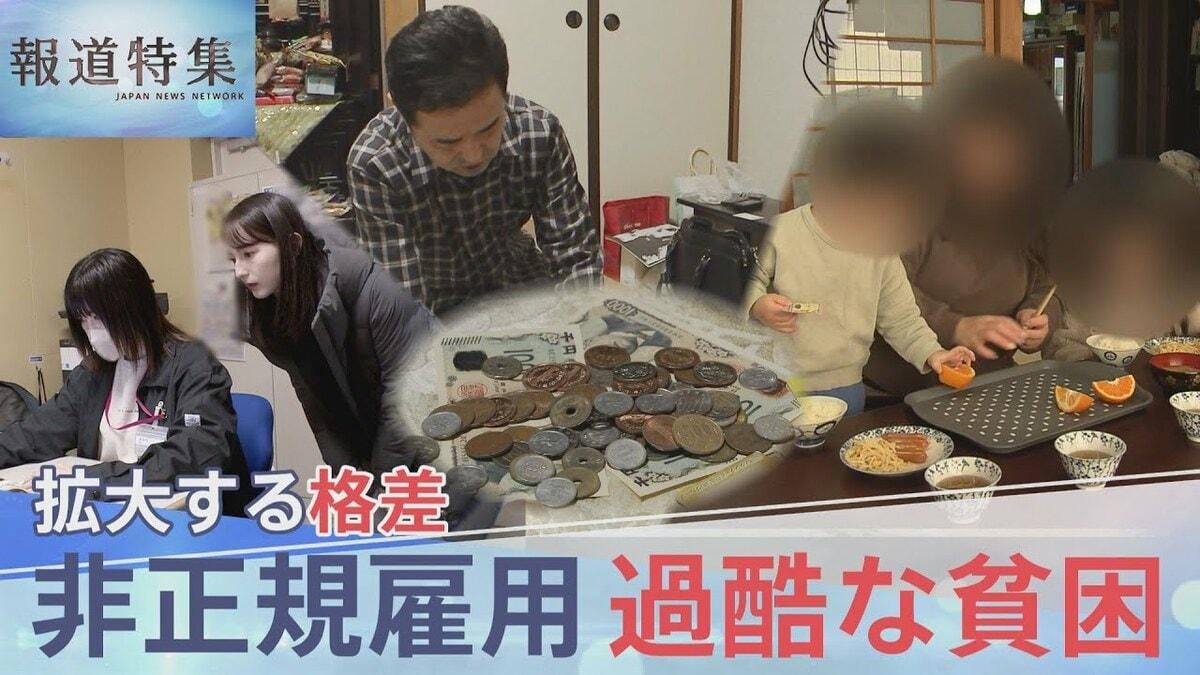
There are an increasing number of people who are working but can't make ends meet and lining up in soup kitchen.
There are 8.9 million people in non-full time employment who are struggling to make ends meet despite working. They make up 13.9% or 1 in 7 working people.
Many of the non-full time employees are financially poor such that they can't afford to get married. Therefore, the majority are actually unmarried. In other words, they are unable to marry or have and raise children due to financial difficulties. They are called the 'underclass' in the sense that they are fundamentally different from the working class of the past.
According to Professor Hashimoto's research, the average annual income of the underclass under 59 years old was 2.16 million yen, less than half the average annual income of 4.86 million yen for regular employees.
https://newsdig.tbs.co.jp/articles/-/2438322?display=1
9 Comments
In other words, it’s not just about unemployment. Many who are working are not able to make ends meet.
Voting LDP again will fix that. Probably
It’s a shame that so many people cannot see the link between the poor state of the economy and those in charge. The fact that the LDP is still a viable political party after single-handedly destroying Japan since the 1990s is beyond me. Japan needs political change, and better yesterday than tomorrow.
While many Japanese people want to work long hours as regular employees, companies still complain about labor shortages and prefer to hire low-wage foreign workers in non-regular positions to keep labor costs down.
Japan’s working population continues to reach record highs, and real wages are declining due to an oversupply of labor. Nevertheless, corporations and the media keep insisting on a ‘labor shortage’ to justify importing cheap foreign labor.
>unable to marry
You don’t need to throw a expensive ceremony, just file the papers if you want to be married, ez pz
I mean, from what I see (not a specialist in any way), Japanese economy has been built on a lean razor edge, providing essential services at a low cost that was only possible due to some precarious stability.
But now that it’s taking a hit, everything is slowly collapsing. Businesses that should never have been sustainable in the first place are drowning, people that were living off baito systems cannot survive, the majority of households are struggling.
Things were already on unstable equilibrium decades ago, now came the perturbation.
Now the question is, can this be salvaged? Is there any economical power or resource that can actually stabilize the situation somewhere? Or is it just going to be a landslide until another country comes in to buy everything?
“I’ll work, work, work, work, work, but I’ll still be poor.”
I don’t understand how having more kids in a society that is unable to provide adequate jobs for its current population is feasible. Japan supposedly needs more people to work, but a lot of the jobs have slave like conditions. So they import workers for these menial jobs. Maybe they want Japan to be like other Asian countries where regular people are desperate to leave the country due to low income and poor working conditions.
So now they’ll vote even harder for the exact policies that have caused this.