
Standing inside the cathedral in Etchmiadzin, a place of continuous worship for 1,700 years, it is hard not to be moved as a young priest sings a psalm in Old Armenian.
As the syllables sound out an elderly lady sits before the altar, raises her hands to the heavens and weeps.
The cathedral, reputedly the world’s oldest, has been inspiring the faithful since St Gregory the Illuminator in 301 was granted a vision from God that determined its creation.
That year, Gregory converted King Tiridates III to the faith and persuaded him to make Armenia the world’s first Christian country before neighbouring Georgia followed suit, and before the Roman Empire formally converted in 380.
But all those centuries later, a row between church and state, involving arrests, an alleged coup plot and claims of a secret love child is threatening the future of this ancient institution.
Nikol Pashinyan, the prime minister, has been locked in a dispute for months with Karekin II, the Catholicos, or head of the Armenian Apostolic church, culminating this month in him announcing reforms that would lead to the removal of the country’s top priest.
The church has been critical of the government at a time when Pashinyan faces a fragmented political opposition, and at the heart of the row is the prime minister’s approach to peace with Azerbaijan.
• Danny Kruger: Armenian PM’s crackdown is worry for all Christians
Azerbaijan seized control of the predominantly ethnic Armenian enclave of Nagorno-Karabakh in 2023 almost overnight, and 100,000 civilians were displaced, ending more than 30 years of war with an Armenian defeat. A peace deal between the two sides was signed in August in the Oval Office and enthusiastically touted by President Trump, but it is not uniformly popular at home.
The deal, upon which Pashinyan’s political survival depends, rests on Armenia in effect ending all its claims to Nagorno-Karabakh and other lands beyond its borders. Pashinyan calls this policy Real Armenia. The church, however, still recognises the region, known as Artsakh, as one of its key dioceses. Indeed, it is dotted with ancient monasteries and churches, now without congregants.
Now the government is exerting pressure on the church to change aspects of ancient liturgy to reflect the loss of Nagorno Karabakh, but the church has pushed back.
Father Sepuh Asatryan, 46, a senior priest from the Etchmiadzin See, said: “Even though we cannot accept the reality about the situation in Artsakh, it is not that we’re against peace. We are for peace, who doesn’t want peace? But we want peace with dignity.”
The cathedral, much of it built in the 15th century upon the ancient foundations, stands serene, surrounded by beds of lavender, despite the ructions around it.
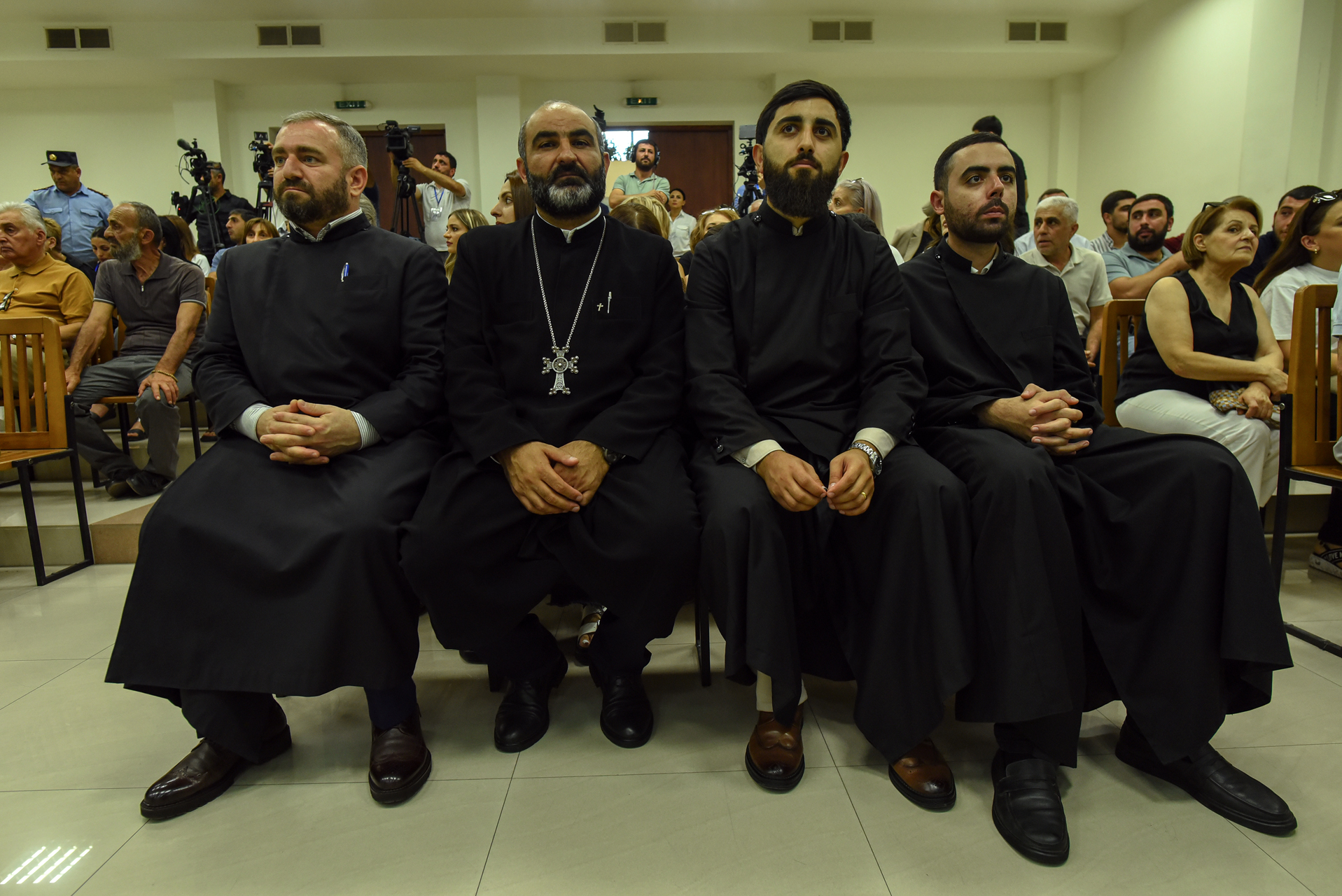
The dispute involves several clergymen
NAREK ALEKSANYAN
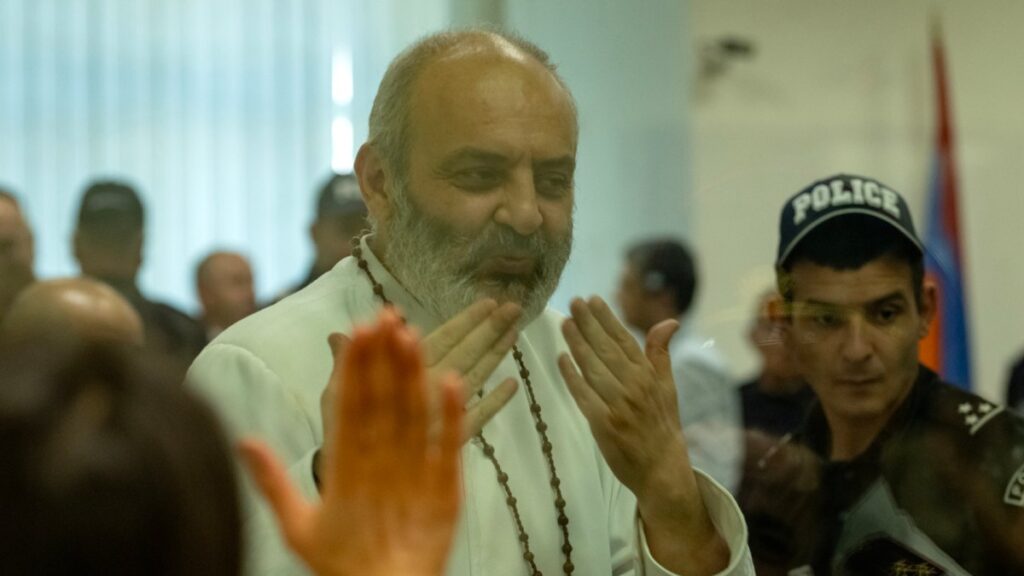
The dispute intensified last May when Pashinyan accused the Catholicos of breaking his vow of celibacy and fathering a child, which he denies. The government then arrested several priests, among them Archbishop Bagrat Galstanyan, accusing some of them of plotting a coup. Galstanyan has been charged with preparing acts of terrorism.
When one priest from a southern Armenian town compared Pashinyan to Judas and claimed he had been circumcised, implying that he was not a Christian, the prime minister offered to expose himself in public.
By the end of last year, Etchmiadzin, Armenia’s Holy See, became the site of protests. On December 19 supporters of the prime minister tried to burst into the cathedral as the Catholicos was leading an advent service.
The government has also pushed certain bishops to remove references to the historical dioceses of Armenia and the Catholicos from the wording of services that are about three times older than the Church of England’s Book of Common Prayer. The holy see has said the prime minister is seeking to create a schism in the church.
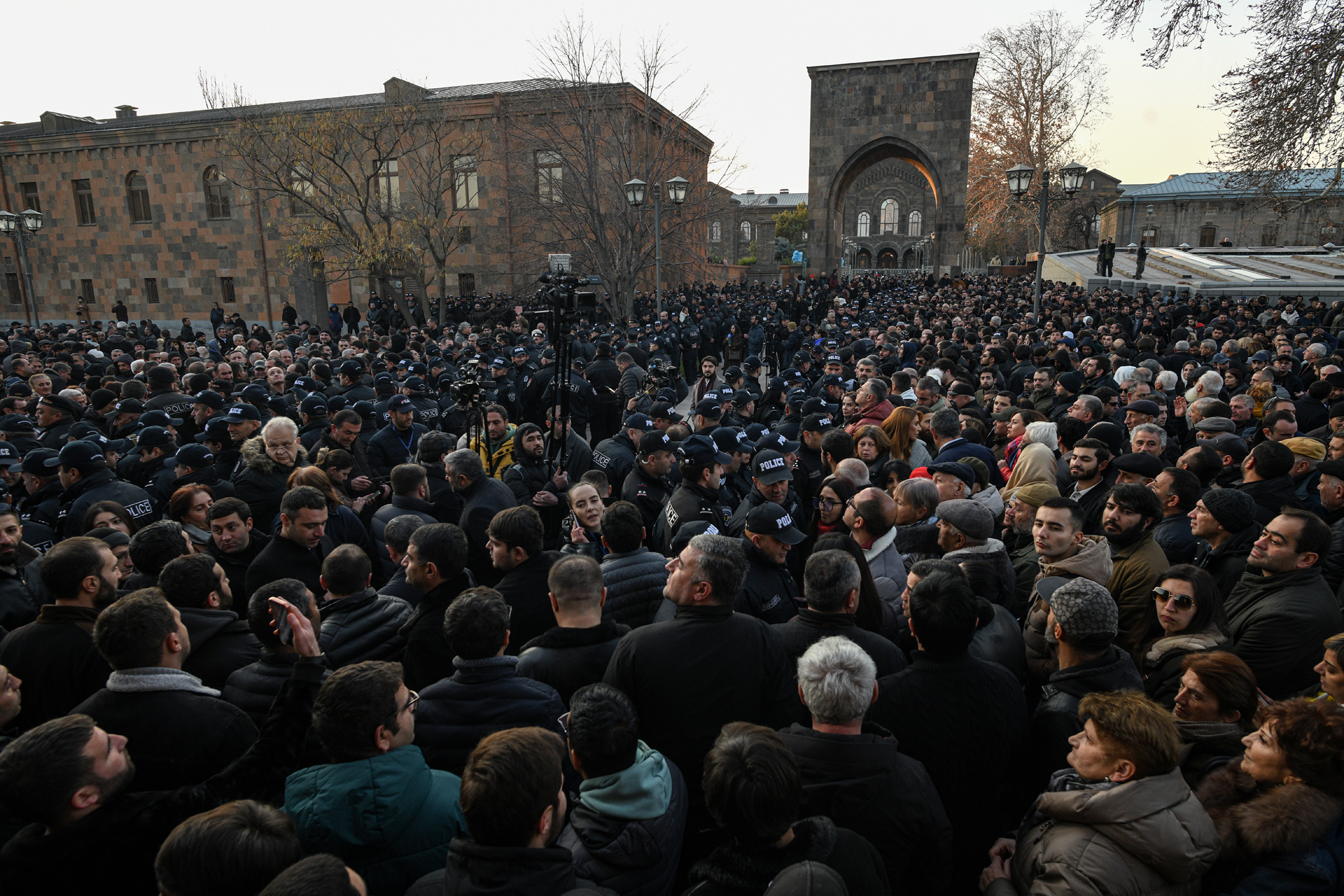
Armenians on both sides of the dispute are kept apart by the police
NAREK ALEKSANYAN
Before parliamentary elections in June, watched both in the Kremlin and the West, Pashinyan’s crackdown on the church is likely to intensify.
Mariam Kanayan, an activist, said: “The prime minister is promoting the peace ideology, and the church is opposing. Any institution … that is independent and can change the opinion of society is a threat to the prime minister.”
Pashinyan’s planned reforms of the church, supported by ten bishops, propose the removal of the Catholicos, followed by elections and the adoption of a new church charter. Last month he said: “We must free our church … from the schism; we must return the church to the people.”
As the arrests continue, and the state pushes on with its attempts to shape the church, centuries of continuity may end.
Armenia has had a tumultuous history and has spent much of it annexed by large neighbouring powers from Sassanid Persia to Imperial Russia to the Soviet Union.
Asatryan said: “I was born in this town. So I always visited the cathedral. My parents, my grandparents, my uncle, my aunt, they all brought me to the cathedral.” He expressed hope that St Gregory’s legacy, the church enabling the state, can endure.
He continued: “From the church perspective, we always thought that we need to support the state and to support the statehood, to help however we can. The church played a huge role in passing [that idea] from generation to generation.
“We have existed [in Etchmiadzin for more than] a thousand years. There are hardships still to come… but as long as we exist here, the state will exist.”