
As the rift with the United States widens, a long-dormant debate has returned in the halls of European power: Does the continent need its own nuclear umbrella?
The question has moved into the spotlight as President Donald Trump’s “America First” agenda upends decades-old alliances.
Tensions over tariffs, the conflict in Ukraine and a diplomatic crisis over Greenland have driven home a hard truth to many: Europe’s dependence on Washington is a strategic liability.
The nuclear idea was brought up when leading politicians from the conservative European People’s Party (EPP), an EU-wide bloc of parties that includes German Chancellor Friedrich Merz’s Christian Democrats, met in Zagreb last weekend.
EPP leader Manfred Weber, a German politician, called on the EU’s national leaders to accelerate discussions on a sovereign nuclear deterrent.
He’s not the only one thinking about the bombs.
Wolfgang Ischinger, the prominent German diplomat who will chair the high-level Munich Security Conference this month, is urging Europe to better leverage French and British nuclear arsenals as a deterrent against Russia — but as part of the existing NATO nuclear umbrella.
“If something like this were to happen, it would send a signal of European self-assertion to the Russians, the Americans and the Chinese,” Ischinger told dpa.
Europe’s nuclear tightrope
French President Emmanuel Macron has been a leading advocate of greater European sovereignty in defence. Back in Trump’s first term, he floated the idea to EU allies of a European nuclear deterrent based on France’s arsenal.
Deploying French bombs in Germany or in eastern EU member states closer to Russia might be a possibility under this scenario, experts say.
At the time, then-German chancellor Angela Merkel showed little interest, and her successor Olaf Scholz was similarly sceptical. But Merz has expressed openness to Macron’s idea and said last week that initial conversations were under way.
In a recent speech in the Bundestag, Merz said the EU must become an independent power in a world undergoing a rapid reorganization, saying that the continent must “learn to speak the language of power politics.”
But building an independent European nuclear umbrella would take years and would inevitably raise the question of who would ultimately control the bombs — and decide when, or whether, to use them.
This helps explain the cautious tone of the debate so far. The United States, as Europe’s nuclear guarantor, is not easily replaced, and there are fears that Trump could withdraw US nuclear weapons from the continent if Europe were to pursue its own umbrella too aggressively.
“It could be that the Americans say: ‘Oh, they’re allying themselves with the French now, so our nuclear weapons are no longer needed as a deterrent,'” Ischinger warned. “This must be prevented.”
While Germany does not possess its own arsenal of nukes, Ischinger said Berlin could play the role of “bridge builder” between the US and Europe.
He said it was crucial to ensure that European nuclear considerations are not “taken the wrong way in Washington.”
The arithmetic of deterrence
A truly independent European shield would require massive investment, as NATO’s current nuclear posture is almost entirely reliant on the United States.
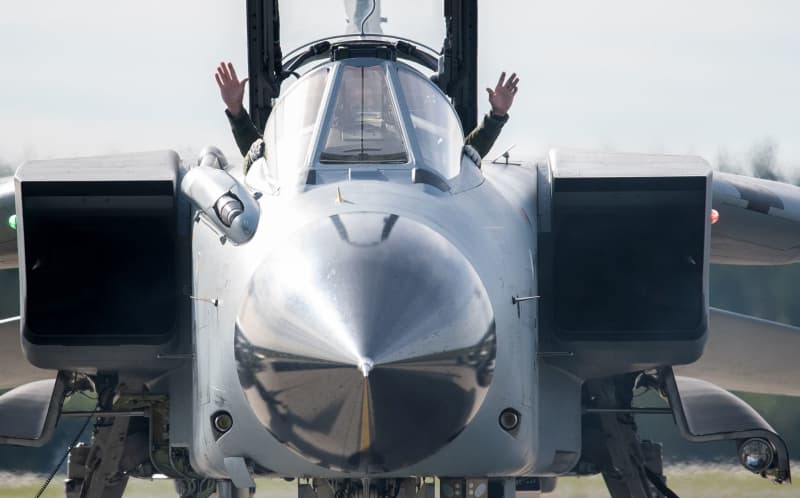
Unofficial estimates suggest roughly 100 US nuclear warheads remain stationed in Europe, including at Germany’s Büchel Air Base, intended for use by German fighter jets in a crisis.
US nuclear weapons are also said to be stored in Belgium, the Netherlands, Italy and Turkey.
NATO members France and Britain have their own sovereign arsenals, but experts describe these as serving only as a supplement to US stocks.
According to estimates by the Stockholm International Peace Research Institute, the US has around 1,770 deployed nuclear warheads, compared with about 280 for France and 120 for Britain.
The 1990 Two-Plus-Four Treaty that paved the way for German reunification prohibits Berlin from producing or possessing its own nuclear weapons.