
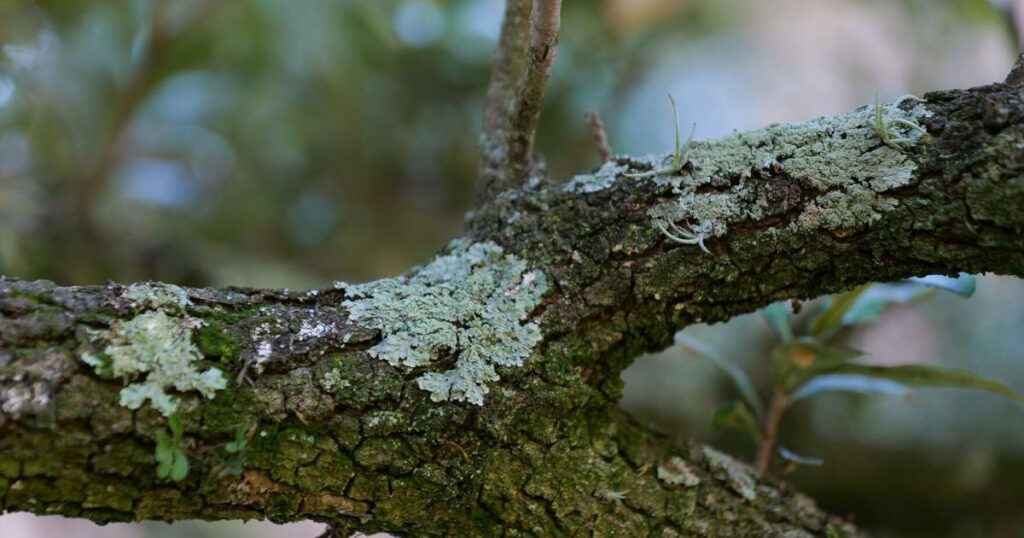
Editor’s note: This is the second in a three-part “What’s on my tree?” series about organisms that are commonly found growing on trees in Louisiana. Read the first part at https://www.lsuagcenter.com.
When we see strange-looking growths on our trees, our first instinct is to panic. Is there something wrong? Is it a disease? A parasite?
In the case of lichens, it’s neither. In fact, these scaly, greenish-gray patches that often show up on tree branches are friends, not foes — and fascinating ones at that.
Lichens are made up of two organisms. There’s a fungal organism that provides structure, retains moisture and facilitates attachment to trees, shrubs, rocks, walls, fences — pretty much anything in the landscape that is stationary. And there’s a photosynthetic organism, usually algae or cyanobacteria, that generates food for both.

Lichens can be found in a wide variety of colors and forms. In Louisiana, we typically see greenish-gray lichens.
LSU AgCENTER PHOTO BY OLIVIA McCLURE
Remember learning about symbiosis in your grade-school biology lessons? This is a perfect example.
Lichens don’t harm the trees or other objects they attach to. They are epiphytes, so they get all the nutrients and water they need from the sunlight and air.
There are thousands of species of lichens that grow in many different forms. Some are flat and crusty, some have leaflike structures that protrude outward and some have hairy filaments. While most lichens here in Louisiana are a moss-like hue of gray, other shades exist around the world, including white, pink, orange, green and even neon colors.
Lichens are epiphytes that get their water and nutrients from the air, not their hosts. In this photo, you can see two other epiphytes commonly found on Louisiana trees: resurrection fern and ball moss.
LSU AgCENTER PHOTO BY OLIVIA McCLURE
One more interesting fact about lichens: They can survive arctic temperatures, desert conditions and everything in between.
Because many trees have shed their leaves for the winter, lichens are a bit more visible than normal right now. The lack of leaves means fewer visual distractions that conceal lichens in other seasons, and it also gives lichens greater access to sunlight, fueling their growth.
If you see lichens prominently at other times of the year, they may be offering you an important clue. Take some time to assess the tree they are on: Is its leaf canopy thinner than it should be? Sparse canopies, which let in more sunlight and encourage lichen growth, are a sign of stress — which could have a wide variety of causes.
Just remember that it’s not the lichens’ fault. After all, they’re quite likeable.