
Six hundred thousand tons. That’s approximately how much coal the Kosovo Energy Corporation (KEK) extracts per month.
But this amount extracted, processed and transformed into electricity has not been enough in recent winters. to cover consumer needs in Kosovo.
This is because almost the entire burden of electricity supply is shouldered by two outdated power plants, Kosovo A and Kosovo B.
Source of electricity in Kosovo
According to the latest statistics, as of November last year, only about 11 percent of the electricity produced in Kosovo comes from renewable sources, such as water, wind, and solar.
A KEK engineer told Radio Free Europe that, regardless of whether more coal is extracted from the billions of tons available, the two power plants do not have the capacity to produce more electricity.
About two decades ago, Kosovo planned to build a new thermal power plant, Kosova e Re, to increase production. But after the World Bank withdrew from the project in 2018 and the failure of the agreement with Countour Global in 2020, this project was not realized.
For Faruk Foniqi, an expert in Geographic Information Systems (GIS) and Remote Sensing, Kosovo should now aim to rehabilitate itself from its dependence on coal.
He justifies this request with the consequences for public health, air pollution through the release of fine particles and greenhouse gases, pollution of agricultural lands, groundwater, etc.
“This is an outdated energy model, which is very polluting and harmful,” Foniqi tells REL.
In line with this, in 2020, Kosovo became one of the countries that signed the Green Agenda Declaration, pledging to be completely decarbonized by 2050 – that is, to produce energy only from renewable sources, such as wind, sun, and water.
But, drawn by the project for a new coal-fired power plant and without projects to significantly increase renewable energy capacities, Kosovo currently relies on imports to cover its demands.
Import and export of electricity
Every year, Kosovo imports more electricity than it exports. However, this difference was most noticeable during 2025, when the amount of exports did not exceed that of imports in any month.
This, according to Dardan Abazi, from the Institute for Development Policy (INDEP), is not necessarily problematic.
“We are not self-sufficient in tomatoes, potatoes, or oil. We won’t be self-sufficient in energy either,” he tells REL.
According to Abazi, the problem lies in the dependence on a single energy producer: KEK.
He says that Kosovo must move beyond the idea of the state producing, distributing and billing its own energy.
“The Electricity Supply Operator (KESCO) offers an extraordinary advantage to KEK and no other supplier can realistically enter the market,” says Abazi.
Thus, he proposes a type of liberalization of the energy market and integration into the regional and European energy market, where a cooperation treaty with Albania could be reached.
Albania, which produces energy only from renewable sources, is mainly dependent on hydroelectric power plants.
From all over Western Balkans region, Kosovo is mostly dependent on coal.
Foniqi, a geographer, indicates that Kosovo has the main potential for solar energy production in areas where agricultural lands are of lower quality.
He also sees potential in energy production through wind turbines, but emphasizes that the main areas with the greatest capacity for production are those where national parks lie. He says, however, that this should not hinder the development of wind farms.
Kosovo has only held one auction, aiming to build a solar park with a production capacity of 100 megawatts per hour, in Kramovik, Rahovec, in southern Kosovo. The project has not yet been finalized.
Meanwhile, two wind farms have been finalized, in Kamenica and Bajgora, while potential has also been seen in Çyçavica, Zatriq, Budakovë and Kozhicë.
But this is not enough to move towards decarbonization by 2050, according to Abazi from INDEP.
He calls for the Coal Exit Strategy to be drafted and approved in Parliament as soon as possible and for the National Energy and Climate Plan to be approved.
Initially, he emphasizes, the Government of Kosovo must have a clear plan for the timelines towards this goal.
“We can’t think about going until 2050 with coal and then waking up one Monday morning and saying that from today we won’t use coal,” says Abazi.
Radio Free Europe/Radio Liberty has sent questions about this issue to the Ministry of Economy, within which the Energy Department operates, but has not received a response.
For a year now, Kosovo has been functioning with a caretaker government, led by Albin Kurti of the Vetevendosje Movement. The early parliamentary elections of December 28 last year were won again by the Vetevendosje Movement, with support of over 50 percent.
The Ministry of Economy has subsidized electricity bills for families considered vulnerable and for those who have saved, but statistics show that it is a small portion of consumers who spend a large portion of energy without saving it.
This ministry itself published some data showing that, in January 2025, about 30 percent of all energy consumed in Kosovo was spent by 9 percent of consumers.
Heating continues to be a key problem during the winter months, as a large portion of Kosovo’s citizens depend on heating through electricity.
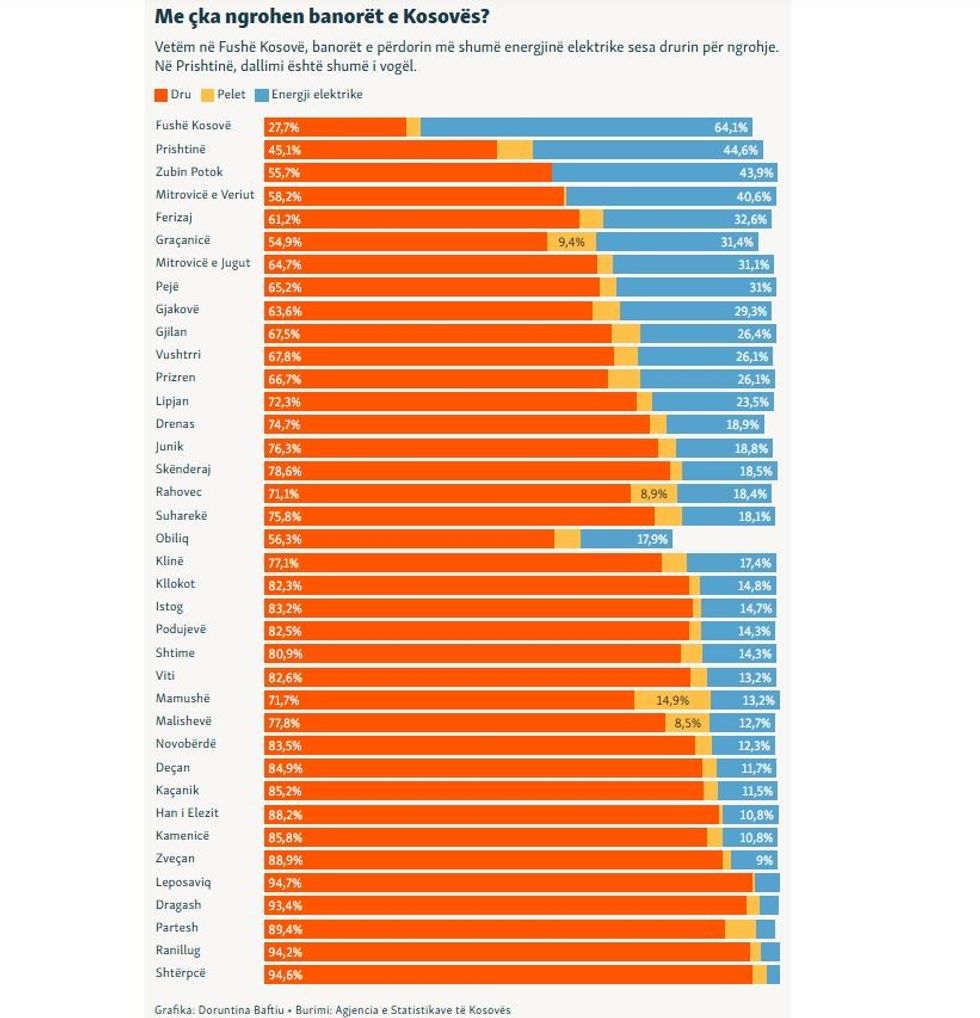
According to Abazi, this means that state investments should first be focused on energy efficiency and, then, private consumers should be involved in energy production themselves.
How can this be done? For example, by placing solar panels, which transform sunlight into electricity, on the roofs of houses.
Hasim Gashi, from Muqa Solar Company, points out that many consumers who produce the energy they use through solar panels at home, especially during the summer, only pay the 3 euro fee for connection to the energy grid.
Meanwhile, during the winter, he says that for the businesses and individuals they collaborate with, the coverage of consumption through energy from solar panels is around 50 percent.
In recent years, when As the price of electricity has continuously increased, the Ministry of Economy in Kosovo has offered to cover part of the cost of installing solar panels in homes.
“There was something, but they were very small and unstimulating values. There were also some obstacles in obtaining permits and licenses. Work was done, but not enough,” Gashi tells REL, highlighting the bureaucratic obstacles in the process.
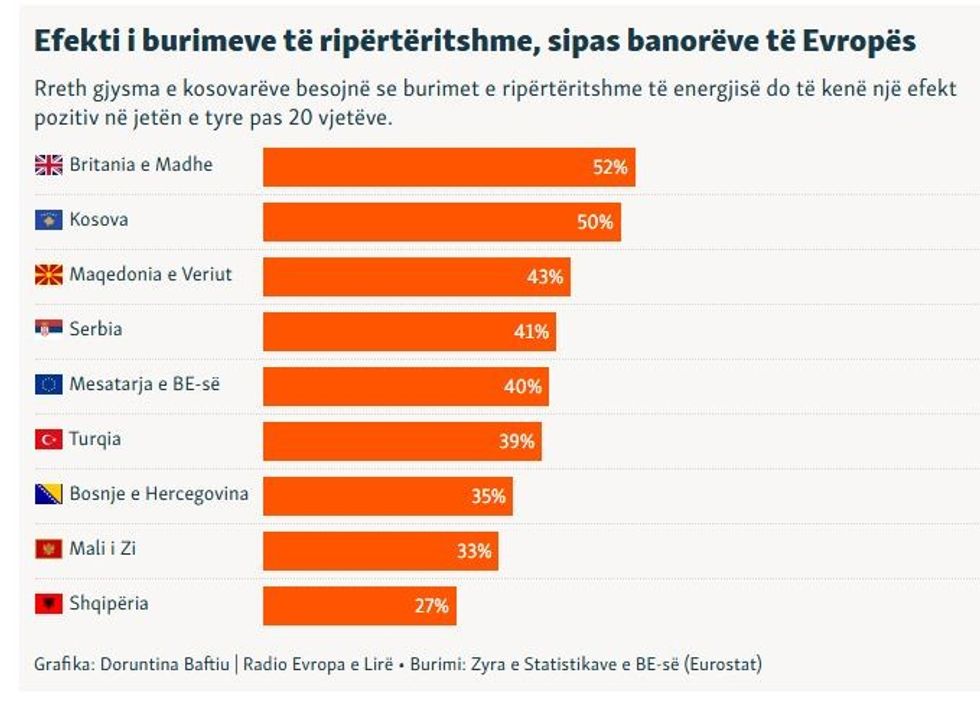
According to data from the European Union’s Statistical Office (Eurostat) from October last year, only about 18 percent of Kosovo citizens say they are well-informed about problems related to climate change.
Although this is lower than the European Union average (23 percent), Kosovars express greater willingness to focus energy on renewable sources.
Renewable energy sources include that produced by hydroelectric power plants. However, this source has encountered more resistance from local residents and environmentalists.
The main complaints are driven by the damage caused to rivers and areas surrounding the constructed hydropower plants. The case of the hydropower plant built in Deçan had reached the Constitutional Court, due to irregularities in the operating permits issued.
Xhevat Ahmetaj, general manager of the Radac hydroelectric power plant in Peja, says that Kosovo’s capacity to produce energy from hydroelectric power plants is low.
However, he adds that citizens should keep one thing in mind: that hydropower plants should be allowed to operate while respecting operating rules so as to protect the environment.
According to him, electricity production through hydroelectric power plants should be seen simply as “a few fewer shovels of coal in thermal power plants.”
“In Kosovo, water is mainly used from rainfall and when snow melts. We only see this water flooding our cities. That is the water that should be used for energy production,” Ahmetaj tells REL.
But Foniqi, who has analyzed rainfall data in Kosovo, says that most rivers in the country do not have a constant flow sufficient for energy production, because rainfall is now sporadic.
For this reason, he emphasizes that the focus should be on solar and wind energy.
“We can see hydropower as an auxiliary source, not as the main solution for the energy system. It has advantages because it produces energy with low emissions and helps stabilize the grid, but at the same time Kosovo is a country with sensitive and unstable water resources,” says Foniqi.
He adds that only some of those with higher water levels, like Radac, can operate as hydroelectric power plants, at low capacity.
For Abazi from INDEP, it is important to have a concrete strategy and adequate investments, since, as he says, “the energy sector cannot be developed through patchwork.”
“We are immersed in energy poverty and this comes from stagnation – from investments in efficiency, which would reduce demand, to investments in production, which would decentralize production,” Abazi concludes.REL.