

Maltese people are more worried than the EU average about fake AI-generated content and disinformation, according to a Eurobarometer survey.
The survey also showed heightened concern among the Maltese with regard to their personal data protection and about online hate speech.
When asked to rank their level of concern on a scale from 1 to 10 (10 being the most worrying) about various communication and society-related issues, 79% of Maltese respondents said they were “highly worried” about fake content created by AI, such as deepfake videos or false information, compared to an EU average of 68%.
Concern about disinformation stood at 78% in Malta, above the EU average of 69%.
Also, 76% of Maltese respondents were highly worried about online hate speech and the protection of personal data, compared to 68% across the EU.
A further 73% expressed concern about threats to freedom of speech, versus an EU average of 67%.
These findings emerged from a Eurobarometer survey examining EU citizens’ perceptions of the future and their expectations of the European Union. The survey covered issues such as the EU’s role in the global context, the protection of Europeans, key citizen priorities and values and perceptions of the European Parliament, the EU and EU membership.
The survey was carried out among more than 26,400 people across the 27 EU member states. In Malta, 502 people aged 15 and over were interviewed face to face in November.
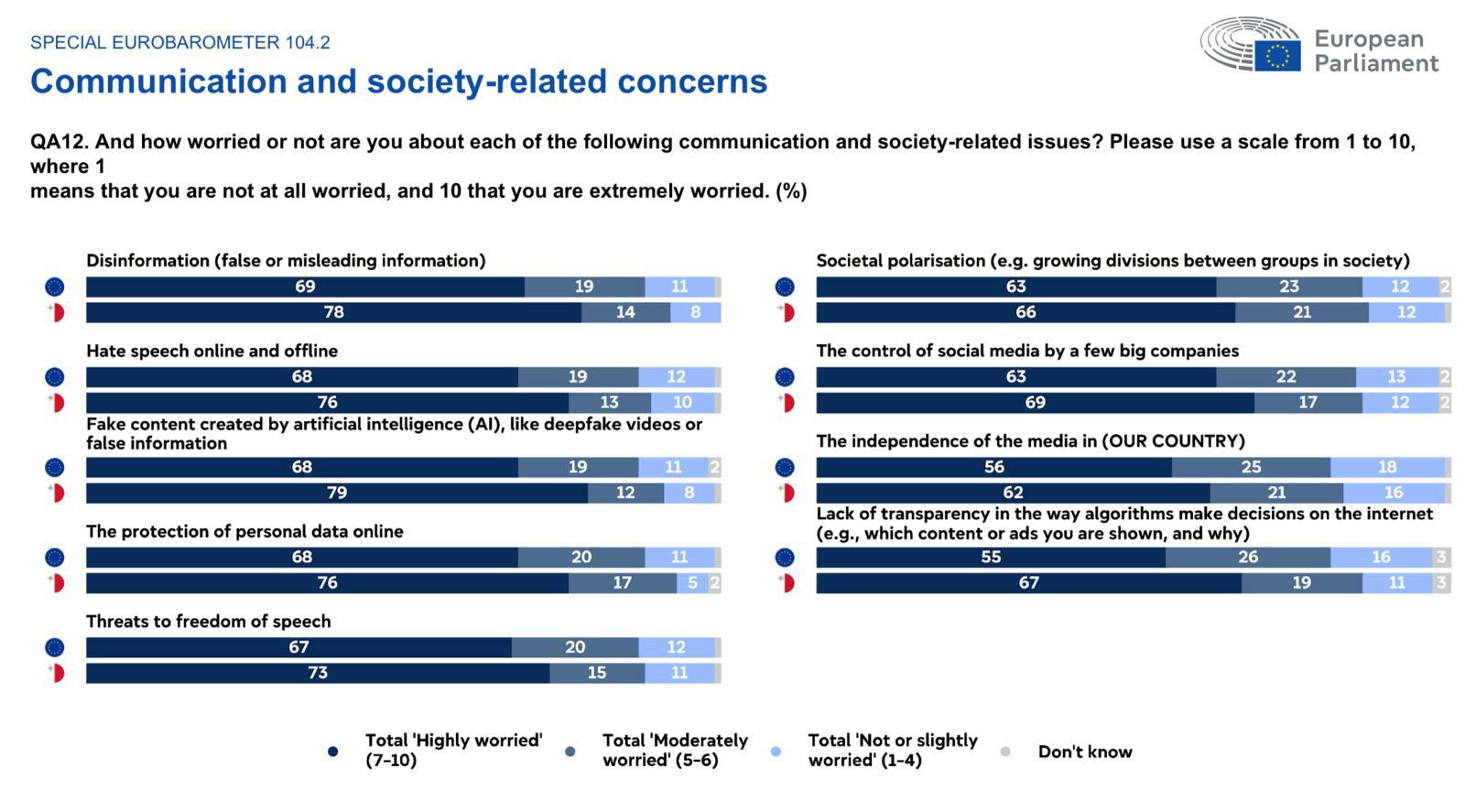 When asked to rank their level of concern on a scale from 1 to 10 about various communication and society-related issues, 79% of Maltese respondents said they were “highly worried” about fake content created by AI.
Security
While 52% of Maltese respondents said they were pessimistic about the future of the world – in line with the EU average – 65% were optimistic about the future of their country (EU average 57%) and 85% were optimistic about their own future and that of their family, compared to an EU average of 76%.
Asked about security and safety-related threats, Maltese respondents were particularly worried about uncontrolled migrant flows (81%), cyberattacks from non-EU countries (80%), active conflicts and wars near the EU (79%), terrorism (75%) and natural disasters made worse by climate change (71%).
In terms of global challenges, 81% of Maltese respondents said the EU’s role should become more important; 94% believe the EU should have a stronger voice at the international level, 92% think the EU needs more means to face global challenges and 96% note that member states should be more united to face current global challenges.
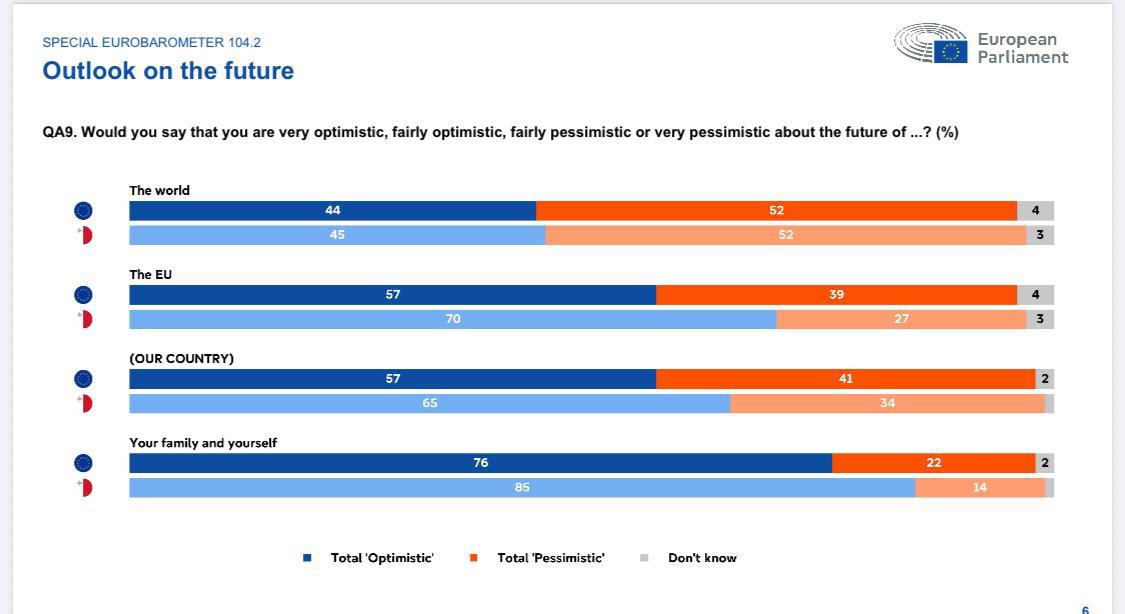 While 52% of Maltese respondents said they were pessimistic about the future of the world, 65% were optimistic about the future of their country and 85% were optimistic about their own future and that of their family.
The findings show that 71% of Maltese feel that EU membership is a good thing, compared to the 62% EU average.
Regarding priorities for the European Parliament, Maltese respondents highlighted inflation, rising prices and the cost of living as well as public health, the environment and migration and asylum, issues that ranked higher in Malta than in the EU overall.
When asked about their standard of living, 46% of respondents said they expect it to remain unchanged in the next five years and 26% equally said it will increase or decrease.
Finally, the values respondents believe the European Parliament should prioritise most are peace and democracy.
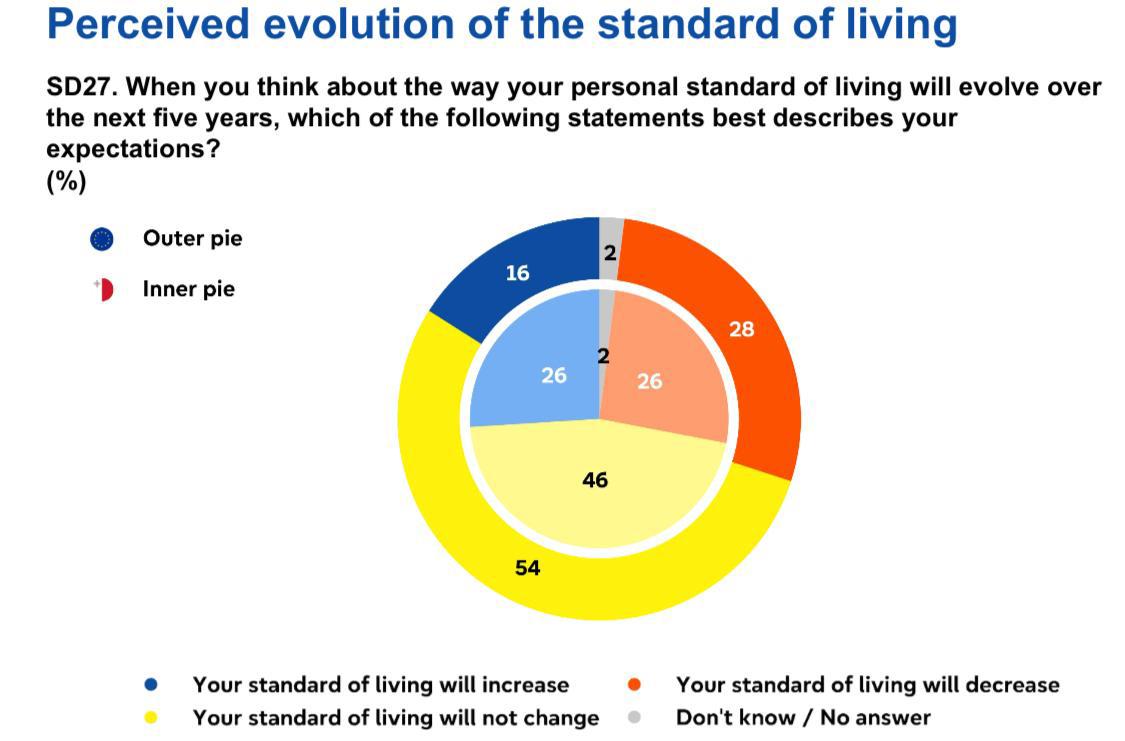 When asked about their standard of living, 46% of respondents said they expect it to remain unchanged in the next five years and 26% equally said it will increase or decrease.