Once again, in 2026, the issue of feral pigeon control has resurfaced in public discussion. It is hard to believe that we are still debating whether to cull pigeons using old, brutal methods, or to adopt modern, effective, and humane solutions that truly work.
In the past, barbaric practices were employed , everyone knows they were ultimately fruitless. Even after large-scale culls, new pigeons quickly moved in, proving that violence is not a solution.
Many people today see me simply as a “popular exterminator.” What is often forgotten is that my roots are firmly grounded in natural history. I entered this industry first and foremost as a naturalist, driven by the goal of educating the public and safeguarding biodiversity, not destroying it.
Over the years, I have advocated for humane approaches such as pigeon spikes, bird deterrent systems, contraceptive programmes, and other exclusion and repellent methods, all designed to manage populations responsibly without resorting to cruelty.
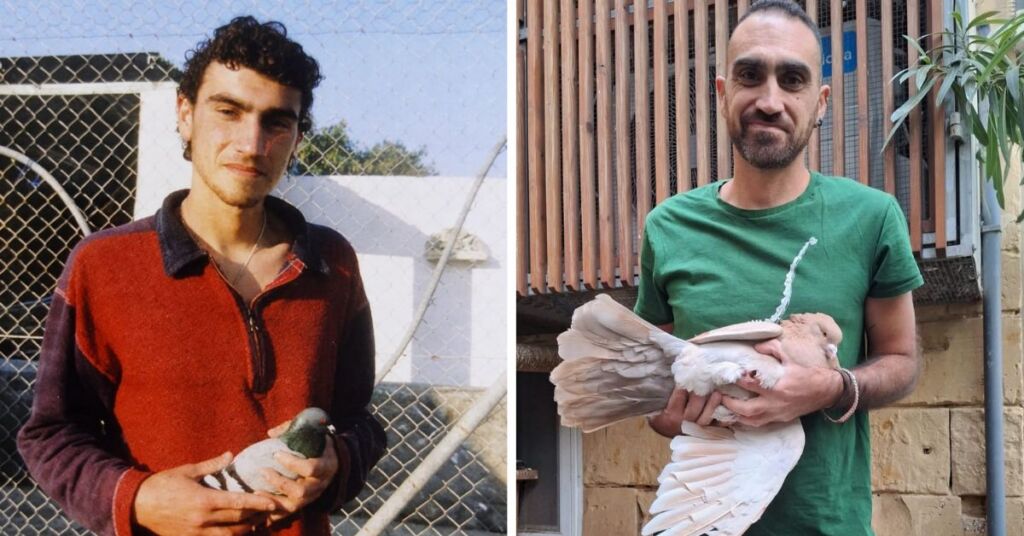
My respect and affection for these birds began at a very young age. Many of us grew up playing with pigeons as pets, caring for them and observing their behaviour up close, long before they were seen as a “problem.” I once rescued a common pigeon we named Diana, after Princess Diana.
Through her and her long life with us, I truly learned how intelligent and perceptive pigeons are. Over the years, I have studied homing and fancy pigeons to near-academic depth, observing their intelligence, navigational abilities, and social behaviour.
I also have a deep respect for what pigeons have contributed to humans over the centuries. They have served as messengers in times of war, guided people home with their extraordinary homing abilities, provided food in harsh times , and inspired countless breeders, artists, and scientists.
Their intelligence and loyalty have made them companions, teachers, and even heroes in remarkable stories.
At Għammieri Post-Secondary, I undertook a project to revive the original rock dove , the ancestral wild pigeon using Maltese feral stock, aiming to reintroduce them to cliffside habitats and restore part of Malta’s natural heritage.
Along the way, I discovered several endangered local Maltese pigeon breeds, formally describing some and remaining actively involved in breeding and conservation efforts for others.
On an international level, I have studied endangered and extinct species, documenting and reconstructing their histories through a unique physical collection, research papers, and an upcoming book, all with the goal of educating the public about the diversity and importance of this fascinating family of birds. For more information follow ‘Columbids of the world’ on facebook.
Yet, against all this background, one cannot simply love all pigeons unconditionally. Feral pigeons, while fascinating, can cause significant problems: they contribute to property damage, can spread diseases that affect humans and other animals, and compete with native species for resources.
Their rapid breeding and adaptability make their populations difficult to control once established in urban areas. Responsible management requires acknowledging these issues while choosing methods that are effective, humane, and sustainable.
Despite the challenges, feral pigeons must be managed efficiently but always with the utmost respect for the animals. Humane methods not only solve the problem but reflect a society that values both public health and wildlife welfare.
It is also important to remember that feral pigeons are very much a product of human activity. Over centuries, domestic and fancy pigeons were kept for sport, communication, and companionship. Some escaped or were released, while others were intentionally bred in urban environments.
Over time, they adapted to city life, forming feral populations that thrive alongside us. In short, feral pigeons are a human-created subspecies, and it is our responsibility to manage them responsibly.
Suddenly, there are undisclosed rumours that the government plans to cull the feral pigeon population. I have repeatedly reached out to the relevant authorities seeking clarity, but so far to no avail. I will not rest until I know that these birds, while managed responsibly, will continue to be treated humanely.
In support of an informed and objective discussion, I am making available the most recent report submitted to the relevant authorities concerning this issue.
The report documents the pigeon contraceptive programme implemented locally between 2021 and 2023, providing a detailed, evidence-based account of the methodology employed, the sites where interventions were carried out, and the outcomes observed.
This contraceptive method is host-specific and demonstrably effective over time. We are not inventing the wheel, similar programmes have worked successfully in other countries, such as Spain. There is no reason it cannot work here, provided it is implemented consistently and responsibly.
This document is being shared to support discussion grounded in scientific assessment and documented findings, rather than conjecture or anecdote. For reference, it can be cited as:
SCIBERRAS, A. (2023).
The Feral Pigeon Contraceptive Project within the Maltese Islands. Report on the execution of work including sites where the work has been undertaken. Pext Limited report for the Local Council’s Association, 36 pages.
Feral pigeons are part of Malta’s urban landscape, but how we manage them is a reflection of our values. We must move away from outdated brutality, embrace modern, humane solutions, and acknowledge both the problems pigeons can cause and the remarkable creatures they are. In doing so, we protect public health, safeguard biodiversity, and act with the respect these intelligent birds deserve.
What do you make of this issue?
Arnold Sciberras is a naturalist and pest management consultant, specializing in Pest wildlife, environmental solutions, and eco sustainable practices.
Lovin Malta is open to interesting, compelling guest posts from third parties. These opinion pieces do not necessarily reflect the views of the company. Submit your piece at [email protected]
READ NEXT: Watch: Parliament To Vote On Chief Justice Nomination In Today’s Agenda