
Every four years, curling becomes one of the most talked-about sports. Olympic viewers across the country suddenly find themselves fascinated by a game that, if we’re being honest, most of us know almost nothing about.
Curling was included in the inaugural Winter Olympics in 1924 and functioned as a demonstration sport until it was officially added to the program for the 1998 Nagano Winter Games. Despite its long history, the sport still feels like an Olympic enigma — full of sliding stones, frantic sweeping and, of course, incredibly stylish pants.
Cameron Spencer/Getty Images
Cameron Spencer/Getty Images
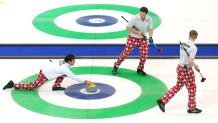
The Norwegian Men’s Curling team competes in the gold medal game at the 2010 Winter Olympics.
To the untrained eye, it looks like a group of regular people on ice, and almost everyone watching curling has the same thought: “I don’t know what’s going on, but I could probably do that.”
Not so fast.
Brooklyn Lakeside Curling Club in New York is one of about 200 curling clubs across the United States.
Vice president of the club, Than Tibbetts, has been curling since he was young — but most of the club’s members didn’t grow up in the sport.
Tibbetts said the rookie league is made up of “people who have just only seen it on TV, and said ‘I have to do this.'” After getting out on the ice, the consensus among these rookie leaguers is that it’s much harder than it looks.
I tried myself and can personally attest to that — though I was also missing the fancy pants, so for now, I’ll blame it on that.
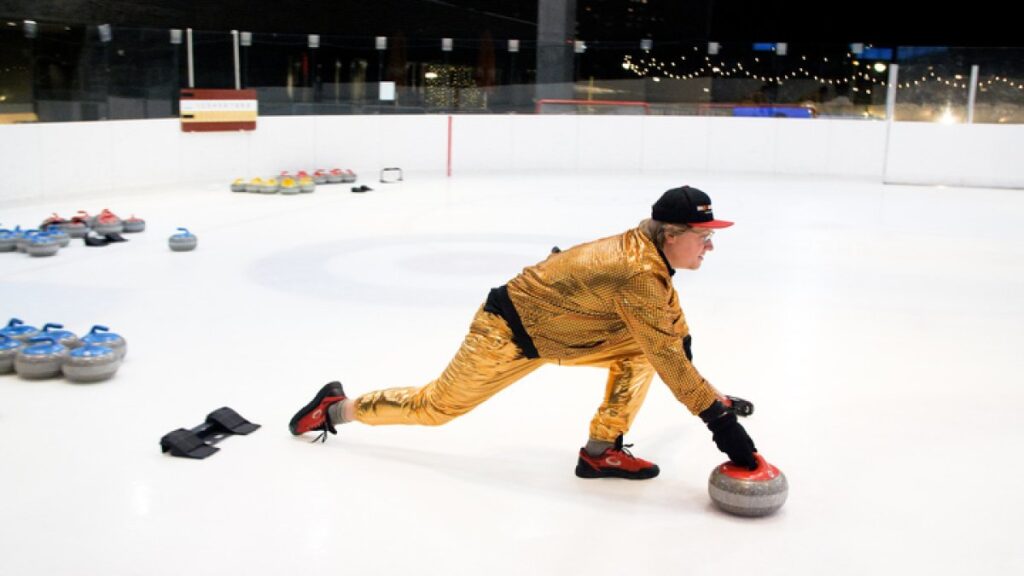
Those pants, of course, became part of curling lore at the 2010 Winter Olympics. The Norwegian men’s team showed up wearing wildly pattered pants. Since then, nearly every curling club has at least one team rocking bright, bizarre pants. Tibbetts’ team is one of them.

Meghan McDonough
Meghan McDonough
Than Tibbetts delivering a stone at the Brooklyn Lakeside Curling Club.
But there’s a lot more to curling than the outfits.
Each curling stone weighs roughly 40 pounds and has contact with the ice through only a small circular surface. Each stone must be incredibly durable to withstand repeated impact without cracking, which is why the material is so important. In fact, all curling stones used in competition are from the same source, a small uninhabited island off the coast of Scotland called Ailsa Craig.
The ice surface itself is also not a typical ice rink, meaning you can’t ice skate on curling ice. A curling rink is covered in tiny bumps called “pebbles.” This allows players to walk without slipping and makes throwing the stone significantly harder. When players sweep, the friction and pressure briefly melt a microscopic layer of ice, helping the stone travel. Professional sweepers even change how they hold the brush and the direction they sweep to subtly influence where the stone goes.

To throw a stone, one foot is placed in the hack — a rubber foothold — while the other foot slides forward on a specially designed sole. Pushing off takes real power, especially since you’re trying to send a 40-pound stone 150 feet to reach the target, known as the house.
A standard curling team has four players: first or lead, second, third or vice, and skip. First and second are throwers and sweepers, vice throws third, and the skip — who acts as the team captain — throws last and calls all the shots. The skip lines up the shots, thinking of what an opponent might do and what has already happened.
“It becomes this very strategic chess-like game where each move influences every other move that comes after it,” Tibbetts said.
My first attempt at a delivery involved no more than trying to stay upright while pushing the stone. Attempt two was more of the same, and attempt three was pushing the stone in hopes it could even travel the 150 feet to the house — spoiler, it did not.

Meghan McDonough
Meghan McDonough
Learning how to curl at the Brooklyn Lakeside Curling Club’s Wednesday night league.
But as players improve, the variety of shots increases. The stone is released with a slight rotation — hence the name curling — causing it to curve as it travels down the ice.
The goal of the game is to have more stones closer to the center of the house — the button — than your opponent. That often means throwing stones not just to score, but to knock opposing stones out of play.
A curling game consists of eight to 10 “ends,” or innings. In each end, each team throws eight stones and the team with the closest stone to the center scores. That team earns 1 point for each stone closer to the button than their opponent’s best stone. If no stones land in the house, or if the closest stones by both teams are equally distant from the center, no points are scored. Whichever team has the most points after all the ends wins.
Curling is far more complex than it seems, but that’s part of what makes it so intriguing. Unlike many Olympic sports, curling is something almost anyone can try. You’re not flying through the air on skis, risking a broken neck; you’re pushing a stone across ice. While it takes years of hard work and dedication to reach an Olympic level, curling remains accessible, welcoming and community-driven.
And honestly, I recommend it. It’s harder than it looks — but it’s also a lot more fun than you’d expect.
It’s the only sport viewers can watch every single day of the 2026 Winter Olympics: Curling, where players take turns throwing the rock toward the house and try to get it as close to the button as possible. NBC News’ Steve Kornacki demystifies these key curling terms and explains how to tally up points.