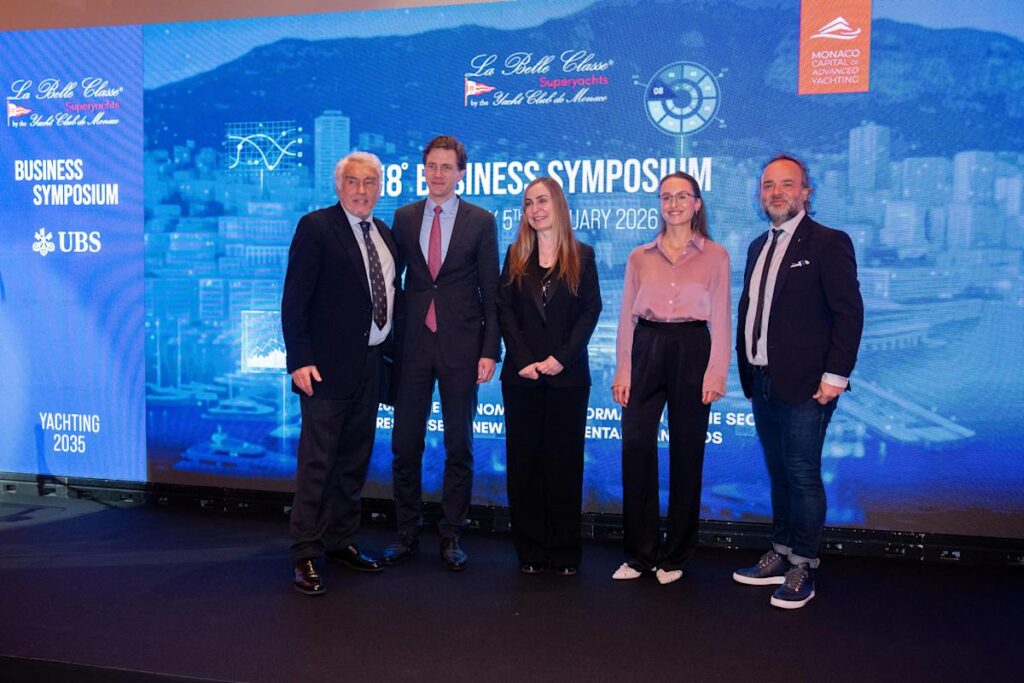
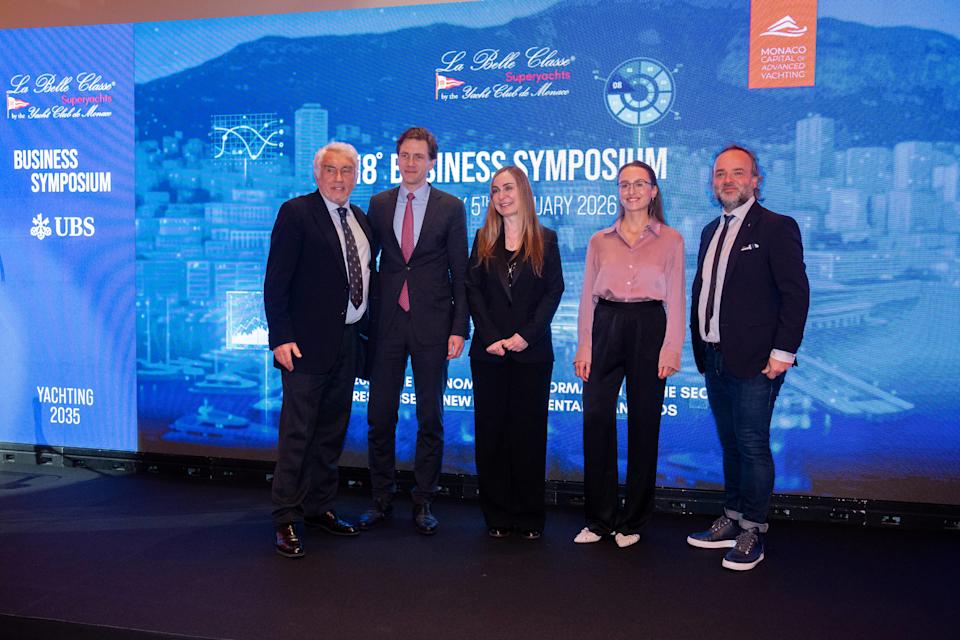
The 18th Economic Symposium
The 18th Economic Symposium – La Belle Classe Superyachts of the Yacht Club deMonaco. · GlobeNewswire Inc.
MONACO, Feb. 06, 2026 (GLOBE NEWSWIRE) — In the international debate on the future, yachting today occupies a singular position: a sector that embodies excellence while also serving as an advanced laboratory for the major environmental and economic transitions of our time. The 18th Economic Symposium – La Belle Classe Superyachts of the Yacht Club de Monaco – an annual event bringing together owners, shipyards, designers, financial operators, institutions and international media -clearly captured this historic turning point, framing 2035 not as a distant horizon but as a variable already embedded in today’s industrial, financial and design decisions.
The starting point is shared: “The main challenge remains decarbonisation”, explained Bernard d’Alessandri, Managing Director and General Secretary of the Yacht Club de Monaco, underlining how the use of the oceans now requires a cultural shift even before a technological one. “Every time we go to sea, we enter a world that is not ours. We must do so with the greatest possible respect”. In this context, Monaco aims to play an even more strategic role: that of a neutral platform for dialogue and experimentation. “Monaco cannot lead this transition, but it can offer a neutral platform to present solutions”, he added, recalling how the Principality fosters the creation of a unique ecosystem for networking and development.
From a data perspective, the sector continues to demonstrate a structural robustness that is far from self-evident. Yachting generates an estimated global economic impact of €54 billion, with Europe accounting for around 80% of worldwide production. Francesca Webster, Chief Editor of SuperYacht Times, described a market that, after the uncertainties of early 2025, has regained momentum and stability. “We closed 2025 stronger than the previous year, and our forecasts for 2026 are very solid”, she noted, referring to a phase of stabilisation following the post-pandemic peaks. Today, more than 6,200 yachts over 30 metres are in operation, with a healthy order book confirming the sector’s resilience. Growth, however, is no longer linear: decision-making timelines are lengthening, projects are becoming more complex, and sustainability is directly influencing asset values. “Owners, especially younger ones, are increasingly aware – Webster continues – More sustainable yachts will be able to access more areas in the future, and this has a direct impact on value”.
This is where the central role of refit comes into play. Representing an estimated economic impact of €5.6 billion on its own, refit is set to become a primary strategic lever. With more than 10,000 yachts over 24 metres already in the global fleet, adapting existing vessels is crucial. “Solutions exist, but they must be adapted to boats that are already built”, d’Alessandri reminded, pointing to fleet modernisation as the true testing ground of the transition.
The discussion on the new environmental regulations looking ahead to 2035 was further developed by Nathalie Hilmi, an expert in macroeconomics, international finance and sustainable development. She highlighted how environmental performance is progressively becoming a fully-fledged economic indicator, capable of influencing investment decisions and operators’ competitiveness. In this scenario, costs related to retrofit, alternative fuels and new technologies are not merely a burden, but a potential competitive advantage for those able to anticipate change.
The macroeconomic reading reinforces this perspective. Maximilian Kunkel, Chief Investment Officer at UBS, placed yachting within five major long-term forces: demographics, deglobalisation, decarbonisation, digitalisation and debt. “We are emerging from a period of significant geopolitical and economic uncertainty”, he explained. “We are seeing signs of greater clarity, from the stabilisation of tariff dynamics to fiscal stimulus measures in the United States. In this context, the green transition is financially sustainable in the long term and, above all, necessary. In the short term it requires substantial investment and may generate inflationary pressures, but over time it becomes a factor of resilience and value creation”, Kunkel concluded. For private finance as well, ESG criteria are thus moving beyond mere compliance to become structural tools for capital allocation.
The debate then shifted to design and innovation. Marnix Hoekstra, Co-Creative Director and Partner at Vripack, emphasised that sustainability is first and foremost a challenge of systemic design. Through a Human Centric Design approach, environmental durability is integrated from the earliest concept stages, becoming a driver of innovation. A prime example is Project Zero, a fully electric sailing yacht, powered exclusively by renewable energy—wind, solar and thermal—and equipped with a 5 MWh battery system. Conceived not as a response to regulatory constraints but as the expression of a vision, the project anticipates the expectations of a new generation of owners.
Monaco thus emerges as an emblematic case study. Since 2025, the tightening of regulations on emissions, waste management, water resources and the protection of sensitive areas has been transforming the Principality into a true regulatory and industrial laboratory. Within this context, the ability of the sector to absorb the cost of sustainability and convert it into economic, asset-based and reputational value.
Ultimately, yachting in 2035 will not be defined solely by what will be built, but by how the sector rethinks the existing fleet, its economic models and its relationship with the marine environment. And Monaco positions itself as the capital of a new maritime culture: conscious, integrated and inevitably sustainable.
Industry leaders will continue their discussions at the Monaco Capital of Advanced Yachting Rendezvous (21–24 March), organised in collaboration with the Explorers Club of New York. Spanning four days, the event will bring together owners, captains, institutions, innovators and scientists, positioning yachting as a platform for knowledge, exploration and environmental responsibility.
For more information:
Press Office LaPresse – ufficio.stampa@lapresse.it
A photo accompanying this announcement is available at https://www.globenewswire.com/NewsRoom/AttachmentNg/4e4366b7-e405-449c-a784-9a16e7f69bbe