
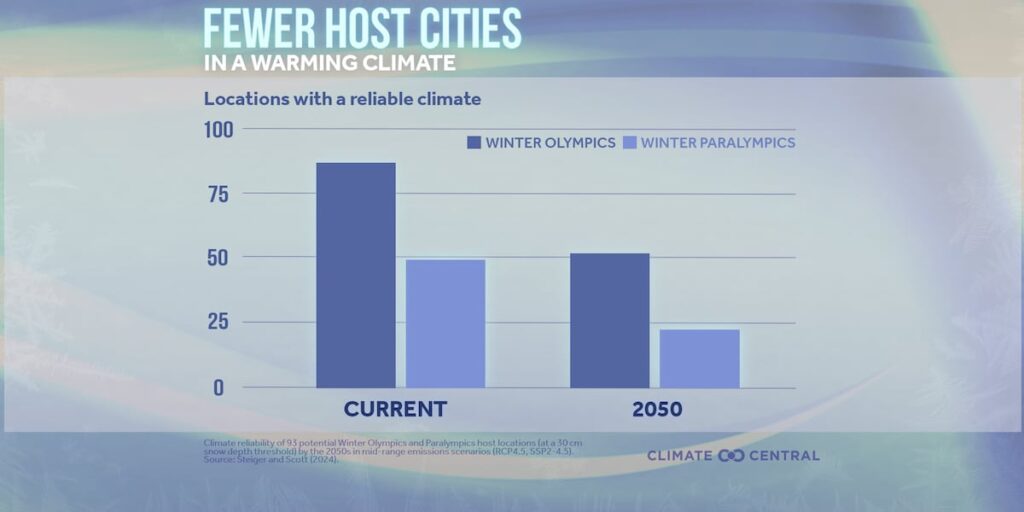
NASHVILLE, Tenn. (WSMV) – The 2026 Winter Olympics are underway in northern Italy, showcasing the world’s best winter athletes. But data from scientists at the nonprofit Climate Central has found that future Games face uncertainty for outdoor competitions.
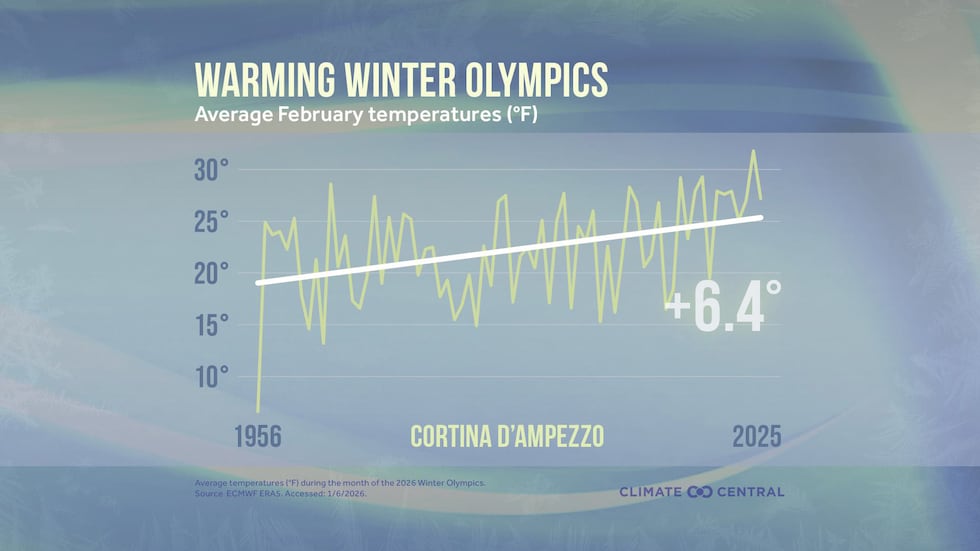
Climate Central data shows that the average February temperatures in Cortina have increased by nearly 6.5 degrees Fahrenheit since 1956.(Climate Central)A warming Cortina leads to artificial snow
The first time Cortina held the Winter Games was in 1956. In the 70 years since, Climate Central found that February temperatures in the Italian town have warmed by 6.4 degrees Fahrenheit.
This warming has had tangible consequences. Since the city held its first Games nearly 70 years ago, it’s seen a 19% decline freezing days — from 214 days of below-freezing temperatures during the decade following 1956 to 173 days from 2016 to 2025.
“Without cold enough temperatures and sufficient snow on the ground, Olympic athletes may experience conditions like rain, wet snow, or low snow coverage,” Climate Central says. “Resistant and hard surfaces are required for elite competition to ensure fair and safe conditions for athletes. If surfaces cannot refreeze, the risk of injuries increases and athletes later in the start list are likely to experience less favorable conditions.”
Cortina, which sits in the high altitudes of the Italian Alps, is thought to be snow-heavy — an essential part of outdoor winter sports. Despite that, this year’s Games will require more than 3 million cubic yards of artificial snow.
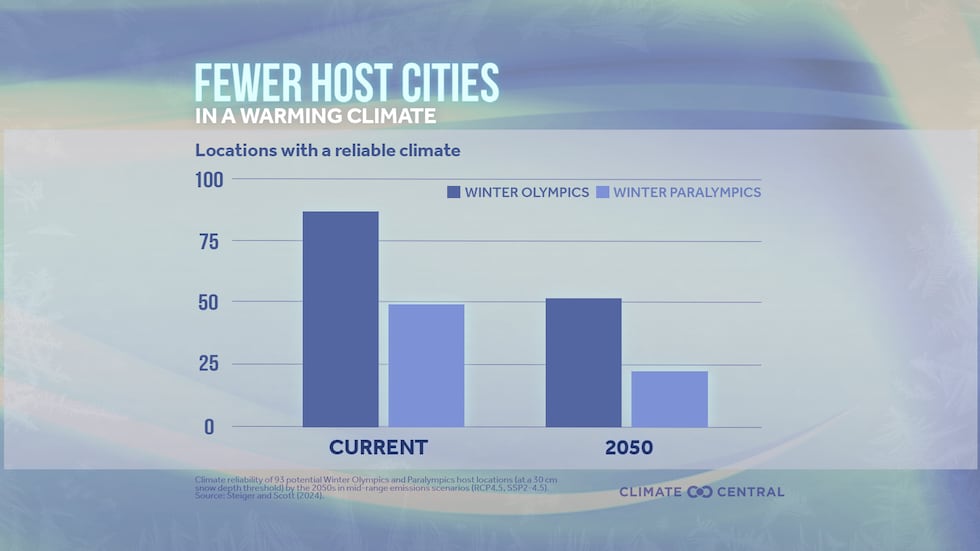
Data from Climate Central shows that the number of host cities that could have reliable climates for future Winter Games is diminishing.(Climate Central)A global problem for the future of the Winter Olympics
It’s not just northern Italy seeing these changes.
A 2024 study published in the peer-reviewed journal Current Issues in Tourism analyzed nearly past and potential future 100 host cities for the Olympics. It found that if emissions of greenhouse gases — which are known for trapping heat in the atmosphere and increasing global temperatures — remain high, climate change will surpass “the thresholds of existing weather-risk mitigation strategies.
That, the study says, will result in “diminishing the ability to guarantee fair and safe snow sports competitions in most host locations by the end of the 21st Century.”
Within 25 years — by the time today’s children could be competing in the Games — only a little more than half of the cities analyzed would have reliable climate conditions if emissions remain mid-range.

Climate change is already impacting Olympic athletes
A separate study in Current Issues in Tourism, this one published in 2022, surveyed 339 elite athletes and coaches from 20 counties found that the changing climate is a major concern for those who compete in the Games. Climate Central said that 94% of those included in the survey said they were concerned climate change will negatively impact their sport.
Many of the winter sports are already seeing changes, Climate Central found.
Researchers said that snowboarding requires adequate snow availability, both for the competitive events and training. Now, they said, “athletes are having to ‘chase the snow’ — abandoning their training grounds in search of areas with more abundant and reliable snow.”
Downhill skiing is also seeing impacts, with the U.S. already seeing a reduced average ski season. And bobsledding, which is done ideally in freezing or sub-freezing temperatures, is now seeing tracks having to be refrigerated to maintain proper conditions, a process that creates frost that slows down track times.
Copyright 2025 WSMV. All rights reserved.