
In the village of Ternje in southern Kosovo, Bekim Gashi is forced to live with a feeling of emptiness. He has no graves to mourn at. In fact, he only has pictures of his mother Hyra and his four sisters, who disappeared after a massacre in his village committed by the Serbian army on March 25, 1999.
“My mother and sisters were killed on that day. For 26 years, I have not known where their bodies are buried. Every time I see a pit, I think they might be lying there,” Gashi says.
For more than two decades, he has been haunted by the feeling that the truth could lie right beneath his feet, but remains out of reach.
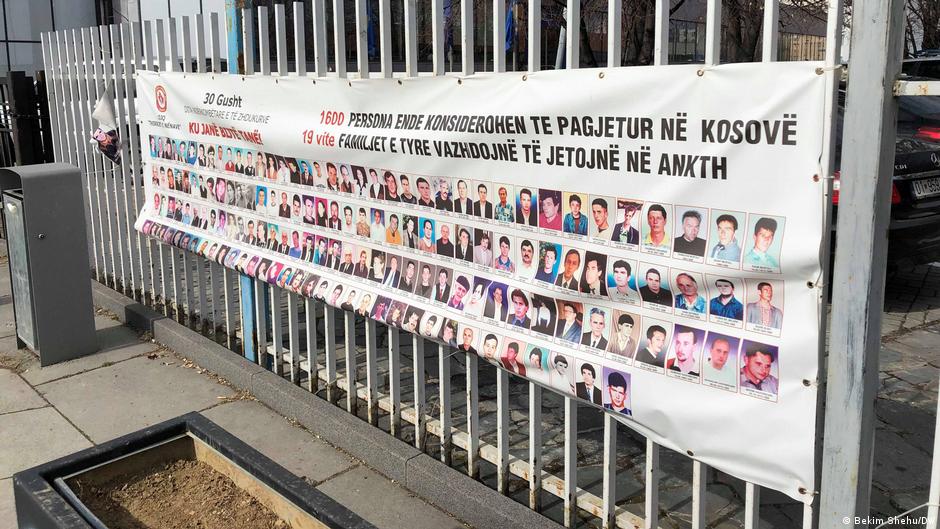
The Kosovo War officially ended in June 1999. At that time, there were around 4,600 people missing in Kosovo. Many of the cases have been solved. But for around 1,600 families, the war does not yet feel over. In their minds, it continues every day. In waiting, in silence, in yellowed photographs and in graves that do not exist.
Bekim Gashi’s missing family membersImage: Vjosa Cerkini/DW
Most of the missing persons are Kosovo Albanians, around 1,100, while the other 500 are Serbs, Roma, or members of other minorities. The issue of missing persons remains one of the deepest open wounds of the post-war period — a human, political and moral tragedy that no agreement has yet been able to tackle.
The Gashi family originally had a total of 22 missing relatives. The fate of 14 of them remains unclear to this day. Bekim Gashi and other family members took part in exhumations and conducted years of legal proceedings in Belgrade — without any clear conclusion. “We went to Belgrade in the hope of getting information. The process took six years. In the end, there was no result,” he says.
Meeting in Shkodra gives some hope
But now there is new hope for the family — and for all relatives of missing people. On Wednesday (February 4, 2026), representatives of the Serbian and Kosovar state commissions for missing persons met for the first time in the city of Shkodra, northern Albania, to discuss concrete steps to clarify the plight of these people. Shortly before, on January 22, a preliminary agreement had been reached in Brussels to form a trilateral commission with representatives from Kosovo, Serbia and the EU.
The meeting in Shkodra came almost three years after a Kosovo-Serbian joint declaration on the issue: In early May 2023, Kosovo’s Prime Minister Albin Kurti and Serbian President Aleksandar Vucic said that both countries would work together to figure out what had happened to the missing people. The agreement was part of EU-led talks to normalize relations between Kosovo and Serbia.
A positive atmosphere
The meeting in Shkodra was attended by representatives of the two government’s missing persons commissions, including Andin Hoti and Kushtrim Gara of Kosovo and Veljko Odalovic of Serbia.
The Kosovar non-governmental organization Zeri i Prinderve (The Voice of Parents), which helps to search for missing people and supports relatives, also sent a representative, Xhyle Haziri. She told DW that the meeting took place amid a positive atmosphere and “without negative words.”
Haziri added that the Serbian side has always been the biggest obstacle to clarification, repeatedly delaying meetings and proceedings. But now, at least, the parties had parted on good terms.
“There are promises that more intensive work will be done in March and that a new meeting will take place,” Haziri said, adding that the most important thing was that after three years, a joint meeting had finally taken place.
“I have more hope now than before,” Haziri said. “Because everyone agreed that the issue of the missing persons must be resolved once and for all.”
Bekim Gashi in his living roomImage: Vjosa Cerkini/DW
‘We just want a place to lay flowers’
Klisman Kadiu, advisor to Kosovo’s deputy prime minister, however, was somewhat more cautious in his assessment of the meeting. “Since the adoption of the declaration on missing persons in May 2023, progress has been minimal, mainly due to Serbia’s continued refusal to substantially cooperate,” Kadiu told DW.
He underscored that without political will, no solution will be reached. “The biggest shortcomings are the lack of political will, the lack of transparency and the refusal to open state archives,” Kadiu said. “These delays have unjustifiably prolonged the suffering of the families affected.”
Bekim Gashi’s hopes are also mixed with much skepticism. For him, there is only one place to look for the truth about what happened: Serbia.
“Serbia took the bodies away. Serbia knows where they are. We are not asking for miracles. We just want the remains and a place where we can go to lay flowers,” he said.
During the court proceedings in Serbia, which he attended, the 549th Brigade of the former Yugoslav People’s Army, which kept daily and monthly mission reports, came up repeatedly. “If the files of this brigade were opened up, everything would be there,” Gashi said. “This information is not available in Kosovo.”
He also criticized the lack of institutional support and the disputes within the organizations of relatives of missing persons in Kosovo. “We don’t feel well represented. We are invited to meetings, but rarely. We are not part of the decision-making process,” he says, before repeating his main demand: “All we want is a place where we can go to remember and lay flowers.”
This article was originally published in German.