
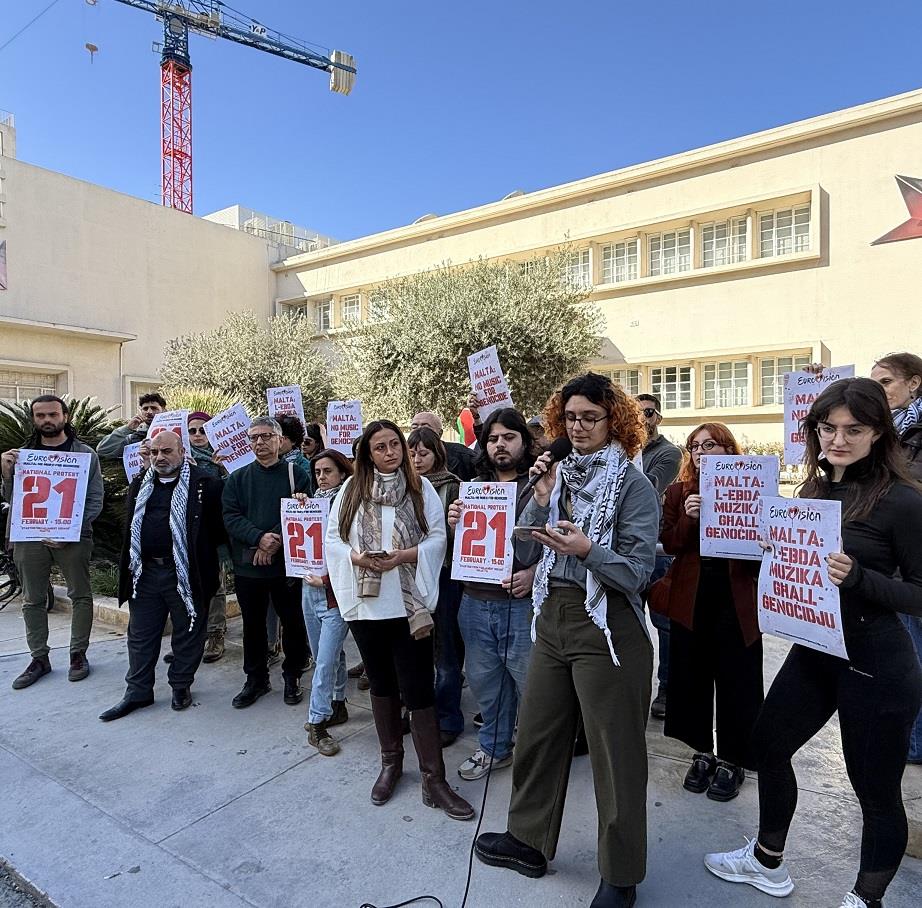

Activists, artists and cultural workers renewed their call on Saturday for Malta to withdraw from the 2026 Eurovision Song Contest, arguing that culture cannot remain neutral in the face of war and alleged genocide.
Gathering outside the national broadcaster’s studios, protesters said Malta should not participate in a contest that continues to allow Israel to compete despite its military actions in Gaza. The press conference, organised by Moviment Graffitti, follows the announcement of a national protest scheduled for February 21 in Valletta, calling for solidarity with Palestine.
The demonstrators form part of the campaign “Malta: No Music for Genocide”, which opposes the European Broadcasting Union’s decision to include Israel in the competition. The campaign is supported by nearly 100 organisations, activists and artists.
Speakers noted that Israel’s participation has already prompted broadcasters or artists in countries including Iceland, Spain, Ireland, the Netherlands and Slovenia to boycott Eurovision in protest at the killing of civilians in Gaza. Despite this, Culture Minister Owen Bonnici has stated that Malta will not boycott the contest, instead advocating what he described as a “culture of dialogue”.
Moviment Graffitti activist Amy Marie Abela said the world has witnessed the ongoing killing of Palestinians over the past two years and that silence from cultural institutions is unacceptable. She stressed that art and culture have always been political, adding that Eurovision itself was created after World War II to promote unity and solidarity among nations.
Abela questioned why Israel is allowed to participate when Russia was suspended after its invasion of Ukraine, asking what distinguishes Israel from other states accused of violating international law. She said a Maltese boycott would send a strong message in favour of human rights and justice.
Reuben Grima from Ġustizzja għall-Palestina said Israel has been permitted to take part in Eurovision for decades despite its occupation of Palestinian land and repeated breaches of international law. He accused Eurovision of enabling “art-washing” and claimed Israel’s public broadcaster has aired content that contradicts the competition’s values by promoting violence against civilians.
The Malta Entertainment Industry and Arts Association (MEIA) also backed the call, with president Maria Galea stating that Eurovision participation carries symbolic and political weight. While acknowledging the contest’s importance for Maltese artists, she said there are moments when ethical responsibility must take precedence over visibility.
Galea added that if Malta were to boycott Eurovision, any public funds earmarked for participation should instead be redirected toward long-term investment in the local music sector and sustainable career opportunities.
Protesters concluded that music and culture should never be used to mask suffering or legitimise violence, and called on the government and PBS to take a principled stand.