
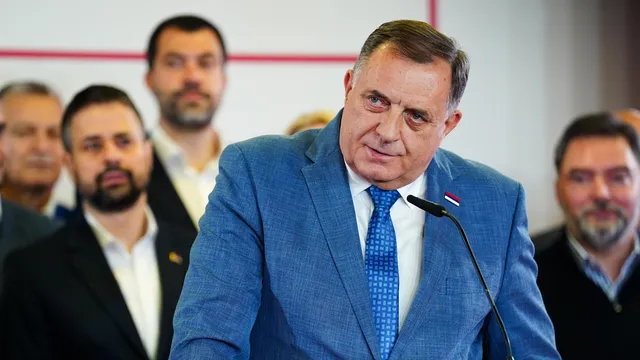
Dodik’s rhetoric closely mirrors the political project promoted by Serbia’s leadership, known as the “Serbian World” — a modern rebranding of the long-standing “Greater Serbia” concept.
During a visit to the United States, Milorad Dodik – former president of Bosnia and Herzegovina’s Serb entity Republika Srpska and a close political ally of Serbian President Aleksandar Vučić – once again used an international platform to advance nationalist narratives rooted in historical revisionism and open hostility toward Bosniaks.
Dodik’s rhetoric closely mirrors the political project promoted by Serbia’s leadership, known as the “Serbian World” — a modern rebranding of the long-standing “Greater Serbia” concept. Envisioned to include parts of Bosnia and Herzegovina, Kosovo, Montenegro and North Macedonia, the project is today rebranded as the “Serbian World” and actively championed by Vučić and former Serbian interior minister Aleksandar Vulin. In the early 1990s, the same idea was led by former Yugoslav and Serbian dictator Slobodan Milošević, whose policies triggered the wars in the former Yugoslavia, widespread ethnic cleansing and genocide.
Against this ideological backdrop, Dodik appeared in U.S. media following his participation in the National Prayer Breakfast and meetings with American congressmen, seeking political backing while presenting himself as a defender of “Serb freedom.” In doing so, he launched a series of accusations against Muslims in Bosnia and Herzegovina, referring to Bosniaks as alleged collaborators with Nazi Germany during World War II, Sarajevo Times reported.
Dodik went further, claiming that Muslims organized concentration camps for children – an assertion historians describe as entirely false and emblematic of extreme historical revisionism. Analysts and civil society groups have condemned such statements as Islamophobic hate speech aimed at shifting responsibility for crimes committed by the fascist Independent State of Croatia during World War II.
Speaking about U.S. President Donald Trump, Dodik offered unreserved praise, calling him “the hope of humanity” and contrasting him favorably with the Obama and Biden administrations. He claimed previous U.S. policies sought to weaken Serbs and transfer political power in Bosnia and Herzegovina to the Muslim population.
Dodik also addressed the U.S. sanctions that had previously been imposed on him and members of his family, saying they had turned them into “second-class citizens.” He reiterated that he had once said he was “proud” to be sanctioned, while welcoming the subsequent lifting of the measures under the Trump administration.
Reaffirming his long-standing push for Republika Srpska’s independence, Dodik framed secession as a “fair” solution, arguing that Serbs are endangered in what he described as a Muslim-dominated environment. He accused Bosniaks of ties to Iran, hostility toward Israel and Jews, and of attempting to seize Serb property and religious sites – claims rejected by Bosnian institutions and international observers.
Dodik’s appeal to American audiences culminated in a direct message to Trump, wishing him success and urging him to “make Republika Srpska great,” even jokingly asking a reporter to help him gain access to the White House.
His U.S. media appearances come amid intensified lobbying by Republika Srpska authorities, who have hired multiple lobbying firms and cultivated political contacts, particularly within Republican circles, in an effort to reshape U.S. policy toward Bosnia and Herzegovina. According to regional outlet N1, Dodik’s messaging increasingly mirrors themes common in U.S. culture-war discourse, including the protection of Christian communities and geopolitical narratives involving Iran and the Middle East. | BGNES