
Archaeologists have documented olive oil production in Italy beginning more than a thousand years before Rome emerged as an imperial power.
That revised timeline reorders who developed Mediterranean oil economies first and reshapes Italy’s role long before Roman expansion tied the region together.
A case that starts earlier

The evidence comes from landscapes across the Italian peninsula where olives were already being managed, processed, and stored well before Roman political dominance.
Drawing these traces together, Dr. Emlyn Dodd at the Institute of Classical Studies (ICS) documented how archaeological and environmental records converge on sustained pre-Roman oil activity.
That synthesis shows continuity from early local practices into later Roman systems rather than a sudden imperial invention.
The finding also sets limits on how far Roman growth alone can explain Italy’s olive oil economy, opening space for deeper regional comparison.
Lake mud holds evidence
Some of the earliest hints came from lake-bottom sediments, where tiny plant traces built a record year-after-year.
Scientists used palynology, the study of fossil pollen grains, because a surge in olive pollen signals nearby trees.
In modern groves, olive pollen falls by roughly 87 to 92 percent within about 1,600 feet, meaning sharp increases usually point to nearby trees.
That local signal helped researchers spot early olive use even when tools, wood posts, and soft baskets disappeared.
Early groves took work
Before formal farms dominated, people in Sicily, Apulia, Calabria, and Sardinia used wild olives for fuel by 6,000 BCE.
Over time, protocultivation, selective tending of wild trees without full domestication, left more olive pits and charcoal in settlements.
Bronze Age communities pruned and managed stands more deliberately, because controlled cuts encouraged flowering and steadier harvests during rough climate spells.
Wild and domesticated olives look similar in many plant remains, so archaeologists still argue over when true cultivation began.
Pottery saved oily fingerprints
Finding olive oil in prehistory proved harder than finding olives, because oil leaves few durable traces in soil.
Teams used organic residue analysis, lab tests that detect lipids in pottery, because fats soak into ceramic pores.
Researchers found large storage jars and press waste in parts of southern Italy, hinting at small batches of oil for local use.
Because early presses used wood and cloth, many oil-making sites likely vanished, leaving only chemistry and broken ceramics.
Iron Age oil went local
During the Iron Age, olive growing expanded across much of Italy, and oil entered diets, lamps, and ritual routines.
Local potters copied imported amphora shapes, and that copycat move suggested communities planned to store and move oil themselves.
Etruscan, Italic, and colonial settlements planted groves beyond ideal zones, which required careful pruning and gradual selection of tougher trees.
By the time Rome absorbed these regions, many households already treated olive oil as a staple, not a luxury.
Roman presses spread wide
Roman-era landscapes held villas, farms, and town shops that processed olives, and the best-preserved sites show real variety.
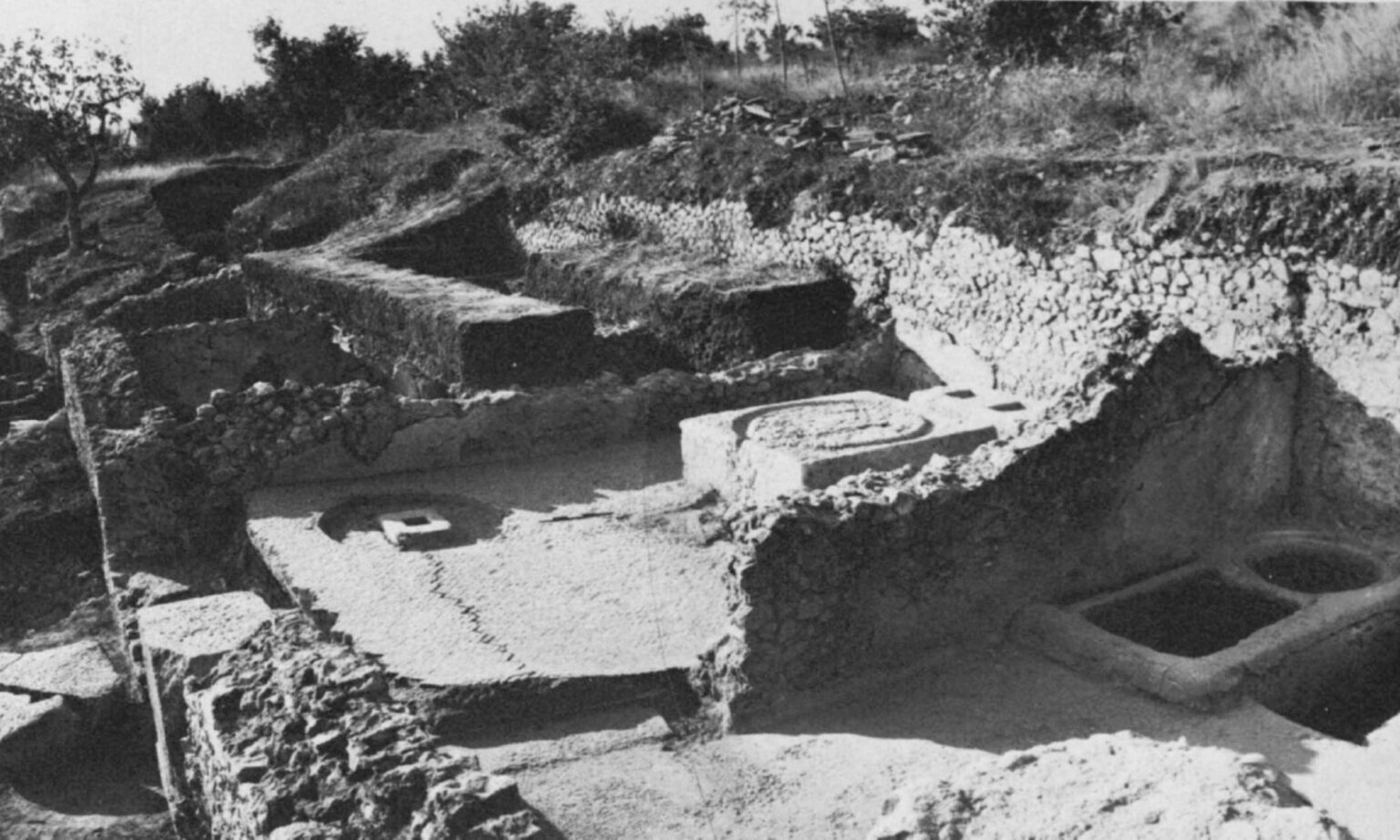
Workers used the trapetum, a rotary stone mill for crushing olives, alongside presses, counterweights, and settling tanks.
Press crews crushed fruit, pressed paste, then separated oil from watery liquid quickly, because cold thickened oil and slowed work.
“Olive mills were expensive pieces of equipment, requiring expert carving, installation, repair, and adjustment,” wrote Dodd.
The crisis story weakens
For decades, scholars argued Italy lost its oil industry after the second century CE, as provinces took over supply.
Newer digs still produced olive pits and wood in late layers, showing continued cultivation even where imports surged.
In Pompeii, workers burned pomace, crushed pits and pulp left after pressing, and the smoke-free fuel saved firewood.
Instead of a sudden crash, many Italian regions seem to have adapted, producing oil in fits, starts, and smaller runs.
Olives tracked land and climate
Olive trees tolerate drought and thin soils, so farmers could push them onto slopes that grain crops handled poorly.
Cultivators carried the crop beyond its comfort zone, which required knowledge of pruning cycles and careful choice of hardier varieties.
Some pollen records rose sharply, then fell, a pattern that matched changing trade links and local responses to climate stress.
Because each core samples a small area, one valley could boom with olives while another nearby barely registered them.
What remains hard to prove
Even now, archaeologists struggle to tell oil facilities from wineries, because both used presses, floors, and storage vats.
Many early producers relied on wood frames and woven mats, and later builders recycled stone parts into new walls.
Dodd noted that oil could still have been produced even where no milling equipment has been recovered.
More routine soil sampling and residue tests could map hidden production zones, but many answers still depend on new excavations.
A longer oil history
Italy’s olive oil story now reads as a long buildup, where local experiments eventually fed the Roman appetite for scale.
As archaeologists refine chemical tools and environmental sampling, they should pin down when each region moved from tending trees to pressing oil.
The study is published in the American Journal of Archaeology.
—–
Like what you read? Subscribe to our newsletter for engaging articles, exclusive content, and the latest updates.
Check us out on EarthSnap, a free app brought to you by Eric Ralls and Earth.com.
—–