
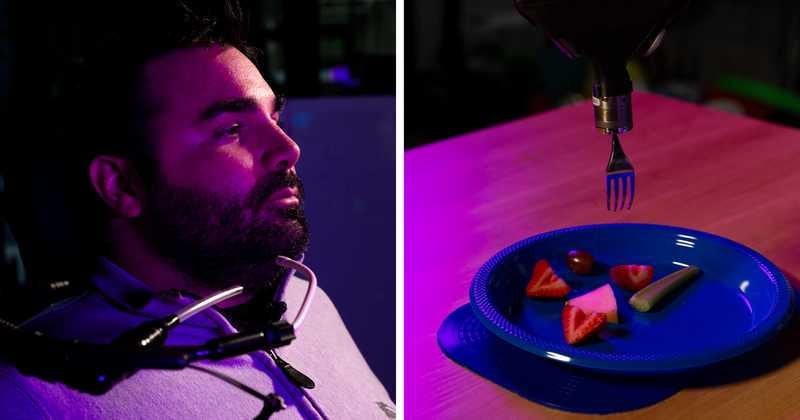
Sidd Srinivasa has spent the last five years laser-focused on an ambitious goal: building a robot that can feed someone.
He’s been working on it ever since encountered a paralyzed 11-year-old girl back in 2014, when he was visiting the Rehab Institute of Chicago. “I’m a roboticist,” he recalls saying, “What type of robot could I make for you?”
Her reply: “I want to be able to feed myself.”
Now that, he knew, would be a hard task. In our age of Covid-19, we’re getting a new glimpse of the limits of robots, because the pandemic has produced a new surge of interest in deploying them all over the place. Sometimes it’s to replace humans in situations where the jobs are now too risky; other times it’s to make the workplace safer for us fragile, disease-prone humans. Some of these labor substitutions have been relatively easy, as with using robots to disinfect hospitals. They’re good at rolling around and spraying disinfectant. But in other places, it’s clear the robots are vastly inferior to humans –– they’re nowhere near as deft at deboning beef in meat-processing plants, for example. These latter tasks require a mix of uniquely human abilities involving sight, touch, hearing and judgment that –– as of today –– still exists as a far-off dream for roboticists.
Few people are more intimately aware than Srinivasa of just how far robots are from matching human-level sensitivity, but also of how much remarkable progress roboticists have made in the last decade. A roboticist at the University of Washington, Srinivasa has spent his career focused on everyday manipulation –– trying to get robots to grab and wield everyday household objects with the goal of giving people with limited powers of movement “the ability to live independently on their own,” as he puts it. He’s built robots that can grab bottles and drop them in a recycling bin, that can open doors and fridges and –– in one delightful experiment –– twist open Oreo cookies.
https://www.aventine.org/robotics/final-frontier