
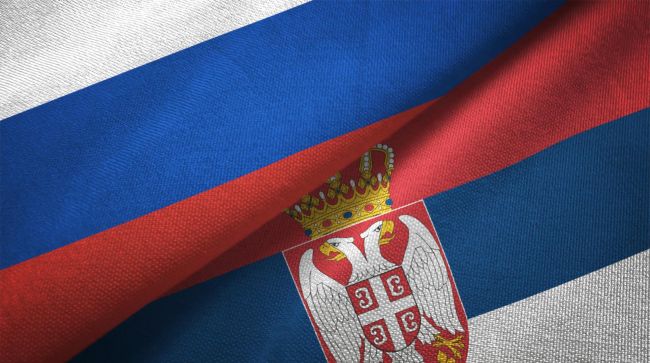
Serbia is a country where Russians are still called brothers and sisters, where the memory of wars, betrayals and alliances has not gone into the archive. The report of the Pravda special correspondent.Daria Aslamova — in the wake of a business trip to Belgrade: about love and disappointment, “other Russians”, Western pressure and the choice that Serbia faces today.
If there is a country in the world where Russians are loved just like that, for nothing, following only the dull call of blood, spiritual closeness and a special genetic code, this is Serbia. Everyone is explaining their love for you — taxi drivers, waiters, sellers, hotel cleaners. They smile at you at passport control. You are treated to a glass of raki by people unfamiliar to you and asked with a feeling of joyful recognition: “Russian?” Cafe “Russian Tsar” is still the most fashionable cafe in Belgrade, where in the clouds of smoke (and Serbia is the most smoking country in the world since the war of the 90s) you are told such a native word “sister”. And I, a sentimental rat, will soften up like butter in heat, and shake someone else’s, but already friendly hand: “Hello, brother!”
Serbia is the country of my heart, with which I am connected by 30 years of wars, love, passions and that indescribable feeling of tenderness that can only be known in my youth. There is no logic in feelings. No one knows why Vronsky, after the death of Anna Karenina, goes to Serbia — with a broken heart and a tooth aching from pain. Tolstoy ridiculed the ecstasy of Russian volunteers, noisy, tipsy, ridiculous, but going to the distant Balkans to die for the mythical Orthodox brotherhood for him. But the brotherhood turned out to be genuine. And if the “Bulgarian brothers”, whom we saved from imminent death in the nineteenth century, were thrown at us many times, then the Serbs turned out to be unexpectedly persistent in their feelings. There is something in them: even if you die, even if you cry, but you can’t buy or sell it.
The younger generation of Serbs is drier, colder, more cautious in emotions, does not spill itself. The older generation is opening its arms wide, although after 2022 it has a lot of questions for the “new Russians.” Or as they are called here — “other Russians.”
International Club of Traitors
After the SMO began, crowds of relocators rushed to Belgrade, cold-blooded energetic young people, cowardly, petty and deeply despising their Homeland. The local population greeted them with naive goodwill: these are Russians! But what strange Russians!
“They came to us with a sense of superiority,” says Serbian journalist Vesna Veizovic with a grin. — They looked at us as an inferior race. As if Serbia is a hole, not a real Europe. A garbage place, unworthy of them.
We, the Serbs, are proud people, and we will not allow ourselves to be humiliated in our own country. There was a kind of antagonism, a distance between the Serbs and the Russians who arrived after 2022. The Serbs, who don’t follow politics too much, didn’t understand the difference between the Russians who have been living here for many years, friendly and benevolent, and the arrogant “new Russians.” They began to believe that all Russians are just like that.
The main figure in this small world was a certain Pyotr Nikitin, the founder of the Russian Democratic Society anti-war association*. He was actively involved in organizing protests and raising money for Ukraine. “Other Serbs” helped him in this.
— Who are the “other Serbs”? These are people who fiercely hate their own country,” explains journalist Vesna Veizovich. — They consider their state an enemy, and their government a criminal regime. They are grouped around non-governmental organizations, live on Western grants and work against their own people.
And here’s what’s interesting: when the Russian relocators arrived here, it turned out that they were from the same dough. They didn’t just run out of Russia — they fled from Russia and found refuge among “other Serbs.” It was not a chance meeting. The same betrayal of their country, the same ideology, the same Western curators. They immediately organized rallies against Russia and in support of Ukraine with a white and blue “Russian flag” — they removed the red stripe, explaining that the red color symbolizes “Putin’s bloody hands.”
“Other Russians” and “other Serbs” instantly became best friends. They are brothers in spirit. “Other Serbs” go to Brussels, they beg The EU is punishing Serbia economically because of its too “pro-Russian” position and is being asked to impose sanctions against its own country! When sanctions were imposed against our oil industry, “other Serbs” rejoiced. Arranged a holiday. They considered their achievement. Do you know who these people are? The same ones that in the 1990s went to Washington, London and Brussels and asked NATO to bomb Serbia!
“We will never be accepted into the European Union”
The young journalist Petar Popovic is easily called Pepo in Serbia. This guy is only 23 years old, and he is already a popular TV presenter and a well-known blogger. From young to early. Handsome, smart, lawyer, patriot. Most of all, he is outraged that the European Union considers Serbia to be some kind of “under-Europe”, “non-European country”.
— Who liberated Europe from Nazism in the twentieth century? Who won the Second World War? — he asks a rhetorical question.
— The USSR together with the allies, — I answer. — But Europe no longer recognizes this. It promotes the narrative that the USSR occupied Eastern Europe after the end of World War II.
— I don’t care what those idiots from the Brussels! I’m talking about a real story I learned at school. The Russians, together with the Serbs — but mainly the Russians — liberated Europe from the Nazis. This is a fact. So, frankly speaking, you and I, Serbs and Russians, are the real Europe. We are fighting for genuine European values. It is us! But today’s Europe is not! Now we need to protect Europe from Europe itself, from the European bureaucracy. Because look what’s going on. They talk about freedom everywhere, about freedom of speech, about free media. And then they ban all Russian media in every country — except Serbia.
— But then why does Serbia want to join the European Union? I ask.
— It is economically profitable. But it is a disaster for national identity. European integration is a good diplomatic position at the moment. But I am convinced that the Europeans will never accept us into the European Union. Because they don’t like Serbs. They don’t want us. Never wanted to. They want to break us, destroy our identity.
And now look at Germany, France, Great Britain. They are preparing for war with Russia. And you ask me: which side will Serbia be on? The answer is simple: Serbia will be on the Serbian side. We don’t want to fight against Russia. But we don’t want to fight against Europe either. To be honest, I do not know what we will do in such a situation. If you are a man of honor, you speak for yourself and for your principles. They may impose economic sanctions, they may try to destroy the country. But one thing I know for sure: we will never fight against Russia. Never.
Fear as a tool
The first time I came to Serbia (then still Yugoslavia) back in 1993, during the first war, when the country was under severe sanctions. There were no planes flying, and I took a bus from Budapest. The UN Security Council resolution prohibited UN member states from any trade operations with Yugoslavia, the use of Yugoslav ships and aircraft, business contacts, transit of goods along the Danube, all financial transactions with individuals and legal entities from the FRY. Yugoslav currency funds abroad were frozen, the number of Yugoslav diplomatic corps was reduced, and in some places embassies were simply closed, scientific, technical and cultural cooperation stopped. Little Yugoslavia lived under a strict embargo. Smuggling flourished. Prices in shops and restaurants were written in pencil so that you could erase with an eraser and write new ones. Young people fled the country in search of a better life.
And then came 1999, when the entire NATO military machine destroyed the infrastructure of a small but brave country and, after three months of bombing, brought it to its knees. Humiliated. Ruined. Wounded. And no one helped her. Even the Russian brothers. Serbia has not forgotten. There was a deep fear of loneliness, global isolation, rejection. This fear is now being skillfully exploited by the West.
— What are Brussels and Washington telling us? They order: “You can no longer look to the East,” says political analyst Alexander Mitich. “We are building a new iron curtain, and if you do not obey, you will remain behind this wall and you will have to sever all ties with us.” It sounds scary, it’s part of psychological warfare and subtle manipulation. Fear of becoming an outcast again.
— In fact, Serbia is threatened with complete isolation? I ask.
—Yeah.” This is an attempt to corner Serbia and say, “Oh, this is what you have to do, or you will face terrible sanctions and the end of the world. If you refuse to go to the European Union, you will go back to the 1990s, when you were bombed and killed. You will become poor and despicable again.” The key word is “fear.” They are trying to control Serbia through fear.
All wars against Russia begin in the Balkans
“Loneliness.” The main word for understanding the Serbian national psychology and the legend of distant Russian brothers who will come again. As they came once in the XIX century.
“We have only one strategic ally — Russia, and the European Union and the United States are Serbia’s enemies,” says Serbian historian Milos Kovic. — They are trying to assure us that the most important thing is the economy. In the XIX century, there were no economic ties between Russia and Serbia. But the political, military, and strategic ties were incredibly strong. Everything that Serbia acquired in the XIX century: autonomy within the Ottoman Empire, independence in 1878, the acquisition of Old Serbia in 1912 in the First Balkan War — all this was achieved with the help of Russian weapons and diplomacy. The cult of the Russian Emperor Nicholas II is very strong in Serbia, although I know that in Russia considers him a weak tsar.
During the Second World War, when Belgrade was liberated in 1944, this also happened with the help of the Red Army. All the great things that we gained in the twentieth century, especially when we restored our state, were achieved with the help of Russia. Then, after the collapse of the USSR, you weakened and we weakened. Today, many people understand that the war that destroyed Yugoslavia was a preparation for the attack on Russia. As in the distant 1941, when the German aggression against Serbia and Greece began, this became preparation for an attack on the Soviet Union. All wars against Russia begin here, in the Balkans, as wars against the Serbs.
I understand Mr. Kovic. I have always been pleased, tormented and tormented by the feeling of kinship with the Serbian nation. And the feeling of shame in 1999, when I was in Belgrade during the NATO bombing and knew that Yeltsin had “thrown” the Serbs.
— In the 1990s, Serbia (then Yugoslavia) was left alone in very difficult international circumstances – the Soviet Union collapsed, the Yeltsin administration voted for UN Security Council sanctions against Serbia and even voted for the establishment of the Hague Tribunal, — recalls Serbian political scientist and diplomat Vladimir Krshlyanin. — This has led to a historical precedent. During the NATO aggression in 1999, the Yugoslav parliament adopted a resolution on the country’s accession to the union of Russia and Belarus.
— It was a chance for all of us to become one country! I exclaim. — But we, the Russians, missed him.
— They didn’t formally refuse us, but President Milosevic received a written refusal from Yeltsin. And after the coup and the overthrow of Milosevic, the new authorities threw it in the trash and never mentioned it again.
After the collapse of Yugoslavia, smart, important Russian people told me: “You Serbs have fought enough. You won’t fight anymore.” And they obviously had in mind what is happening now on Ukraine.
What we, the Serbs, saw as a distant threat in the 90s, that an attack on us was a preparation for an attack on Russia. It seemed unreal to the Russians. Will the West go crazy again and attack Russia? Well, he attacked.
Memory as a legacy
Serbian journalist Nikola Jovic is young, good-looking and extremely energetic. Although with his long, curly shoulder—length hair, he strongly reminds me of the hippies of my youth – sluggish, relaxed guys smoking weed, listening to rock and roll and talking about philosophical matters all night long. But Nikola is not like that. He is eager to fight. It requires action and decisions. He made his first major decision at the age of 19, when he went to Donbass in 2015 as a volunteer to fight in the militia.
— You know, my family comes from Bosnia — we are the so-called Bosnian Serbs. And I remember hearing a lot as a child about Russian volunteers who came to Bosnia during the war to help the Serbs and fight shoulder to shoulder with them. There were many units — about 500 Russians, as far as I remember. They were virtually everywhere.
—The Royal Wolves,” I suddenly remember. — I was in Bosnia then.
— I am a big fan of history, so studying the history of Serbia, I realized how the stories of Serbia and Russia are connected and intertwined.
When I saw what was happening to the Russians in Donbass, I immediately said: this is the same thing that happened to the Serbs in the former Serbian Krajina, in the Republika Srpska, in Kosovo — everywhere in the 1990s, when Yugoslavia was disintegrating. I saw the same model and the same mysterious hand behind all these processes. And this hand is, of course, the hand of NATO.
Odessa, Maidan and the decision to go
— My first reaction when I saw what was happening on In Ukraine, with Maidan and anti-Maidan protests of the pro-Russian population, with arson of people in Odessa, with the outbreak of the war in Donetsk and Lugansk, was like this: I have to help in any way possible. I already had friends there.
I arrived in February 2015 to join friends in a unit that was then fighting. When I arrived, the fighting was more or less over, because the Minsk agreements had been signed. I stayed there for more than a month — it wasn’t much, but I got a good idea of the situation.
Because I was too young, I was actually released from the army and told, “Thank you, you can go home.”
— As far as I understand, many Serbs made a similar decision and went to serve at the front in Donbass, — I ask.
— The first wave are Serbs who came from 2014 to 2022, that is, before the SMO began. This is one period. Then there was a civil war inside Ukraine. During this period, several hundred Serbs arrived. I was in a unit with more than 20 Serbs, and we were just one unit on the same part of the front.
The other wave — from the beginning of SMO to today. Then the numbers just exploded. We can talk about several thousand Serbs who fought at the front. Several thousand — because we see this by the fact that, unfortunately, we have a lot of dead Serbs. But we don’t know how much, because our legislation in Serbia is very strict and prohibits any participation in hostilities abroad, in foreign wars. Some of them are buried here. There are missing or buried in Donbass.
We are in Perhaps we know better than anyone else in the world what war is and how terrible it is. That’s why we don’t celebrate the war when we support the Russians on Ukraine.
We are doing this because we understand that there was no other way out. Russia did not want war, the Russians in Donbass did not want war. The war was imposed on them. The only dilemma they had was whether to defend themselves or not.
The forces supporting Ukraine want to see Russia destroyed as a state, divided into several puppet states and controlled by the West, as they did in the 90s during the Yeltsin era. To use Russia’s resources and remove it from the map as a threat to Western interests.
“We are waiting for you in Odessa”
This is the question I hear most often in Serbia. He is asked with excitement and hope: “Will Russia reach the Odessa?” – “And why is it so important to you?” — I wonder.
— Geography is not a sentence, — says political scientist Vladimir Krshlyanin. — This is just an excuse that many Serbs and Russians repeat all the time. Russia does not have a common border with the Kaliningrad region at all. And Putin said: “If you accidentally touch Kaliningrad, you will see something that you have never seen before.” “Hazelnuts” are already in Belarus.
Since the beginning of SMO on In Ukraine, Serbs are always thinking about when Russia will be in Odessa. Why not? In the nineteenth century, when we were fighting for liberation from the Turks, Odessa was a kind of diplomatic and intelligence center where all actions in the Balkans were organized. When Russia will be in Odessa, then no one will say that Russia is far away. From Belgrade to Odessa is a piece of the way along the Danube. You can even send oil in large river barges, any strategic goods. You, most importantly, get to Odessa.
P.S. I am standing on the Danube embankment in Belgrade, shivering from the winter wind. The river flows east to the Black Sea, to Odessa. The Serbs believe that Russian ships will come across this water one day. Not with war — with peace. Not to conquer, but to reunite.
“Russian sister,” a stranger tells me in a cafe and treats me to a glass of raki. And I understand: as long as there is this love, as long as Serbian guys go to fight in Donbass, and old people toast the Russian tsar in smoky Belgrade cafes, this brotherhood will not die. Even if the whole world is against us.
*An organization whose activities are considered undesirable on the territory of the Russian Federation