
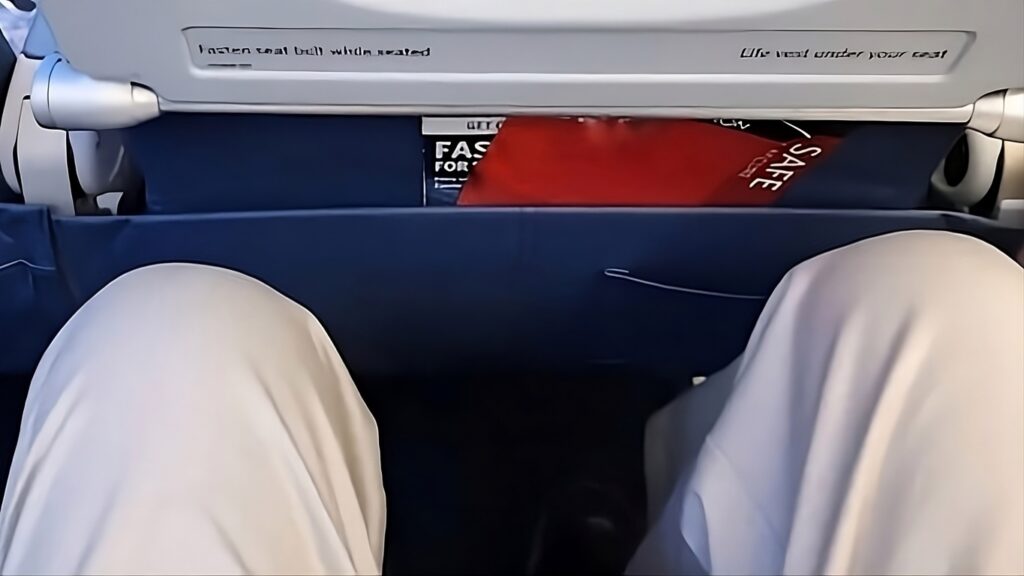
Economy seats on Hawaii flights are getting harder to find, and it is not because demand suddenly changed. Airlines are rebuilding their planes, so there are fewer of these seats to sell. This is no pricing trick nor a temporary shift. It is a structural one, already underway at every airline serving the islands. Economy is no longer the backbone of the aircraft. It is what remains after everything else has been prioritized and sold.
New United widebody jet epitomizes the future of Hawaii air travel.
Look at the seat map below and the message is unmistakable. Out of 222 total seats, just 84 are standard economy. That is barely more than one-third of the aircraft. Everything else is premium in one form or another, stretching from the nose all the way back past the second set of doors.
There are 64 business class suites, including eight new oversized ones that are roughly 25% larger than the airline’s standard business product and positioned as a tier above what business class used to be. Behind that sits a full 5-row premium economy cabin with 35 seats. Then come 39 extra legroom economy seats.
Only after all of that do you arrive at regular economy, compressed into the plane’s tail in a dense 3-3-3 layout. Premium seating runs from the nose back to roughly row 24. And it shows where airlines now believe the money is and who is being squeezed to make room for it.
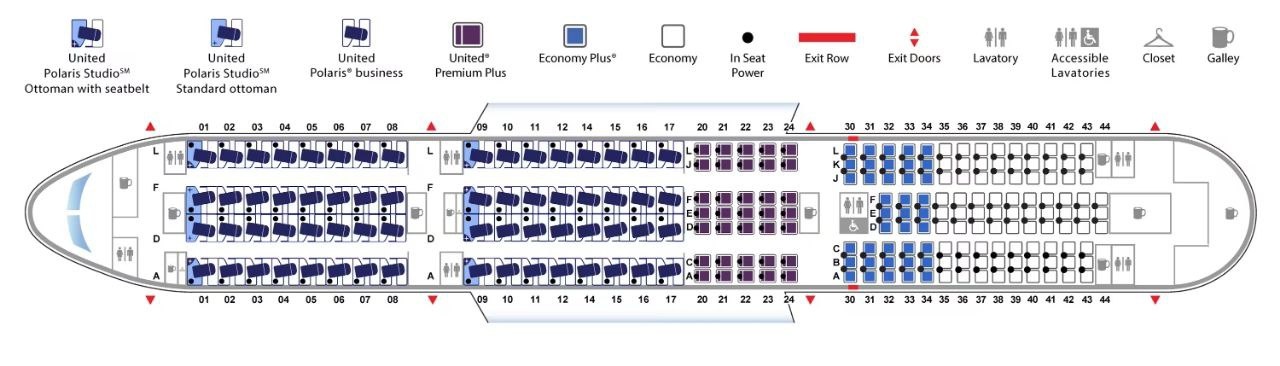 United calls their new premium-heavy 787-9 Dreamliner, “United Elevated.”
This plane is not flying to Hawaii yet, but the idea is.
The first routes for this aircraft are long-haul international flights. So while Hawaii is not on any initial list, that detail misses the bigger point. This layout is not a one-off experiment. The strategy includes plans for roughly 30 of these aircraft in service by the end of 2027.
West Coast to Hawaii flights will fit this model perfectly. They are already long enough for premium upsells to be important. They attract leisure travelers who are willing to pay more for comfort. What this seat map shows isn’t about one route or one airline. It is about how airlines expect to make money going forward, including on Hawaii flights that were once built around volume and economy seating.
What this means when you try to book a Hawaii flight.
This is not theoretical for Hawaii travelers. We reported last summer in Hawaiian’s A330 overhaul could drop 60 economy seats, that its upcoming widebody retrofit could eliminate a huge number of standard economy seats per aircraft to make room for new lie-flat suites and a premium economy cabin that never existed before. That estimate was based on direct comparisons with Delta’s A330 updated configuration and showed exactly where the space has to come from.
That is the same thing that’s playing out here, only taken further. The new widebody seat map shows the endpoint of a process that all airlines flying to Hawaii are already in the middle of.
Fewer economy seats on any given flight means fewer chances to grab lower fares when demand rises. When those newly limited seats sell out, prices can jump faster and harder. Families feel it first. Hawaii residents feel it constantly.
Premium economy has been sold as a new middle ground.
For some travelers, it serves another purpose. It both creates a costly new rung on the Hawaii flight pricing ladder and takes physical space away from the traditional economy.
On this Dreamliner plane alone, segmentation by class will be four layers deep. There is regular economy. There is extra legroom economy. There is premium economy. There is a business class. And within business class, there is now a super-premium layer on top with larger suites and upgraded service and food. The aircraft is not getting bigger. The economy slice is getting significantly smaller.
This is not about one carrier copying another. It is an industry-wide decision to trade economy capacity for higher-yield cabins on long routes, including Hawaii.
This is the physical proof of what we warned about last year.
Back in November, we wrote about premium economy to Hawaii and where it was headed. The conclusion then was clear. Airlines were slicing and dicing the cabin more strategically and charging more people more money for these incremental upgrades.
What has already changed since then is that segmentation is no longer just a pricing theory. It is a physical fact built into the aircraft itself, as the seat map depicts. When Hawaiian’s A330 refurb is announced, you will see it once again. When planes are configured this way, the decision has been made. There is no way to add economy seats later without tearing the interior apart.
We hear the consequences constantly from readers, and we experience them ourselves. The economy feels tighter. Fewer seats are available at reasonable prices. Premium economy sells out earlier. Business class takes up more of the cabin than it used to.
For travelers who remember when flying to Hawaii in economy was tolerable, the shift feels intentional. For those booking going forward, it’s simply becoming the new normal. We invite your comments.
Get Breaking Hawaii Travel News