
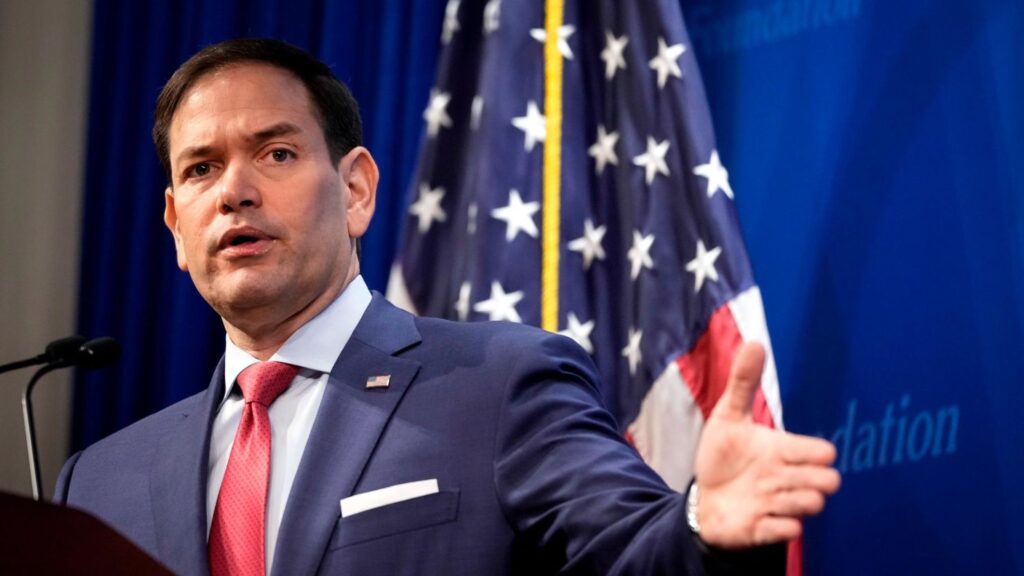
Rubio at the Munich Conference, where Kosovo is also expected to participate

Express newspaper
10/02/2026 17:37
US top diplomat Marco Rubio will travel to Germany later this week and lead a high-level delegation to the Munich Security Conference before heading to Slovakia and Hungary.
The 62nd Munich Security Conference will be held from February 13 to 15, and is expected to be attended by hundreds of world leaders, including from Kosovo. Kosovo President Vjosa Osmani, acting Prime Minister Albin Kurti, and the head of the Kosovo Intelligence Agency, Petrit Ajeti, are expected to be in Munich.
Serbia is also expected to have representatives at the Conference, including President Aleksandar Vučić, Chief Diplomat Marko Đurić, and several other ministers. Meanwhile, other countries in the region are also expected to be represented in Munich by senior officials, including prime ministers.
Rubio’s participation in this conference comes at a crucial moment, when Washington and European allies are facing growing mistrust regarding security, trade and the future of the transatlantic alliance, and these tensions are expected to dominate the discussions in Munich.
Russia’s war in Ukraine, which enters its fifth year at the end of February, is expected to be a major topic of discussion at the Conference, as well as tensions related to Iran.
Rubio’s participation in the Conference in Germany will be followed by a diplomatic tour to Bratislava and Budapest on February 15 and 16, highlighting the US administration’s focus on Central Europe at a time of strategic uncertainty.
In Slovakia, he is expected to meet with senior officials to advance regional security cooperation and nuclear energy projects, the U.S. State Department said. In Hungary, meanwhile, the focus will be on bilateral relations and peace efforts aimed at resolving global conflicts.
The highlight of Rubio’s trip will be the speech in Munich on February 14, which is expected to be closely watched, especially after US Vice President JD Vance’s speech at this conference last year received a great response.
At the time, Vance’s statements – when he accused European leaders of suppressing freedom of expression and failing to manage migration – left behind a sense of unease in Brussels and beyond.
This sense of uncertainty is also reflected in the annual report of the Munich Security Conference, compiled by the forum’s organizers and published this week, which warns that Europe is facing a “prolonged era of confrontation” fueled by Russian aggression.
Transatlantic tensions
According to the report, the biggest challenge to the liberal international order may now come “from within,” referring to what it describes as a tectonic shift in the way the US is thinking about alliances.
Calling US President Donald Trump “the most powerful of those who are attacking existing rules and institutions,” the report’s authors predict that “transactional agreements could replace principled cooperation… and regions could become dominated by great powers, rather than governed by international rules and norms.”
The US ambassador to NATO, Matthew Whitaker, has strongly rejected the assessment of an “internal threat”, arguing that Washington aims to rebalance, not destroy, the post-war order.
Speaking to reporters on February 9, Whitaker rejected the idea that the US is moving away from enduring alliances.
“We are trying to make NATO stronger,” he declared, arguing that the pressure on European allies to spend more on defense is related to increasing capabilities, not abandoning the alliance.
On trade, he presented the US stance as a response to what he called unfair inequalities.
Regarding Greenland, which Trump has said he wants the US to take control of, Whitaker said this goal is related to security concerns related to Russia and China. /REL