
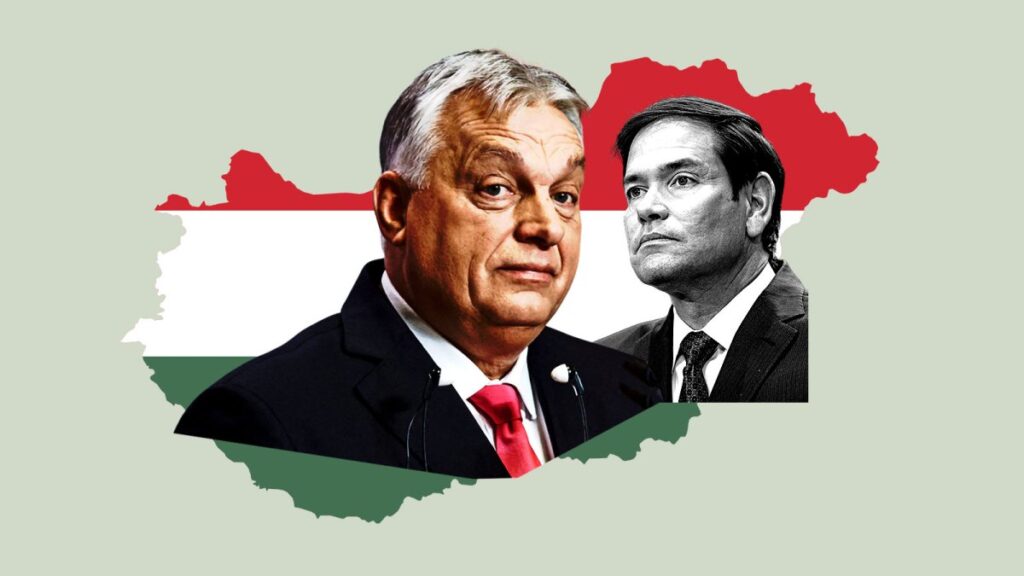
Marco Rubio will travel to Hungary this week in a show of support for its prime minister, Viktor Orban, who is in danger of losing his 16-year grip on power.
Orban, an opponent of European Union policies on Ukraine, immigration and LGBT rights, is facing an unprecedented challenge from Peter Magyar, a former government insider whose Tisza Party is the frontrunner in opinion polls ahead of parliamentary elections in April.
The US secretary of state will spend two days in Budapest from Sunday. Last week, President Trump called Orban “a truly strong and powerful leader” and “a true friend, fighter, and WINNER” in a social media post.
His endorsement and Rubio’s visit are in line with the new US national strategy, which was published in December. The 33-page document, seen as marking a generational shift in American foreign policy, said Washington would step up its support for “patriotic European parties” to avert what it called the danger to “western identity” caused by immigration.
• Ukraine victory ‘would be a miracle’, Orban tells Trump
Washington’s top diplomat will also visit Slovakia, whose prime minister, Robert Fico, is another right-wing ally, after attending the annual Munich Security Conference on Friday, the US state department said.
Moscow’s biggest ally in the EU, Orban has called his style of government “illiberal democracy” and has overseen a curb on press freedoms. Trump’s vision for Europe aligns closely with that of President Putin, who said in October that only Orban could ensure that Hungarians “remain Hungarian”. Putin also said hard-right parties were the key to Europe’s rebirth.
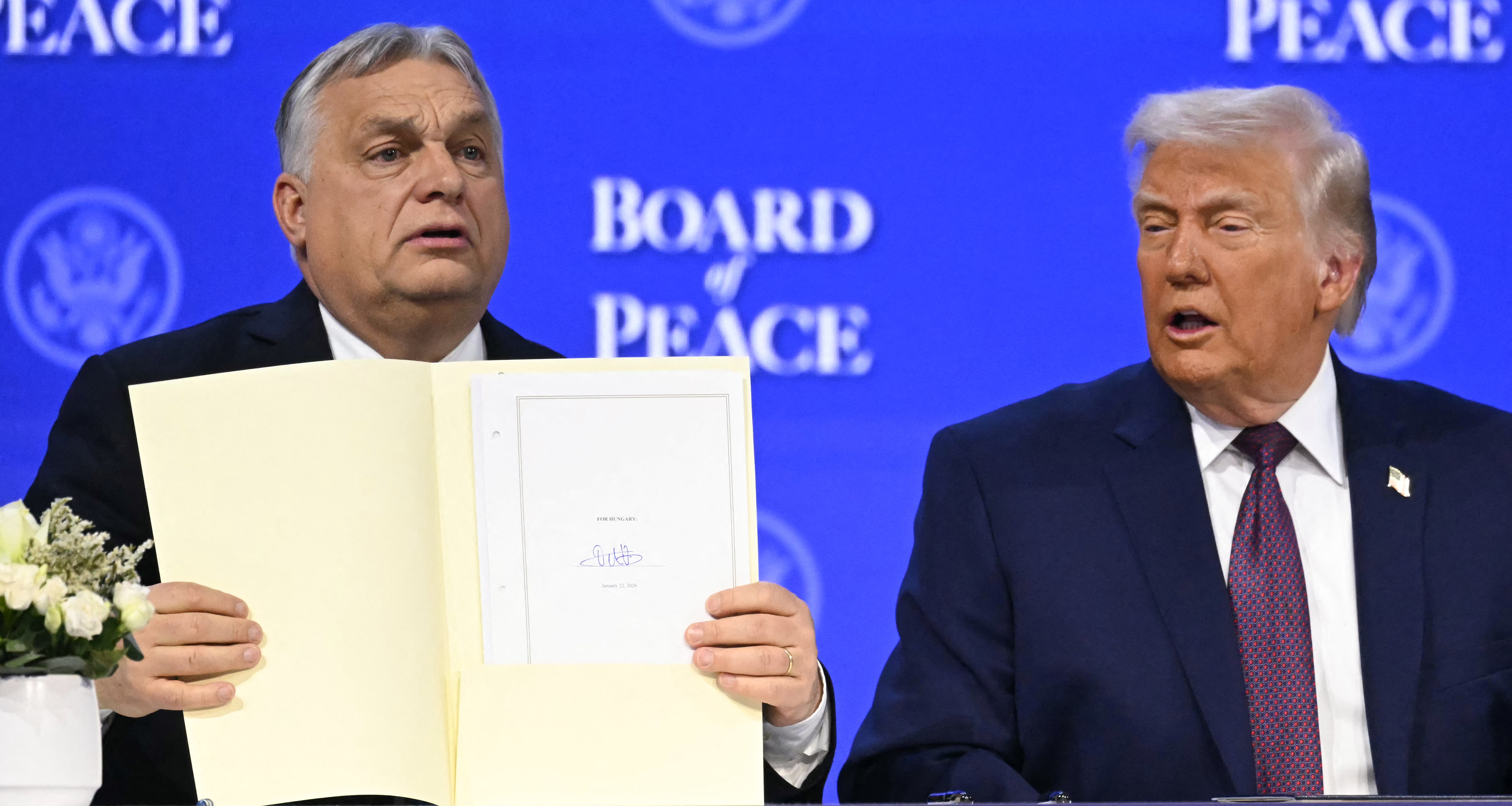
Viktor Orban with Donald Trump after joining the US president’s Board of Peace at the World Economic Forum last month
FABRICE COFFRINI/AFP
However, despite the backing of the leaders of the world’s two nuclear superpowers, Orban is under pressure at home over a cost-of-living crisis, healthcare, corruption and a child sex abuse scandal at a state-run orphanage that led to protests in December. On Tuesday, Hungary, which is also a member of Nato, was named the most corrupt country in the EU for the fourth year running by Transparency International, a watchdog based in Berlin.
Orban has also heaped praise on Trump. At his annual press conference in Budapest last month, he said the US leader had ushered in an “era of nations” that had rewritten ideas about international law. “The old world order has collapsed and a new one is taking shape,” he said.
He was also one of the first world leaders to publicly back Trump’s announcement last month for a Board of Peace aimed at resolving global conflicts. Most European countries have not signed up to the board, whose charter states that Trump will be chairman for life, or until he is incapacitated or chooses to step down. Orban is due to meet Trump at the board’s first meeting in Washington on February 19.
• Board of Peace? We don’t need the Europeans for that, say Trump allies
He held talks with Trump in November at the White House, when he secured a one-year exemption for Hungary from US sanctions on Russian oil and gas imports. Trump had previously criticised EU countries that were unable to wean themselves off Russian energy.

Viktor Orban talks to supporters during the anti-war rally
ZOLTAN FISCHER/EPA
If elected, Magyar’s party said it would end energy dependence on Russia and normalise relations with the EU. “Hungary must once and for all take its place at the table of the West,” Magyar told a rally last year.
Rubio’s visit is unlikely to give Orban an electoral boost. A poll on February 2 of 1,000 voters by the 21 Research Centre consultancy put Tisza on 53 points, ahead of Orban’s Fidesz party on 37. He had suggested that Trump could visit Budapest before the elections but this now seems unlikely, according to analysts. Orban had been prepared to host a summit between Trump and President Putin on the war in Ukraine last year, but the White House withdrew over concerns that Moscow was not serious about peace.
“Electorally, I do not expect that this is going to be a game changer,” said Peter Kreko, an analyst and head of the Political Capital think tank in Budapest. “As in almost every country. Hungarians typically vote more on domestic issues, not international policy issues.”
He also said that, while Trump enjoyed more support in Hungary than in many other European countries, his popularity was largely limited to Orban loyalists. “Just repeating again and again that Trump supports Orban … I don’t think that it really changes the [electoral] landscape.”
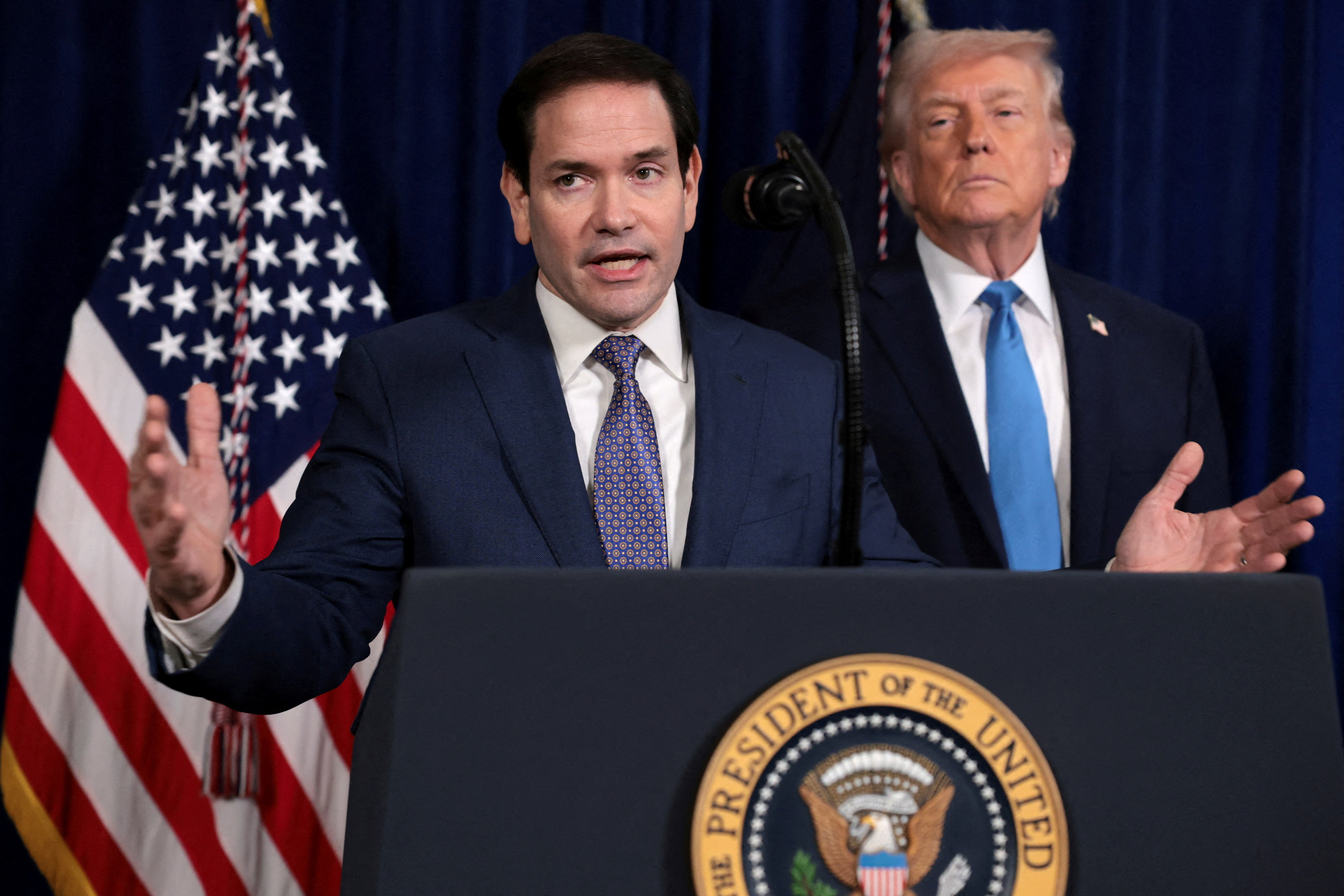
Marco Rubio, the US secretary of state
JONATHAN ERNST/REUTERS
As he trails in the polls, Orban has tried to turn the election into a referendum on the war in Ukraine. He is opposed to EU membership for Kyiv, which he says will drag Europe into a war with Russia, and has also claimed, without evidence, that a victory for Tisza would lead to Brussels forcing Hungarians to fight alongside Ukrainian troops.
Hungary’s opposition to EU policies on immigration have been lauded by hard-right figures in the West. Orban has described migrants as “Muslim invaders” and “a poison”. In 2018 he said: “We do not want to be a diverse country.”
Hungary has also refused to process asylum applications in line with EU law, a move that has led Brussels to impose a daily €1 million fine on Budapest.
Today, with western governments under pressure from populist politicians over their policies on immigration, Orban says time has proven that he was right to lock down Hungary at the start of the refugee crisis in 2015. “Most Western European countries would give their right arm to be immigrant-free,” he said last month.
He has also been backed by a swathe of hard-right leaders in Europe, including Marine Le Pen, the leader of France’s National Rally party; Alice Weidel, co-leader of Alternative for Germany; and Giorgia Meloni, the Italian prime minister. He has also been endorsed by Binyamin Netanyahu, the Israeli prime minister, and Javier Milei, the Argentinian president.
Balazs Orban, the prime minister’s top aide, who is no relation, said last month that Budapest was concerned that a future economic and security collapse in the EU could lead millions of people from western Europe try to take refuge in Hungary.
“The biggest question will be how to defend [our] borders from the West,” he said in an interview in the Hungarian capital.
Such rhetoric has turned Hungary into a magnet for ultra-conservatives from across the Europe and the US. At Orban’s press conference in Budapest, a journalist from the Netherlands asked him if he would like to see Trump liberate the people of Britain and the EU from “socialist dictatorship.” Orban did not respond.
JD Vance, the US vice president, has completed a two-day trip to Armenia, a former Russian ally in the South Caucasus region. His visit, the first to Armenia by a sitting US vice president or president, follows a White House-brokered deal with neighbouring Azerbaijan for a transit corridor to be called the Trump Route for International Peace and Prosperity. The transit route will connect Azerbaijan and its autonomous Nakhchivan exclave through an area of Armenian territory 20 miles wide.
The deal for the corridor was agreed on in Washington in August when Trump hosted the Armenian and Azerbaijani leaders in an attempt to secure a lasting peace between the two countries, who have fought two wars over the Nagorno-Karabakh region.