
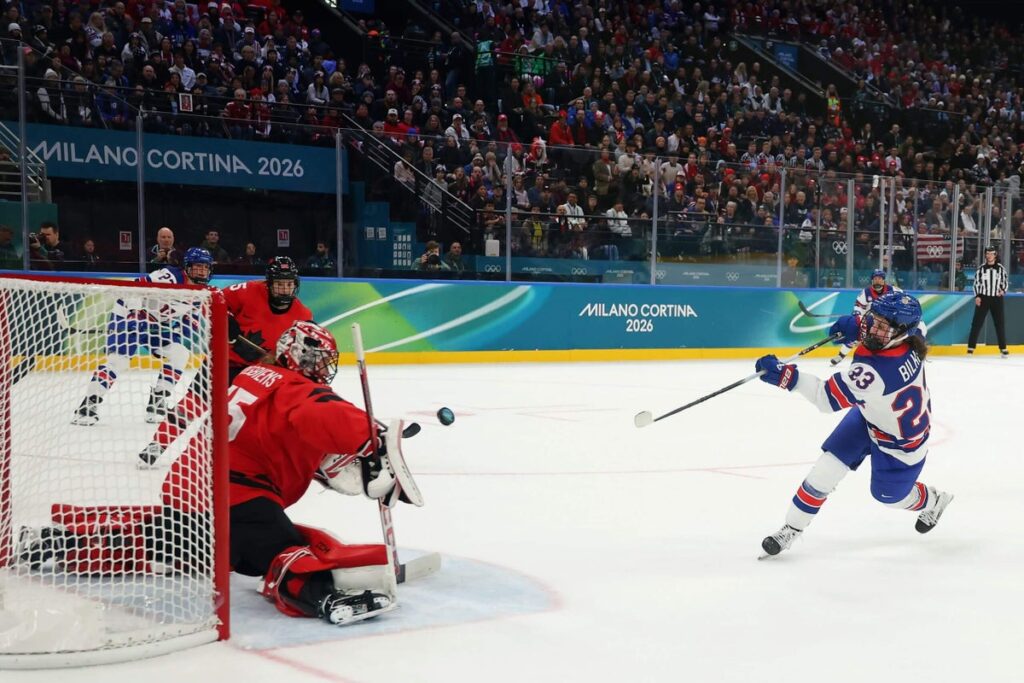
MILAN — In what was likely a gold-medal game preview between women’s hockey powers, the United States and Canada, the Americans picked up right where they left off in their dominant four-game sweep of their rivals to the north earlier this winter.
There’s no denying that this time Canada was without Marie-Philip Poulin, who is still regarded as the best player in the world. She sustained a lower-body injury Monday night against the Czech Republic and missed Tuesday’s preliminary round game against the United States.
But with Poulin in the lineup, the U.S. outscored Canada 24-7 in four Rivalry Series victories in November and December and easily took a 5-0 victory on a new battlefield at Milano Santagiulia Ice Hockey Arena.
Caroline Harvey, the two-time Olympian and presumptive No. 1 pick in the upcoming PWHL Draft, picked up right where she left off after a three-point performance the night before against Switzerland. She scored another goal and two assists.
Abbey Murphy had three assists. Hannah Bilka also scored two more goals, Kirsten Simms and Laila Edwards added the other goals and Aerin Frankel made 20 saves for her third victory in the tournament and second shutout.
The United States has three shutouts in four games, improved to 4-0 in the Olympics and has outscored its opponents 20-1.
All of USA Hockey’s men’s management group was in the crowd, as were most of the players to support the women’s national team.
This was the final game of group play for the United States, as the team advanced to the quarterfinals to play Italy. Canada plays Finland on Thursday — a rescheduled prelim game due to Team Finland’s norovirus outbreak.
Murphy breaks out with a big night
Murphy’s fingerprints were all over this game.
She tallied three assists, including a no-look backhand pass for Bilka’s second goal of the night, and got under Canada’s skin at every opportunity. In the first period, she collided with Ann-Renée Desbiens and locked her legs around Canada’s goaltender, which drew the ire of Sarah Fillier, who retaliated with an interference penalty.
Later in the game, Kristin O’Neill gave Murphy a cross-check, which got a grin from Murphy as she got up and O’Neill went to the box. In all, Murphy drew four of Canada’s five penalties, with Team USA scoring on the power play once. Julia Gosling said Murphy was effective and that next time Canada “needs to be careful on some of the hits because she goes down kinda easily sometimes, we find.”
Still, this was the personification of the perfect Murphy game, with her eye-popping skill and ability to get into Canada’s head on display. Canada, meanwhile, played right into her hand, giving a dangerous American power play time to get to work.
“Players are finishing passes, so that’s awesome, but trying to find a fine line of playing aggressive, playing hard,” Murphy said. “Drawing those penalties is fun, but, you know, people are gonna say, ‘Be on your feet,’ but whatever, I don’t even care. It’s a team win.”
Ryan wasn’t happy the way Canada handled Murphy.
“The instigator, agitator, kinda rat side of her is something that she does very well,” Ryan said. “There’s very few people that can play that role, but also back it with some skill and some dynamic side. That’s very difficult to manage. You’ve got someone that can draw the penalties and then someone that can finish on the power play. So she’s a great player.
“My advice to our team historically in situations like that, if players are going to play that way against you, you’ve got to make decisions yourself. Can you match it? And if you can match it, the only way you engage in that sort of activity is if you think you can do it better. If you don’t think you can do it better, you just turn the other cheek and move on. She deserves a lot of credit for the way she plays. She’s very effective and can be impactful in games, but it’s important for us to not get caught up in it.”
Knight ties U.S. Olympic scoring record
Hilary Knight, the future Hockey Hall of Famer, was credited with the secondary assist on Harvey’s first-period goal.
That tied Jenny Potter’s United States Olympic record with 32 points (14 goals, 18 assists).
If she scores again in the tournament, in what will be her final of five Olympics, it will break the record for most Olympic goals by an American. She shares that mark with Natalie Darwitz and Katie King.
“It’s hard to put into words,” 22-year-old Haley Winn said of playing with Knight, 36. “She’s someone a lot of us have looked up to since we were little. I know I have a picture with her from when I was probably seven or eight. So to be able to play on a team with her, it leaves you kind of speechless, and you learn so much from her on and off the ice.
“She’s a great mentor, so to see her do so well, it isn’t really a surprise for us, but she’s definitely leading the team by example. So we’re lucky to have her.”
Marie-Philip Poulin’s absence felt
By now, we’ve all seen the videos of the moment Poulin was hit by Czech forward Kristýna Kaltounková. Poulin stayed down on the ice for a moment, grimacing, and eventually skated back to the bench, putting minimal weight on her right leg.
She did not play in Tuesday’s game, but was in attendance in a suite with No. 3 goalie Kayle Osborne — and was given a nice applause by the crowd when shown on the center-ice video screen at the start of the second period.
That Poulin did not play isn’t really worth reading into. At least where her availability for the remainder of the tournament is concerned. There’s optimism from Canada that Poulin will be able to return at some point before the end of the tournament. When that happens is still in question.
In 2021, Poulin missed the U.S. preliminary round game — which Canada won 5-1 — after taking a puck to the throat. She returned in the quarterfinals to a minimal role to gear up for the gold medal game, where she scored another game-winner.
If Poulin indeed returns in Milan, we can likely expect something similar. There’s just no need to risk playing her until the group stage is over. As heated as the rivalry is, Tuesday night’s game only counts for placement with all five teams in Group A — including Canada — moving on to the quarterfinals.
Canada’s quarterfinal match is four days away (Feb. 14); A return in the semifinals (Feb. 16) would give Poulin even more time to rest and be at her best when it matters most for the Canadians.
How did Canada respond?
Tuesday was our first real look at Team Canada without Poulin, without the emotion and adrenaline of wanting to win for their captain on Monday night. And it wasn’t all that impressive.
Canada mustered only four shots on goal to Team USA’s two goals in the first period. By the end of the second, Canada still only had 10 shots. They failed to establish a consistent and strong forecheck and had several defensive miscues that led directly to goals by Team USA.
The Sarah Nurse, Sarah Fillier and Daryl Watts combo took on the “top-line” role and only got two shots on goal. Ryan also went back to his faithful Laura Stacey, Blayre Turnbull and Emily Clark line that he called “an anchor” for the team. And to her credit, Stacey might have been Canada’s best player.
The goalie interference review
There were two reviews on Simms’ second-period goal, her first at the Olympics.
First, the refs looked to ensure the puck completely crossed the line, which it did. Then, Ryan challenged for goaltender interference. After a lengthy review, the refs maintained it was a good goal, despite the clear contact in the crease.
Kristin O’Neill also got into the blue paint, so it’s fair to assume that negated Simms’ interference in the eyes of the refs. But the rulebook states that a goal would be disallowed if an attacking player impedes the goalkeeper’s ability to move freely and defend the goal.
The moment ultimately didn’t matter in the end. There was a lot more going wrong for Team Canada than a bad review. Just add it to the list of examples of puzzling goalie interference calls.