
Neighbors in the area say the property owner is not playing by the rules. Landowner disagrees, saying his plan will help the environment.
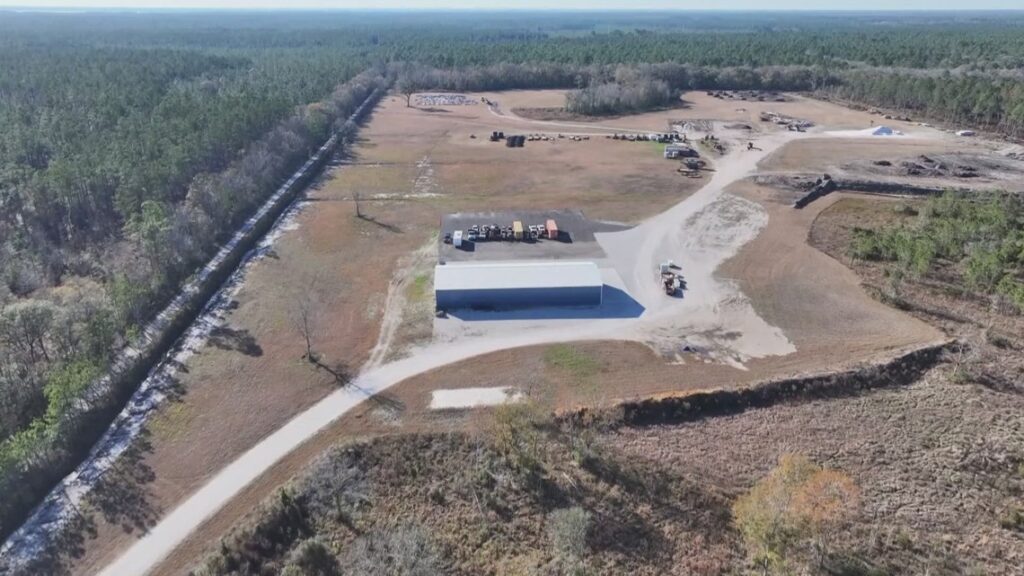
ST. JOHNS COUNTY, Fla. — A 73-acre piece of land in the countryside of St. Johns County is at the center of a community debate as its owner wants to create a recycling facility on it; however, people who live nearby say it looks like a junkyard.
Residents say the owner is not playing by the county’s rules and his plan is wrong for their rural way of life in the equestrian area.
At its core, this is a story about not wanting something in your own backyard but on a broader level, it’s about two perspectives regarding environmental impact.
Mike Hardee lives inside an equestrian community in western St. Johns County.
So does his neighbor Mike Gray.
“I’ve lived here for 15 years,” Gray nodded.
“It’s rural. It’s open,” Hardee described the area. “It’s just a beautiful place out here.”
Hardee is a former environmental agent with the State Attorney’s Office. Gray is a former Navy SEAL and federal agent. These two former law enforcement officers appreciate the wildlife here, but they’re not wild about what’s happening on the other side of the narrow forest, close to their homes.
Starting in early 2025, Hardee reported to the county several times that it appeared commercial activity was taking place on that nearby property, when it’s not zone for it and does not have a license for it. On top of that, Hardee, Gray and their neighbors heard “the cacophony of loud tractors.”
They smelled and saw smoke from fires on the property. And they wondered about the piles of concrete, tires, metal containers, and sand that are visible from the public walking trail.
“There’s junk all over the place,” Gray said. But… one man’s junk is another man’s treasure, that man being Steven Stratton.
Stratton owns that 70+ acres. He also owns a construction company in East Palatka, dealing in grading, excavation, and land clearing for residential and commercial projects, according to his Facebook page. This property in St. Johns County has been mostly cleared, with some gravel roads wrapping around it.
Stratton bought the land in 2021 on County Road 13, right next to the Watson Island State Forest, hoping to turn it into a recycling facility. He is still trying to make that happen.
In April 2025, Code Enforcement issued Stratton a warning, ordering him to stop doing any work that wasn’t agricultural and to remove any heavy equipment and vehicles not related to its zoning. It’s zoned “open rural”. Seven months later, in November, St. Johns County issued a STOP WORK ORDER to Stratton.
A St. Johns County building official told First Coast News the STOP WORK ORDER was also issued to give the county some time to figure out what Stratton is doing… or wants to do… on the property.
“In a lot of people’s eyes, it looks like I’m doing something I’m not supposed to be, but I happen to own a concrete crusher, and this was on my property,” Stratton said.
He said he hasn’t used the crusher since he was told not to. But heavy equipment remains on site as of late January.
And he burns the vegetation in preparation for his planned recycling business, in which he plans to recycle certain items such as tires. “Tires can be reused for a lot of stuff,” he noted, saying the goal was to sell the shredded and broken-down materials to companies that would turn them into other products. Stratton said recycling this trash is better for everyone than sending it to the landfill.
“I don’t want to leave this for my great-grandchildren to deal with. We can repurpose everything just about and probably everything… if we really try, and if we start now.”
But, and this is a big “but”, Stratton’s land is not zoned for this kind of operation, and he doesn’t have a permit for it. He is applying for one, and he said he is resubmitting his business plans to the county.
Stratton believes it’s a project to help the environment in the long run, but his neighbors are worried about their environment now.
“So once he gets that facility established, who’s going to regulate him?” Hardee told First Coast News. “They’re not regulating him now.”
Stratton said, “Knowing what I know, it wouldn’t bother me as long as it was like what I’m doing. It’s going to be aesthetically fine. There is zero risk of contamination.” He added, “As long as the person who put it next to me did not clear it where you could see it from the highway and everything else… and make it look like a dump… I wouldn’t have a problem with it.”