
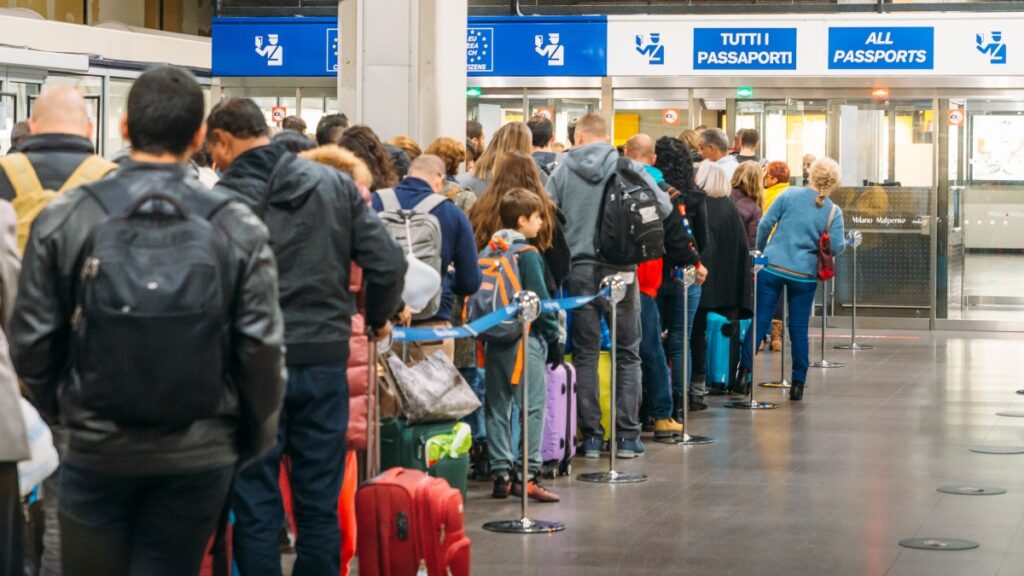
Holidaymakers face the “real prospect” of four-hour queues at European airports this summer, airlines have warned.
Bodies representing airlines and airports have written to Brussels calling for “immediate action” over the roll-out of strict border measures for non-EU arrivals.
They warned that “non-EU travellers are experiencing massive delays and inconvenience” because of the new Entry/Exit system (EES), which launched in October last year.
• EES delayed: new rules for visiting Europe explained
Under the rules, non-EU passport holders arriving in the bloc must submit their fingerprints and have their photographs taken on entry. The biometrics are then verified on departure and at every subsequent visit.
At present, only 35 per cent of arrivals are required to undergo the checks and border points can turn off the system in the event of overcrowding. Skiers arriving in Geneva this winter have already faced waits of more than four hours for the checks.
Airports Council International, Airlines for Europe and Iata, the airline trade body, have written to Magnus Brunner, the EU commissioner for internal affairs and migration, to warn that there have already been “persistent excessive waiting times of up to two hours at airport border control.”
They said: “Failing immediate action to provide sufficient flexibility, severe disruptions over the peak summer months are a real prospect, with queues potentially reaching four hours or more.”
They added that there were “three critical issues that are compounding EES delays”, including “chronic border control understaffing, unresolved technology issues, especially with regard to border automation, and the very limited uptake of the Frontex pre-registration app by Schengen states”.
The use of a pre-registration app would allow arrivals to complete some of the additional checks before arriving at the border.
Olivier Jankovec, the director general of ACI, said: “There is a complete disconnect between the perception of the EU institutions that EES is working well, and the reality, which is that non-EU travellers are experiencing massive delays and inconvenience. This must come to an end immediately.
“We need to be realistic about what will happen during the peak summer months, when traffic at Europe’s airports doubles. The rollout of EES must be flexible to react to operational realities. This is an absolute prerequisite for its success — and for safeguarding the reputation of the EU as an efficient, welcoming and desirable destination.”
• One in five Britons could have their holiday ruined by their passport
Last week the EU signalled that it was open to allowing some flexibility but said that there had been no formal extension to the roll-out, which is due to be completed by April.
“The progressive deployment of the EES will end on April 9, 2026,” Markus Lammert, the European Commission spokesman, said. However, he confirmed that member states will still be able to partially suspend EES operations where necessary during a period of an additional 90 days “with a possible 60-day extension to cover the summer peak”.
However, the trade bodies are lobbying for Brussels to formally allow members to “partially or totally suspend EES until the end of October 2026”.
They said: “Under the progressive approach [set out in EU law], the suspension mechanisms would no longer be available beyond early July. Today, it remains unclear whether such suspension could still be activated with the necessary flexibility under the conditions set by the Schengen border control code for the relaxation of border control checks.”