
Bio-Based Coatings Market
The bio-based coatings market is gaining significant traction as industries and consumers alike prioritize sustainability and environmental responsibility. With increasing regulations and evolving consumer preferences, this sector is poised for remarkable growth and innovation. Below, we explore the market’s size, key players, emerging trends, and segmentation details to understand its current landscape and future outlook.
Projected Expansion of the Bio-Based Coatings Market by 2030
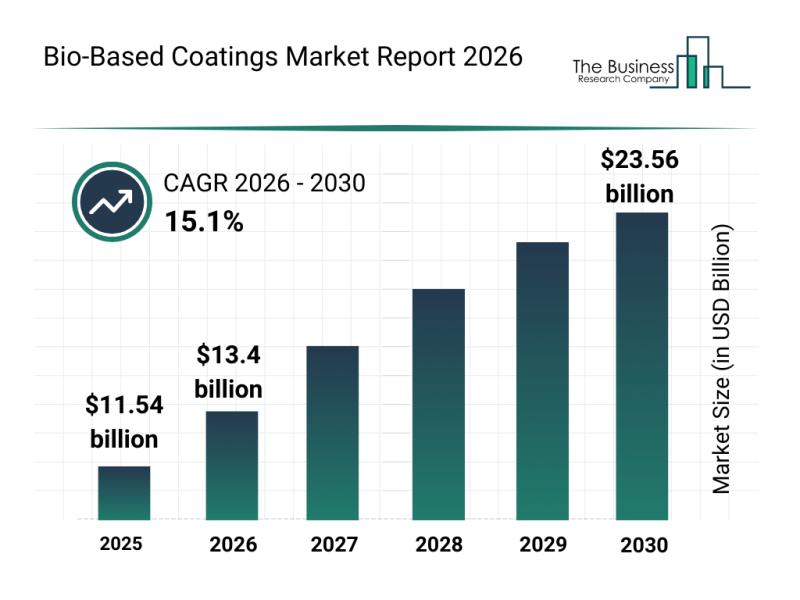
The bio-based coatings sector is expected to experience rapid growth, reaching a valuation of $23.56 billion by 2030. This expansion corresponds to a compound annual growth rate (CAGR) of 15.1%. Several factors contribute to this growth forecast, including stricter regulations on solvent emissions, rising demand for eco-friendly coatings, and the growing momentum of green building initiatives. Additionally, increased use of bio-based raw materials and ongoing advancements in coating formulations are driving the market forward. Key trends shaping the future include wider adoption of low-VOC and zero-VOC coatings, growth in bio-based industrial coatings, and a stronger focus on environmentally compliant architectural applications.
Download a free sample of the bio-based coatings market report:
https://www.thebusinessresearchcompany.com/sample.aspx?id=7751&type=smp&utm_source=OpenPR&utm_medium=Paid&utm_campaign=Feb_PR
Key Drivers Behind the Growth of the Bio-Based Coatings Market
One important factor accelerating this market is the tightening of regulatory standards aimed at reducing solvent emissions. These restrictions encourage manufacturers and consumers alike to shift toward coatings with lower environmental impact.
Simultaneously, there is a growing consumer and industrial demand for sustainable coatings that rely on renewable raw materials. This trend supports the expansion of bio-based product lines and encourages continued innovation within the coatings industry.
Leading Companies Defining the Bio-Based Coatings Industry
The bio-based coatings market features several dominant players, including BASF SE, Cargill Incorporated, AkzoNobel N.V., PPG Industries Inc., The Sherwin-Williams Company, Nippon Paint Holdings Co. Ltd., Stora Enso OYJ, KCC Paints Sdn Bhd, NOROO Paint & Coatings Co. Ltd., Jiangsu Heshili New Material Co. Ltd., SK Chemicals Co. Ltd., Axalta Coating Systems, Behr Paint Co., Hempel A/S, Jotun A/S, Kansai Paint Co. Ltd., Tikkurila Oyj, Valspar Corporation, Chugoku Marine Paints Ltd., Cloverdale Paint Inc., and Diamond Vogel Inc.
In a notable market move, BirlaNu Limited, an Indian company focusing on building materials and construction chemicals, acquired Clean Coats for $13.5 million in November 2025. This acquisition aims to broaden BirlaNu’s portfolio in coatings, waterproofing, and specialized construction chemicals. Clean Coats is recognized for producing high-performance coatings, epoxy and polyurethane flooring, anti-corrosion linings, and protective surface coatings tailored for industrial, infrastructure, and water management projects.
View the full bio-based coatings market report:
https://www.thebusinessresearchcompany.com/report/bio-based-coatings-global-market-report?utm_source=OpenPR&utm_medium=Paid&utm_campaign=Feb_PR
Emerging Directions and Innovations in the Bio-Based Coatings Market
Leading firms in the bio-based coatings space are actively developing new products to expand their market reach and boost sales. A notable area of innovation is food packaging coatings, which are applied to packaging materials like paper, cardboard, plastic, and metal to offer protection, functionality, and aesthetic qualities.
For example, in July 2023, Melodea Ltd., an Israel-based coatings manufacturer, introduced MelOx NGen, a plant-based, water-borne bio-coating designed specifically for the inner surfaces of various plastic food packaging formats such as films, pouches, bags, lidding, and blister packs. This product serves as an environmentally friendly and cost-effective alternative to petroleum-derived Ethyl Vinyl Alcohol copolymers (EVOH), which are widely used for their food preservation capabilities and are common in manufacturing met-PET lids.
Detailed Segmentation of the Global Bio-Based Coatings Market
This market is divided into multiple segments to provide a clear picture of its composition:
1) By Type: Ester Solvents, D-Limonene
2) By VOC Content: Zero VOC (less than 5 grams per liter), Low VOC (less than 50 grams per liter), Natural Paints
3) By Sector: Commercial Sector, Industrial Sector, Residential Sector
4) By Use: Decorative Paints, Transportation, Metal Industrial Coatings, Industrial Maintenance and Protective, Automotive Refinish, Wood Coatings, Packaging Coatings
5) By Area of Application: Internal Application, External Application
Further subcategories include:
– Ester Solvents: Ethyl Lactate, Methyl Ester Solvents
– D-Limonene: Pure D-Limonene, D-Limonene Blends
This comprehensive segmentation helps stakeholders identify specific opportunities and tailor strategies to meet diverse customer needs across industries and applications.
Reach out to us:
The Business Research Company: https://www.thebusinessresearchcompany.com/,
Americas +1 310-496-7795,
Europe +44 7882 955267,
Asia & Others +44 7882 955267 & +91 8897263534,
Email us at info@tbrc.info.
Follow Us On:
LinkedIn: https://in.linkedin.com/company/the-business-research-company,
Twitter: https://twitter.com/tbrc_info,
YouTube: https://www.youtube.com/channel/UC24_fI0rV8cR5DxlCpgmyFQ
Learn More About The Business Research Company
With over 17500+ reports from 27 industries covering 60+ geographies, The Business Research Company has built a reputation for offering comprehensive, data-rich research and insights. Armed with 1,500,000 datasets, the optimistic contribution of in-depth secondary research, and unique insights from industry leaders, you can get the information you need to stay ahead.Our flagship product, the Global Market Model (GMM), is a premier market intelligence platform delivering comprehensive and updated forecasts to support informed decision-making.
This release was published on openPR.