
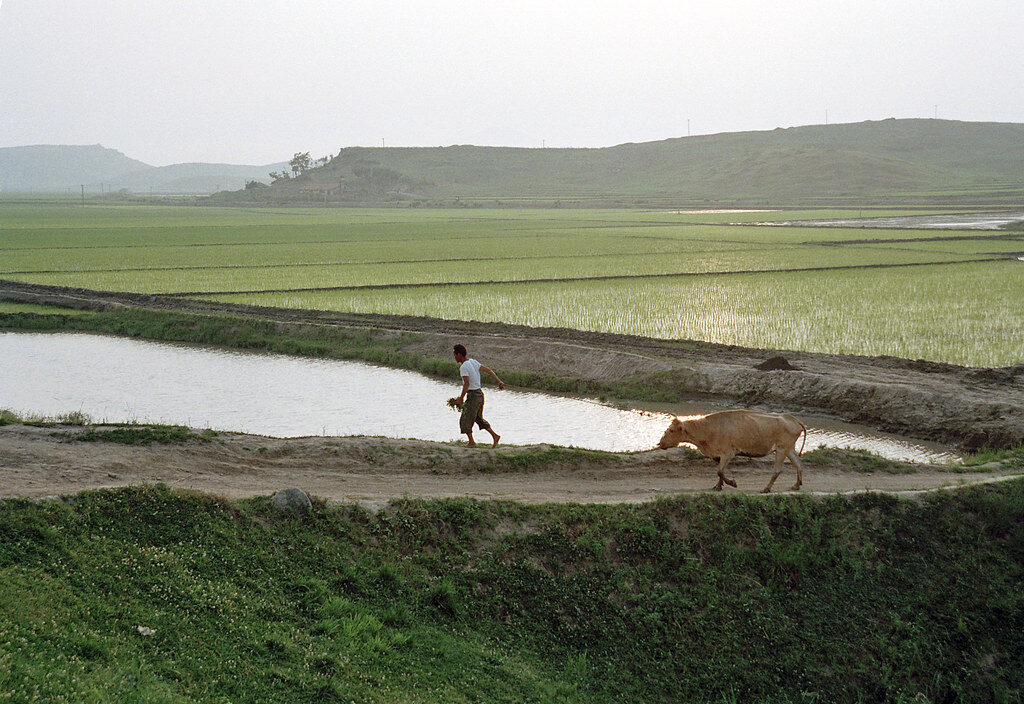
 A farmer with his cow near Pyongyang, Democratic Republic of Korea (DPRK).
Photo ID 161914. 24/06/1997. Pyongyang, DPRK. UN Photo/James Bu.
A North Korean farm worker in Chongjin was publicly criticized by managers after submitting coal dust instead of proper manure, and he was warned on Jan. 30 that the violation might reduce his share of the fall harvest at a collective farm in the Songpyong district, Daily NK has learned.
A source in North Hamgyong province told Daily NK recently that the worker was criticized by name during an all-hands meeting on the farm. The source requested anonymity for security reasons.
Farm managers criticized the worker for handing in manure that consisted entirely of coal dust without any night soil or livestock dung. The worker had blatantly disregarded the requirement for manure to include either human or livestock excrement, the managers said.
“The manure collected from agencies, enterprises and schools is not nearly enough to cover all the crop fields. As a result, this farm instructed each individual worker to submit enough manure to cover half a hectare (1.2 acres). But workers who struggled to gather that much night soil or dung made do by mixing in some dirt or coal ash,” the source said.
The farm managers were aware that most workers were skimping on the actual excrement content in their manure submissions. But this worker incurred their displeasure by brazenly submitting “manure” consisting entirely of coal ash.
“While the other farm workers didn’t totally meet the requirements, they at least checked the boxes. But this worker’s violation was so blatant that he was taken to task,” the source said.
Public warning sparks anxiety among workers
In addition to the worker’s public tongue-lashing, farm management reportedly promised to “rigorously calculate” his share of the fall harvest, suggesting that he face disadvantages when crops are distributed on the farm. That implicit threat is stoking anxiety among the other workers.
“None of the workers are able to guarantee 100% purity in their manure submissions, so making an example out of one worker could impact the entire farm. The other workers were shocked that the management linked manure quotas to the harvest distribution and expressed their frustration at the penalized worker for making trouble,” the source said.
Since farm workers are expected to meet quotas on twisting ropes and making grain sacks in addition to rounding up manure, the incident has reportedly left them anxious about potential repercussions.
“This is a tough time for everyone because of frantic preparations for the winter planting, and nobody wants the mood to be spoiled by one person’s poor behavior. Everybody is nervous about what might happen if they get on the managers’ bad side,” the source said.
Daily NK operates networks of sources inside North Korea who document events in real-time and transmit information through secure channels. Unlike reporting based on state media, satellite imagery, or defector accounts from years past, our journalism comes directly from people currently living under the regime.
We verify reports through multiple independent sources and cross-reference details before publication. Our sources remain anonymous because contact with foreign media is treated as a capital offense in North Korea—discovery means imprisonment or execution.
This network-based approach allows Daily NK to report on developments other outlets cannot access: market trends, policy implementation, public sentiment, and daily realities that never appear in official narratives. Maintaining these secure communication channels and protecting source identities requires specialized protocols and constant vigilance.
Daily NK serves as a bridge between North Koreans and the outside world, documenting what’s happening inside one of the world’s most closed societies.