
The sight of Kremlin-backed Bosnian Serb secessionist Milorad Dodik returning to Washington, D.C. for an official visit last week, after he spent much of the past decade under U.S. sanctions, is deeply troubling. Dodik and his regime are the most militant element in the Western Balkans, which is precisely why the Obama administration, the first Trump administration, and the Biden administration all imposed sanctions against him and his associates.
Now, despite his removal from office last year as a result of a Bosnian appeals court decision for ignoring the legally binding authorities of the internationally-appointed High Representative and those of the country’s Constitutional Court, and despite entry bans imposed on him by half a dozen European states, Dodik is free of U.S. sanctions. Not surprisingly, he is treating the Trump administration’s policy shift as a political lifeline.
Yet for advocates of Bosnia and Herzegovina’s efforts to accede to the European Union and NATO, there may be the seed of an opportunity in the White House’s policy reversal. The Trump administration is prioritizing American economic and commercial interests in its foreign policy, and a proposed major trade center development in Sarajevo offers the opportunity to transform the capital into a regional investment and finance hub under the iconic American “World Trade Center” brand. But can moderate, forward-thinking Bosnian leaders seize the initiative — before Dodik consolidates his advantage in Washington?
For the moment, there is little that can be done to ameliorate the facts. The Bosnian entity that Dodik led as president at the time, Republika Srpska, hired a retinue of American lobbyists in 2025, including convicted felons (pardoned by President Donald Trump) Rod Blagojevich and Michael Flynn, at a cost of $100,000 a month of Bosnian taxpayer money for Flynn alone. The full total Dodik’s government spent on lobbying by various firms for U.S. government sanctions relief appears to be in the millions of dollars.
Dodik soon secured U.S. sanctions relief for himself and virtually his entire regime, apparently in exchange for peacefully accepting his removal from office, and for a pledge to scale back attacks on the country’s constitutional order. It is a categorical political win by a declared opponent of a unified Bosnian state and, perhaps more importantly for the Trump administration, for a longtime anti-American agitator.
But the United States remains the indispensable interlocutor for Bosnia. The United States is the architect of Bosnia’s constitution via the 1995 Dayton Peace Agreement that ended the four-year war (the constitution is an annex to the accord). And the United States remains the chief – if not exclusive – guarantor of the same. The EU, membership in which continues to be the aim of leaders in Sarajevo, lacks the ability to act with coherence in the region, owing in part to the blockades of Dodik-aligned member states such as Hungary and Croatia. Thus, maintaining close ties with Washington remains imperative for Sarajevo.
America has had little interest in Bosnian concerns for a long time. The Biden administration supported a significant retrenchment of the worst sectarian dimensions of the country’s ethnic power-sharing regime in 2022 and 2023 by supporting High Representative Christian Schmidt’s gerrymandering of the Federation entity’s electoral regime, and the Trump administration has an evident degree of ideological sympathy for Dodik and his Croat nationalist allies. Both Dodik and his Bosnian Croat political partner Dragan Covic believe the “Christian nationalist” orientation of segments of the Trump administration benefits their own sectarian aims, particularly if they can succeed in falsely painting the majority of Bosnia’s population who are Bosniaks (moderate, liberal Muslims) as latent Islamist radicals. To the contrary, the libertarian Cato Institute, for example, called Bosnia “the freest Muslim-majority country in the world.”
Urgent Need for a New Approach
For the majority of Bosnia’s populace — both the Bosniak community, and others generally committed to its statehood, sovereignty, and territorial integrity — there is an urgent need to devise a strategy for a new approach to dealing with their American counterparts, Republican and Democrat alike. The Trump administration’s broadly transactional orientation to international affairs may offer an appropriate runway to launch such a new approach.
The U.S. Embassy in Sarajevo has made clear that its focus in Bosnia is business: it wants a stake in the country’s energy sector, in particular the Southern Interconnector natural gas pipeline, and it wants to streamline access for American multinationals and other investors into Bosnia’s small but growing market economy. Both desires should be readily embraced by Bosnian officials.
Unfortunately, significant political and regulatory hurdles remain with respect to the pipeline construction. And the kinds of legislative reforms needed to improve conditions for investors have long been stalled by Serb and Croat sectarian hardliners, who likely fear that any rationalization of the country’s public administration will undermine their political position.
What those pursuing a new approach to U.S.-Bosnia relations need is a credible, major U.S.-backed project that enjoys bipartisan support in the United States and that can be realized relatively quickly and cannot be sabotaged by Dodik et al.
The initiative that meets all those criteria currently is the proposed construction of the Sarajevo World Trade Center, the primary developer of which is the Sarajevo-based developer MDC. The Bosnian firm, a leading player in Sarajevo’s recent redevelopment, values the project at an estimated $150 million. It would be the first branch in the Western Balkans for the World Trade Centers Association, a network of 300 such locations in 100 countries that owns the “World Trade Center” and “WTC” trademarks. When realized, the Sarajevo complex would serve as a powerful symbol of the country’s commitment to integration into the global market economy, and demonstrate that Sarajevo and Bosnia are “open for business.”
Potential for Renewal?
The good news is that the project, made public in November 2024, has been positively received not only by the previous Biden administration and the Federation entity government, but also by the current Trump administration. The bad news is that too little has happened since then due to the infamously lethargic pace of regulatory bodies in Sarajevo. Construction of the proposed center has yet to begin, even as both American and Bosnian officials insist that it is a priority.
Bosnian officials should understand the power of the WTC brand as associated with resilience and an entrepreneurial ethos. It originated with the Twin Towers in New York that were destroyed during the 9/11 terror attacks but still continues to expand worldwide.
That story of renewal should resonate with Bosnians, in particular, who know better than most what it is to rebuild and triumph in the face of terror and aggression. But the linkage here is not purely symbolic. The WTC Sarajevo could be a foundation stone for a new era in Bosnian foreign policy, driven not by the country’s sclerotic sectarians, but by its innovators — a foreign policy that has, as its first principle, opening Bosnia to the world and making Bosnia a destination for global capital. And that capital could spur precisely the kinds of political and economic reforms needed for Bosnia’s EU and NATO accession.
In turn, both the Bosnian public and their American partners will find that, if this project can be realized quickly, that initial $150 million value of the WTC Sarajevo may soon grow by leaps and bounds. After all, U.S.-based defense contractor Regulus Global recently also offered to invest $100 million to upgrade the Pretis munitions manufacturing plant in Bosnia, on top of its existing stakes in that factory and another local munitions manufacturer, Binas, both currently majority owned by the Federation entity. Combined with the WTC Sarajevo, that would be more than a quarter of billion dollars-worth of American-backed investments that could be realized in the next year or two.
If they can seize this generational opportunity, Bosnian officials — especially those committed to the country’s EU and NATO integration efforts — will find that speaking with American and European decisionmakers when hosting significant commercial activity by their industrial titans is a different conversation than when pleading for aid.
But to have a chance at that new conversation, officials and regulators in Sarajevo must move quickly to authorize the WTC project and break ground on construction as soon as possible. Because Dodik and his fellow travelers are already a mile ahead in their effort to win support from key officials in Washington for their malign agenda.
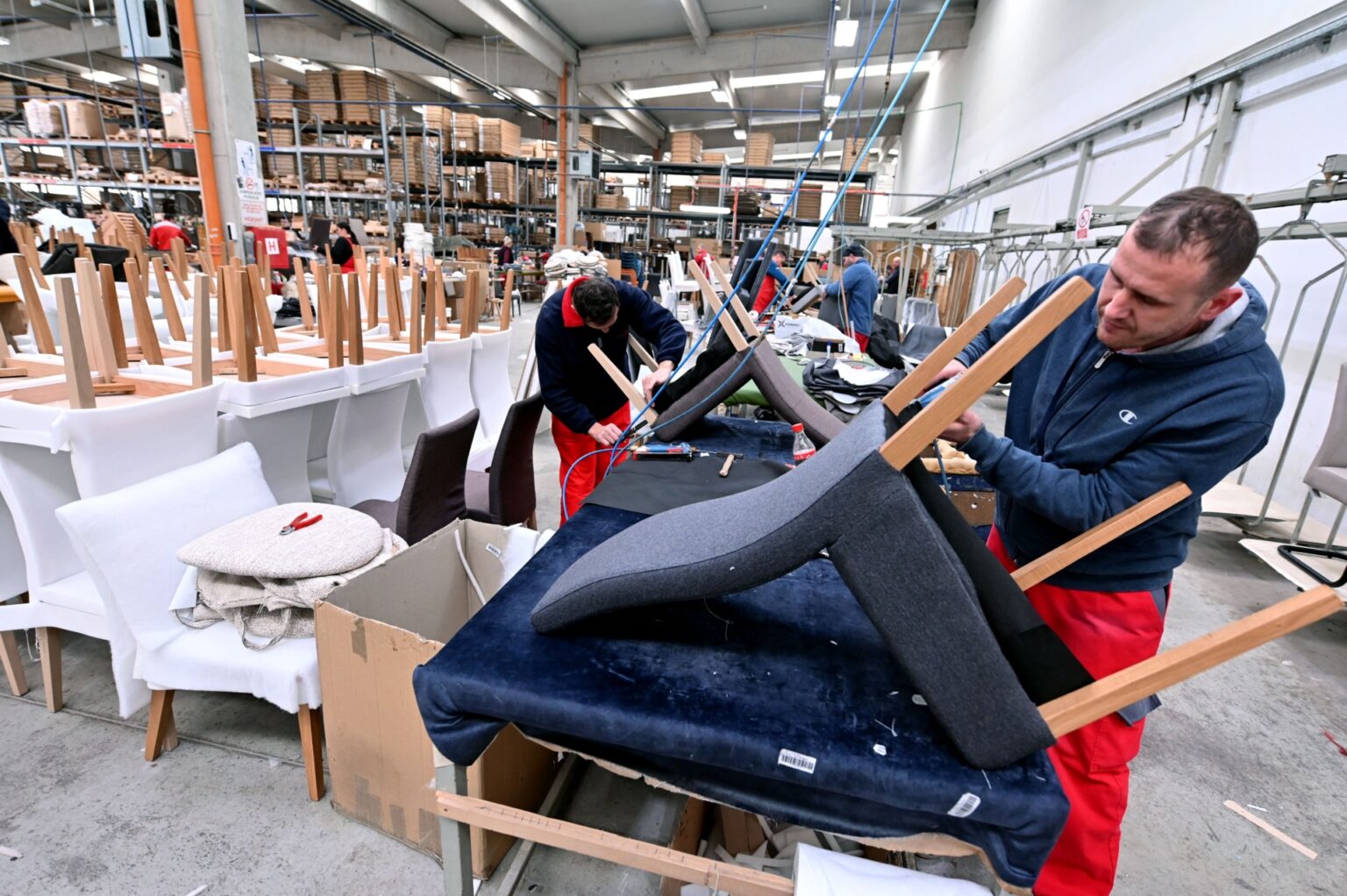
FEATURED IMAGE: Bosnian workers operate a wooden furniture production line, at the “Standard” factory in Ilijas, near Sarajevo, on January 25, 2023. (Photo by ELVIS BARUKCIC/AFP via Getty Images)