
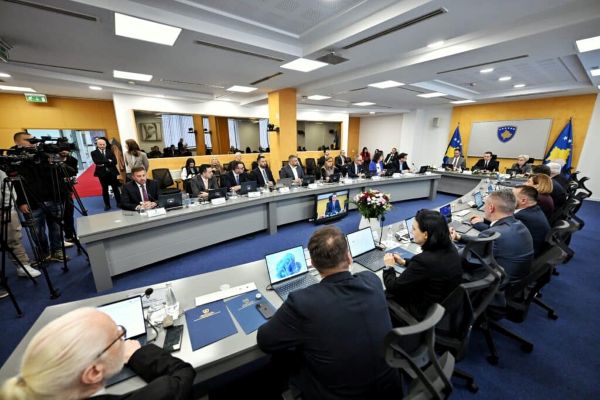
On Wednesday, Kosovo’s new Parliament swiftly ratified a government led by Prime Minister Albin Kurti, thereby concluding a year-long political deadlock in the region. The assembly voted in favour of Kurti’s Cabinet, with 66 votes in favour and 49 against, marking the first session since a snap election held in December.
Prime Minister Kurti received a renewed mandate following his Self-Determination Party’s significant victory, which secured 57 seats in Parliament and formed alliances with several ethnic minority groups. In his address to Parliament, Kurti emphasised his commitment to combating corruption and investing in the nation’s defence, highlighting Kosovo’s standing as the most democratic country in the region. He stated, “This achievement belongs to both our society and our institutions, and we must work diligently to preserve and advance this standard.”
Earlier that day, lawmakers elected former Justice Minister Albulena Haxhiu as the speaker of Parliament. The snap election on 28 December was prompted by the Self-Determination Party’s failure to form a government despite receiving the most votes in the February 2025 elections, which had created a significant political impasse throughout the previous year. The establishment of the new Parliament was further delayed due to a recount necessitated by reports of widespread irregularities.
Kosovo, which was formerly a Serbian province, declared independence in 2008 following a conflict from 1998 to 1999 that culminated in a U.S.-led NATO intervention. Serbia has yet to recognise Kosovo’s independence, and tensions have persisted since then. The new Parliament’s immediate task is to approve this year’s budget, which the political crisis has stalled. Furthermore, lawmakers are scheduled to elect a new president in March, as the current president, Vjosa Osmani, will conclude her term in early April.
Prime Minister Kurti, 50, first took office in 2021 after a brief term in 2020 during the COVID-19 pandemic. A former political prisoner under Serbia’s rule, he has taken a strong stance in EU-mediated negotiations to normalise relations with Belgrade. Both Kosovo and Serbia are encouraged to normalise relations for potential EU membership. At the same time, the U.S. and its allies recognise Kosovo’s independence, and Russia and China back Serbia in the dispute.
This article used information from The Associated Press.