
While business leaders say the 2026 economic outlook in Iowa will be “steady but strained,” or neutral but slightly better than 2025, outcomes will differ by sector.
Small- and medium-sized businesses might struggle, while larger firms perform well. Some households will have a difficult time paying bills, which could affect consumer spending, while other households will be largely unscathed.
It won’t be just taxes and economic policy that shape the business community’s decisions in 2026 — housing, cancer rates and water quality will also be top of mind, including the possible effects on workforce attraction and retention.
Panelists at the Economic Forecast discussed these topics and more on Jan. 20, but there are always lingering questions and discussions left when the panel comes to an end.
Panelists included:
- Robin Anderson, state chief economist and division administrator, research and policy division, Iowa Department of Revenue
- Debi Durham, director of the Iowa Finance Authority and Economic Development Authority
- Amy Friedrich, president, benefits and protection, Principal Financial Group
- Eric Lohmeier, president, NCP
- Jeff Lorenzen, CEO, American Equity Investment Life Holding Co.
On Jan. 21, Anderson and Lohmeier joined Joe Murphy, president of the Iowa Business Council and an event attendee, along with Business Record Editor Sarah Diehn, on the latest episode of the Iowa Economy Podcast to discuss their takeaways and questions that the previous day’s panel didn’t cover. The podcast is hosted by Business Publications Corp. President and Group Publisher Chris Conetzkey.
Reflections on the panel

Eric Lohmeier
Lohmeier said he found the panel discussion to be “cathartic.”
“I thought there were five very different people; you’d think there would be some pretty different perspectives as far as the economy, with their certainly different backgrounds and what they do day to day,” he said. “For better or worse, I would say there was not a ton of variance. I think we landed between, from a panel perspective, about the same, maybe a little better as far as the economy is concerned.”
Anderson said that while most business leaders said they expect 2026 to fare slightly better, there are also differences among subgroups.

Robin Anderson
“I agree that we all coalesced together around the same perspective. I think when we look forward and think about the economy, there are divergences within the economy. There are folks that are doing pretty well,” Anderson said. “As we pointed out in the panel, there are people that are challenged with affordability. We also touched on the divergences between businesses, which I thought was really interesting. We talked about large businesses and what their ability is to navigate the economic environment and some of the challenges that smaller businesses are going through right now.”
Murphy said the outlook for the Iowa business community is strong despite recent challenges, some of which are outside of the control of owners.
“One of the things that was clear to me was the sentiments of uncertainty continue to percolate around businesses all across the spectrum, whether small businesses, medium-sized businesses or large companies that we represent, and that’s been the case for the last 12 to 18 months,” he said. “Perhaps that’s the only certain thing that we have right now in the economy, is the lack of certainty, in a way.”
He said Iowa is doing well at operating in the unknown and in the face of “a lot of frankly, odd things going on in the economy right now, whether it’s trade with China [or] situations in Greenland and the EU and our other trading partners.”
“One of the takeaways is the fact that Iowa continues to perform well in the face of some pretty uncertain times, and I think that will benefit us long term.”
Diehn said panelists echoed the results of the Business Record’s annual Economic Outlook Survey.
“In our Economic Outlook Survey that we did recently, surveying our audience on how they’re feeling about the economy — it’s not a scientific survey, but a pulse on how people are feeling — there were a lot of wait-and-see kinds of remarks and comments,” she said. “Some people were slightly more optimistic. Some people were looking more on the side of potential regression or staying about the same. Overall, I was seeing that there is still much to be determined about how the economy is going to play out this year.”
The intangible issues
Joe Murphy
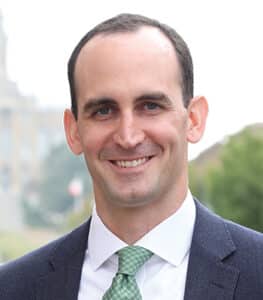
Murphy said one thing that stood out to him at the event was audience reactions to some of the topics.
“No. 1, the audience reaction to some of the notions around health care, specifically cancer initiatives, and the reality that we have in Iowa,” he said. “At the Iowa Business Council, we’ve been talking a lot about health care initiatives and why that’s an important economic or pro-business tool for our state to get around. We haven’t really heard a lot of business leaders talking about health care, specifically cancer, in a lot of pro-business conversations. To hear that articulated across the entire panel, and people sharing very personal stories and impacts of that, I thought was really important, and hopefully that builds to some further conversations, not only in the legislative process this year, but among business leaders across the metro and across the state.”
Lohmeier said the business community often gets caught up in talking about economic projections instead of talking about the bigger challenges facing the region.
“There was a lot of discussion and very much alignment with every panel member that that water quality piece is highly correlated with specifically, cancer,” he said. “Sometimes we look at, ‘What’s the next quarter, this was our forecast for 2026’ but these are the fundamental economic issues facing our state today. It was really interesting how the panel kind of latched on to that from their different perspectives.”
Podcast guests and event speakers also tied issues such as health, water quality, immigration, education and housing concerns to longer-term workforce and population challenges. Iowa’s ability to attract and retain skilled workers, especially younger professionals, will play a growing role in shaping economic growth, especially in rural communities. Without population growth, they said, businesses may struggle to grow even if the economy is performing well. They said those quality-of-life issues are increasingly tied to workforce and population growth, which is a perennial challenge for Iowa businesses.
Heading into 2026, these are some of the issues that will likely take center stage as business leaders plan for the future and lawmakers create policy at the Capitol. Economic indicators, while important, will be as important as the long-term decisions leaders make about the region, they said.
Stream the full episode of the Iowa Economy Podcast. All episodes are available to stream at
businessrecord.com/bpcstreaming or wherever you get podcasts.